📖 Read more: Viking Gold Coin Reveals Great Heathen Army Warrior
🗿 The Discovery That Changed Everything
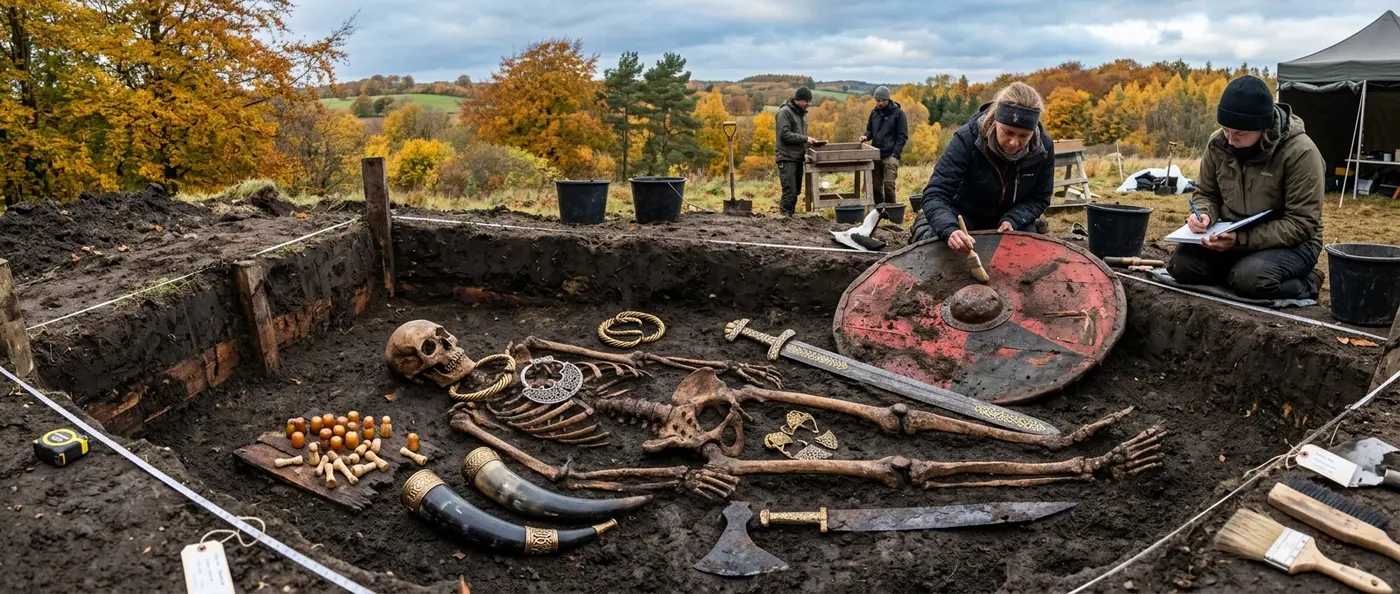
The Åsum find on Funen island stands out as an extraordinary discovery. Michael Borre Lundø, the Museum Odense archaeologist who led the excavation, calls finding this many preserved Viking skeletons "extremely unusual." Scandinavia's acidic soil typically dissolves bones within centuries, turning these graves into a treasure trove for researchers.
The graves date to the 900s CE — a pivotal moment when King Gorm the Old and Queen Thyra ruled from Jelling in Jutland. Central Funen, where the tombs surfaced, formed a crucial piece of their emerging kingdom. The burial goods tell the story: these were Denmark's most powerful families.
Meanwhile, at Lisbjerg near Aarhus, another team from Moesgaard Museum uncovered 30 additional graves belonging to what appears to be a noble family. Liv Stidsing Reher-Langberg, who directed that dig, called the discovery "exceptional" — most Viking-era graves contain few or no burial goods.
⚔️ The Powerful Chieftain of Lisbjerg
At Lisbjerg, archaeologists had already identified a chieftain's farmstead. The new graves connect directly to this nobleman — a member of the aristocracy sitting just below King Harald Bluetooth in the social hierarchy. "The chieftain at Lisbjerg wielded enormous power," Reher-Langberg explains. "Economic, political, religious, and social."
Harald Bluetooth, son of Gorm and Thyra, seized the throne around 958 CE and ruled until approximately 985 CE. He completed the unification of Denmark that his father started and conquered Norway. His greatest achievement? Converting the Danes to Christianity. His name lives on not just in history books but as the inspiration for Bluetooth technology — which connects electronic devices just as he connected the tribes of his realm.
The Lisbjerg graves show dramatic variation in size and luxury, suggesting a mix of social classes. They likely include the chieftain's family members alongside servants or even slaves, according to the archaeologists.
💎 Treasures Beneath the Earth
The burial goods reveal a world of wealth and international trade networks. At Åsum, one woman was buried in a rare "Viking wagon" — a bed-like cradle mounted on a cart. "The woman was buried in the wagon she likely traveled in," Borre Lundø notes.
Her grave contained stunning artifacts: a necklace of beautiful glass beads, an iron key symbolizing her household authority, a knife with a silver-thread decorated handle, and a small piece of glass that probably served as an amulet. The burial also held an intricately decorated wooden chest whose contents remain unknown.
Another grave contained an impressive three-lobed bronze brooch, a red glass bead hanging from the deceased's neck, an iron knife, and a small piece of rock crystal. Borre Lundø points out that rock crystal doesn't occur naturally in Denmark and was likely imported from Norway — proof of the era's international trade connections.
Jewelry & Beads
Glass necklaces and red beads revealing the aesthetic tastes and wealth of upper-class Vikings.
📖 Read more: Viking Mass Grave: Giant Warrior's Brain Surgery
Symbols of Power
Iron keys indicating control over household property and the social position of Viking women.
Imported Goods
Crystals from Norway and other exotic items proving extensive trade networks.
🔬 Technology Serves Archaeology
At Lisbjerg, the Moesgaard Museum team used advanced X-ray technology to examine burial goods without opening the graves. The most impressive tomb belonged to a woman whose coffin had "the finest fittings, nails, and an advanced locking mechanism," according to Reher-Langberg.
Inside the coffin, X-rays revealed elaborate personal items: jewelry, a needle, and an elegant pair of scissors. These finds, along with coins, pearls, and ceramics from other graves, paint the picture of a prosperous community with strong connections.
The discovery was completely unexpected. Although preliminary surveys had shown traces from the pre-Roman Iron Age (500-1 BCE) and the chieftain's farmstead had been found, nobody expected Viking-era graves. "It was a huge surprise," Reher-Langberg admits. "We simply had no expectation of finding burials."
💡 Why is this discovery so rare?
Scandinavia's acidic soil typically dissolves bones within a few centuries. The preservation of 50 nearly intact skeletons from the 10th century represents an extremely rare phenomenon that offers a unique opportunity for scientific research.
🧬 The Future of Research
The Åsum and Lisbjerg discoveries open new pathways for understanding Viking society. Museum Odense plans extensive scientific analyses that will reveal information about the general health, diet, and origins of the people buried there.
DNA testing may reveal family connections between the dead — analysis that's never been possible with Viking graves before. DNA analyses could reveal family relationships and shed light on the social organization of the era.
Human remains, wood, and soil from the excavations have been sent to the museum's Department of Natural Sciences and Conservation for further analysis. The artifacts will be displayed at Moesgaard Museum this summer, giving the public a chance to see these treasures from the past up close.
📖 Read more: Viking Religion Asatru: Thor Odin and Freyja Gods
🏰 The Age of Harald Bluetooth
The graves date to a critical period in Danish history. Harald Bluetooth, born around 910 CE, took the throne after his father Gorm's death around 958. During his reign, he completed the unification of Denmark that his father had begun and conquered Norway.
His most significant achievement was Christianizing the Danes. After his baptism around 960, his father's pagan grave at Jelling was transformed into a Christian worship site with a church between two large burial mounds. The newly appointed bishops of Jutland, under the Archbishop of Hamburg, organized the country's Christianization.
The Trelleborg-type fortifications date from his reign, proving his organizational ability. However, his final years were marked by war with his son Sweyn I, who continued the expansion his father had started in Norway and eventually conquered England in 1013.
👑 The Jelling Dynasty
🗺️ The Significance of the Discoveries
The Åsum and Lisbjerg discoveries offer a rare window into the daily life and beliefs of 10th-century Vikings. This period marks the transition from paganism to Christianity, from tribal conflicts to unified monarchy.
The rich burial goods reveal a society with complex social structures and extensive trade networks. The presence of imported goods from Norway and other regions shows that Danish Vikings weren't isolated warriors but part of a broader network of commerce and cultural exchange.
Scientists expect the bone analysis to reveal diet, health, and migration patterns within months. The ability to study so many well-preserved skeletons from the same period and region offers a unique opportunity for comparative studies that will deepen our understanding of Viking society.
These graves aren't just archaeological finds. They're testimonies of human lives, family bonds, social hierarchies, and cultural changes. Through them, we can see the image of a society in transition, where old gods gave way to Christianity and tribal chieftains became subjects of a unified kingdom.