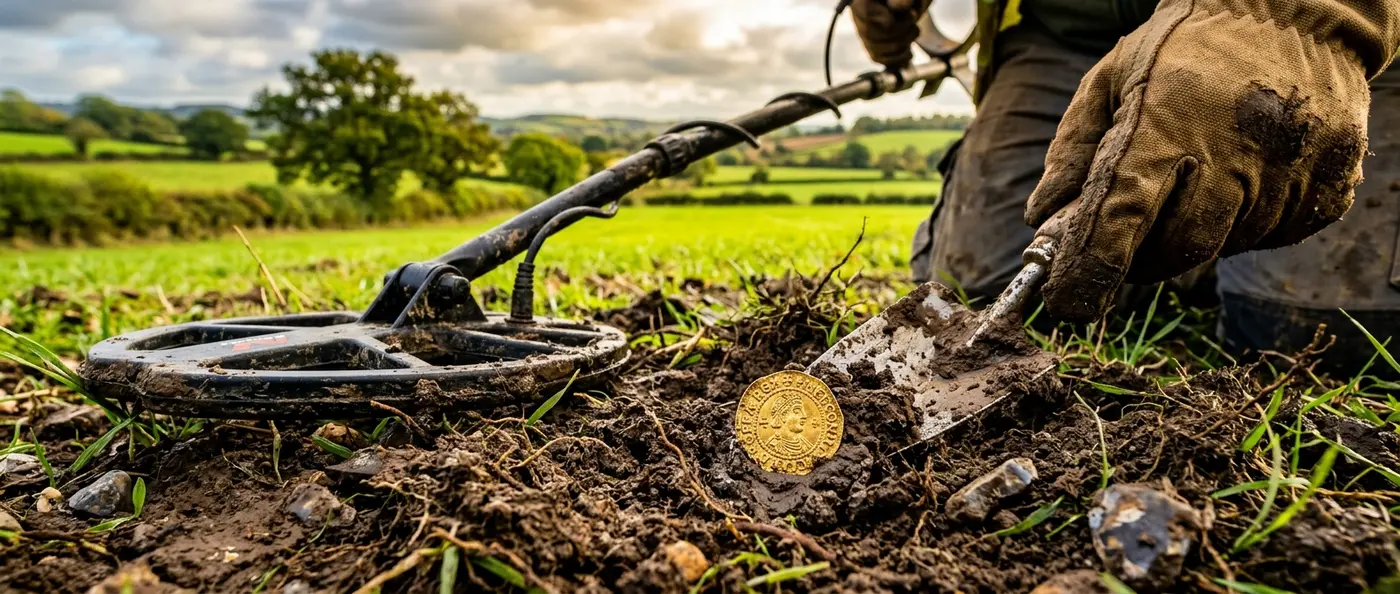
A metal detectorist sweeping a Norfolk field struck gold — literally. The coin he pulled from English soil may have hung around the neck of a Viking warrior from the Great Heathen Army, the legendary force that invaded Britain in 865 AD and carved up three kingdoms. Two holes punched above an emperor's head turned precious metal into personal jewelry, creating a 1,200-year-old link to one of history's most feared invasions.
📖 Read more: Viking Ash Pendant: Pregnant Woman Warrior Found in Grave
🪙 The Gold That Survived Four Centuries Underground
Near the village of Elsing in Norfolk, an amateur treasure hunter's detector screamed over something extraordinary in 2024. The find was a solid gold coin, transformed into a pendant with two deliberate holes drilled above the emperor's portrait. Someone had worn this around their neck — and that someone likely sailed with the most notorious Viking army in English history.
Independent numismatist Simon Coupland identified the coin as a solid gold imitation of earlier "solidus" coins minted by Carolingian Emperor Louis the Pious, Charlemagne's son, around 50 years before the invasion. The original solidi were awarded to high-ranking Carolingian nobles, but later copies — probably manufactured in Frisia — circulated as "portable wealth" throughout Scandinavia.
Norfolk sits among the first territories hit by the Viking invasion. The timing fits. The location fits. As Coupland notes, "the Norfolk find is a particularly choice specimen compared to most."
The real story lies in those two holes. Vikings didn't just collect coins; they wore them. This pendant represents wealth made visible, status displayed on the battlefield, treasure that traveled from Scandinavia to English soil on a leather cord.
⚔️ The Army That Carved Up England
The force that Christian Anglo-Saxons called the "Great Heathen Army" landed in 865 under Danish warlords Ivar the Boneless, Halfdan, and Ubba. All three claimed descent from the legendary hero-king Ragnar Lothbrok, whose exploits fill Scandinavian sagas with blood and glory.
According to the Anglo-Saxon Chronicle, hundreds of Viking ships carried the Great Army to England's eastern shores. Scholars debate the size — some estimate just 1,000 warriors, others over 5,000. Whatever the exact number, the impact was devastating.
The Vikings conquered three of four Anglo-Saxon kingdoms. Only Wessex survived unconquered, though it endured years of warfare. As battles raged, reinforcements arrived from Scandinavia in 871, swelling the army's ranks.
For years, archaeologists wondered what happened to the Great Heathen Army. Despite massive invasion and conquest, few physical traces had surfaced until a grisly discovery in Derbyshire.
Between 1980 and 1986, excavations revealed a burial mound containing 264 human remains. Over 80% were male, many bearing signs of violent trauma. Among the bones, archaeologists found evidence of warfare — axes and knives that spoke of brutal death.
Initially, radiocarbon dating suggested the bones were too old for the Viking invaders — dating to the 7th and 8th centuries instead of the late 9th. But a new study published in Antiquity solved the mystery.
🐟 The Marine Reservoir Effect
Viking diet held the key. Because they consumed large amounts of seafood, carbon-14 in their bones was affected by the "marine reservoir effect." If a Viking had killed a fish and a sheep on the same day, radiocarbon dating would show the fish died 400 years before the sheep!
🏺 Viking Culture Beyond the Battlefield
Vikings weren't just barbaric raiders as popular culture often depicts. They were traders, explorers, and settlers who left an indelible mark on European history. Many English towns ending in "-by" still carry Scandinavian DNA — the word means village in Old Norse.
In 878, Viking leaders negotiated with Anglo-Saxon King Alfred the Great to create the Danelaw — a Viking kingdom with unique laws covering much of eastern and northern England. This kingdom persisted for over 50 years, fundamentally altering English society.
Between the 9th and 11th centuries, Vikings conducted more raids. But the Second Viking Age involved a new form of power: money. They demanded payment, later known as "danegeld," in exchange for not raiding and maintaining peace. England's tax system was founded on this method of extortion.
The Vikings traveled to North Africa, Canada, the Middle East, Russia, France, and Spain. Their ships were technological marvels of the age, capable of both ocean voyages and river navigation. They established trade routes that connected distant continents.
Naval Supremacy
Viking longships could sail oceans and navigate shallow rivers. Their shallow draft and flexible construction made them perfect for surprise attacks and quick escapes.
📖 Read more: Viking Chieftain's Tomb Reveals 1,000-Year-Old Secrets
Legal Innovation
The Danelaw introduced new laws and institutions to England. Many Viking legal concepts influenced English law for centuries.
Linguistic Legacy
Hundreds of Scandinavian words entered English. Common words like "knife," "skill," and "window" have Scandinavian origins.
💎 Gold as Currency and Status Symbol
The Isle of Man yielded another piece of the Viking puzzle. Ronald Clucas, a Manx Detectorist Society member with 50 years of experience, found a Viking-era gold bracelet dating to around 1000-1100 AD.
Eight gold rods twisted together form the bracelet, each curve shaped by a master craftsman. Found folded in half, it weighs nearly 27.3 grams, a "significant weight" for jewelry of this size.
According to Allison Fox, archaeology curator at Manx National Heritage, such jewelry served multiple functions in the Viking Age. They were simultaneously precious personal items, visible displays of wealth, and easily portable currency for economic transactions.
The bracelet has been cut twice, likely from two different transactions. The Isle of Man operated a dual economy of coins and pieces of silver or gold weighed to calculate their value. Gold pieces from the Viking era are rarer, making this intricate bracelet an unusual find.
Scientist Catrine Jarman from the University of Bristol plans to conduct DNA analysis on bones from the Derbyshire mass grave to better determine the ethnic origins of the dead. This research may definitively confirm whether they were members of the Great Army.
Archaeologists also found evidence of what may have been a large defensive ditch near the graves. A separate double burial nearby contained the remains of two men buried with a Thor's hammer pendant and a Viking sword.
With new carbon dating, Jarman says archaeologists can't state with 100% certainty that the burial belonged to the Great Heathen Army, but evidence strongly suggests this possibility. It's the only burial site found so far connected to the army.
⚖️ Viking Find Comparison
🏰 The End of Viking Dominance
Around 1100, Viking dominance waned. Political power consolidated as scattered tribal systems gave way to Scandinavian kingdoms and legal institutions. Viking targets had invested in fortifications and learned to defend themselves effectively.
The Battle of Hastings ended Viking dominance in England in 1066, and Christianity's adoption in Scandinavia slowed raiding. Vikings and other Scandinavians, starting from the central Danish kingdom, didn't begin embracing Christianity until the late 10th century.
Vikings never wore horned helmets or drank from skulls — both Hollywood myths. Their peaceful trade networks stretched from Greenland to Constantinople. Viking cultural power and contributions to communities where they settled were equally strong as their ability to sail and plunder.
The Norfolk gold coin and Isle of Man bracelet survived a thousand years underground. Both pieces tell the same story: gold that doubled as wealth, jewelry, and identity.
Each hole punched in that Norfolk coin tells a story. Each twist in the Manx bracelet speaks of craftsmanship and commerce. Together, they reveal Vikings as more than raiders — they were people who understood that gold could be both armor and currency, protection and proclamation, legacy and loss.