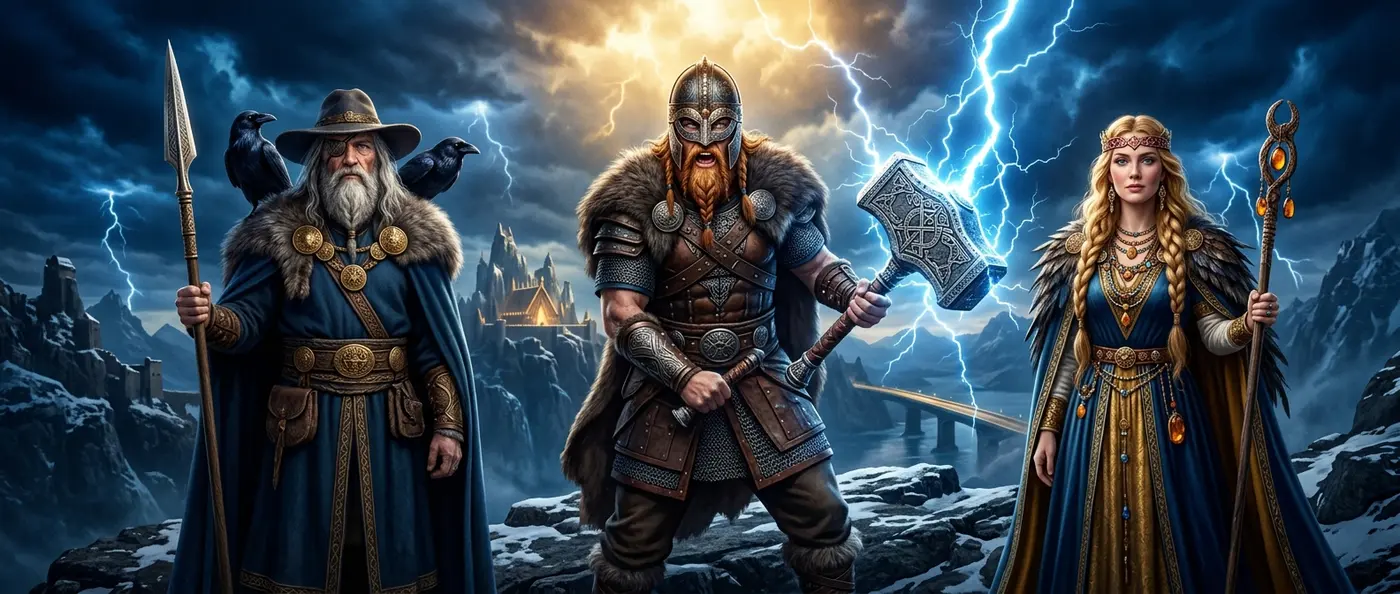
In the frozen expanses of Scandinavia, where winters lasted for months and nature showed its most savage face, the Vikings developed a religion that merged the practical with the mystical. Asatru, the faith in the Æsir gods, wasn't merely a collection of myths. It was a way of life that guided warriors into battle, sailors across oceans, and farmers through their fields.
⚡ Thor's Lightning and the Power of Mjöllnir
Thor, son of Odin and protector of mortals, held a central position in Viking worship. Archaeological discoveries published by National Geographic reveal that, Vikings placed prehistoric stone tools in their graves, believing they were "thunderstones" that fell from the sky when Thor struck with his hammer.
Archaeologist Eva Thäte from the University of Chester explains that these objects, dating thousands of years before the Viking era, weren't random additions. Excavations have revealed approximately ten Viking burials in Scandinavia containing such "thunderstones," up to 5,000 years older than the graves themselves.
In one intact 5th century stone grave, archaeologists found a single thunderstone nestled among the burial goods. In Iceland, where no natural flint exists, microscopic rounded flint "eggs" were found in Viking graves. This means some made the extremely dangerous journey from Norway carrying these sacred objects.
🔱 Odin: The All-Father and the Quest for Wisdom
Odin, also known as Woden to the Anglo-Saxons, was the supreme god of the Viking pantheon. Unlike his son Thor who protected through strength, Odin ruled through wisdom and magic. Warriors who fell in battle believed they would be welcomed in Valhalla, the hall of the heroic dead.
Odin's worship was particularly intense among warriors and leaders. He sacrificed everything for knowledge - even his own eye to drink from the well of wisdom. Vikings valued cunning as much as courage - a mindset that helped them navigate from Greenland to Constantinople.
🌸 Freyja: The Goddess of Love and Death
Freyja, the most important goddess of the pantheon, combined seemingly opposite qualities. She was goddess of love and fertility, but also of war and death. She shared the fallen warriors with Odin - half went to his Valhalla, the other half to her own realm, Fólkvangr.
Like Freyja herself, Viking women wielded power in multiple spheres. They weren't merely wives and mothers, but played important roles in managing family and property, especially when men were away on distant journeys or wars.
According to Britannica, Hel was originally the name of the world of the dead and later became the name of the goddess who ruled it. Daughter of Loki, Hel reigned over Niflheim, the World of Darkness, located downward and to the north.
Her realm was divided into different sections. Náströnd, the shore of corpses, was a castle facing north, filled with serpent poison. There murderers, adulterers, and oath-breakers suffered tortures, while the dragon Nidhogg sucked blood from their bodies.
An early poem mentions the nine worlds of Niflheim. Significantly, those who fell in battle didn't go to Hel but to Odin, to Valhalla. This distinction gave warriors particular incentive to die with honor on the battlefield.
⚔️ Why Vikings Didn't Fear Death
Belief in Valhalla and Fólkvangr made Viking warriors nearly fearless. Death in battle wasn't an end but a beginning - an eternal life filled with feasts and battles alongside the gods. Conversely, death from illness or old age led to Hel's dark realm.
🏺 Rituals and Sacred Objects
Archaeologists Olle Hemdorff and Eva Thäte discovered that Vikings selected "thunderstones" using three specific criteria. First, the shape had to resemble an axe or hammer. Second, the stone had to have "fiery" properties, like flint and quartz. Third, all stones had worn edges - "proof" they fell from the sky.
Hemdorff explains: "Thor's mission was to protect gods and humans from evil and chaos. That's why they believed Thor's stones protected homes and people." New research shows they believed the stones also protected the souls of the dead.
Mjöllnir - Thor's Hammer
The most powerful weapon in Viking mythology. It created lightning and always returned to Thor's hand. Small replicas were worn as protective amulets.
Odin's Eye
Odin sacrificed one eye to gain cosmic wisdom. This sacrifice symbolized the value of knowledge over physical integrity.
Freyja's Necklace
The Brísingamen, Freyja's magical necklace, was so beautiful that even the gods desired it. It symbolized fertility and beauty.
🗿 Asatru's Legacy in the Modern World
Similar discoveries in British graves suggest Vikings weren't the only ancient Europeans who saw millennia-old tools as equipment for the afterlife. John Creighton from the University of Reading mentions the Lexden Tumulus, a wealthy Iron Age burial just before the Roman conquest, containing a Bronze Age bronze axe.
Tim Champion from the University of Southampton adds that in southern England, Stone Age millstones and stone axes have been found in Iron Age ritual pits. These pits weren't related to burials but may have been used to mark the end of habitation at a site.
Viking religion wasn't simply a belief system. It was a comprehensive way of understanding the world that influenced every aspect of their lives. From war to agriculture, from seafaring to family life, the gods of Asatru were always present.
⚡ The Three Great Gods of Asatru
🌊 The End and Rebirth
Asatru didn't disappear suddenly with the arrival of Christianity. For centuries, the two religions coexisted and intermixed. Many traditions and symbols survived in disguise. Even today, the names of weekdays in English and Scandinavian languages recall the ancient gods - Thursday (Thor's day), Friday (Freyja's day), Wednesday (Odin/Woden's day).
Archaeological discoveries continue to illuminate new aspects of this ancient religion. Every "thunderstone" discovered in a grave, every hammer-shaped amulet, every runic inscription, reveals how this faith governed Viking life from cradle to grave.
Asatru teaches us that religion for ancient peoples wasn't something separate from daily life. It was the lens through which they understood the world, from thunder in the sky to waves on the sea. And perhaps that's why, despite the passage of centuries, the stories of Thor, Odin, and Freyja continue to captivate us.