📖 Read more: Ragnarök: The Norse Apocalypse That Terrified Vikings
🔱 Where Runes Came From
Runes appeared in Northern Europe around the 3rd century AD, but their exact origin still divides scholars. Most researchers believe the runic alphabet developed from the Goths — a Germanic tribe — based on the Etruscan alphabet of northern Italy, possibly with Latin influences during the 1st or 2nd century BC.
Two crucial inscriptions support this theory. The Negau and Maria Saalerberg inscriptions, written in Etruscan script but in Germanic language and dated to the 2nd and 1st centuries BC respectively, strengthen the case for Etruscan origins. The angular shape of the letters and the fact that early runic inscriptions ran right to left, like older Mediterranean alphabets, suggest connections to ancient writing systems far from Scandinavia.
The name "futhark" comes from the sounds of the first six letters: f, u, th, a, r, and k. This early Germanic system had 24 letters, divided into three groups called "ættir" with 8 letters each. Simple. Practical. Built for carving into wood and stone with a knife.
📜 Three Main Runic Scripts
Over centuries, the runic alphabet evolved into three major variants, each adapted to the needs and languages of the peoples who used them. These variants reflect the geographic spread and linguistic evolution of Germanic tribes across Europe and beyond.
Early Germanic (Teutonic)
Used in northern Europe before about 800 AD. This original 24-letter form was common to all Germanic tribes and formed the foundation for later variants. Clean lines, sharp angles, perfect for carving.
Anglo-Saxon (English)
Used in Britain from the 5th or 6th century to the 12th century AD. Expanded to 28 letters, then to 33 after 900 AD, to represent Old English sounds that didn't exist in other Germanic languages.
Scandinavian (Nordic)
Used from the 8th to 12th or 13th century AD in Scandinavia and Iceland. Paradoxically reduced to just 16 letters, with each symbol representing multiple sounds. Less letters, more complexity.
The Scandinavian variant defied logic. While Scandinavian languages were richer in sounds than Old English, Nordic script users chose to simplify the system rather than expand it. They used the same letter to represent multiple sounds — one letter for k and g, another for a, æ, and o. Efficiency over precision.
⚔️ The Viking Age and Runic Expansion
The Viking period (roughly 750-1050 AD) marked the widest geographic spread of runic writing. As Scandinavian explorers, traders, and warriors traveled across Europe and beyond, they carried their script with them. Every raid, every settlement, every trade route became a pathway for runes.
Nordic expansion established Scandinavian speech and writing in Iceland, Greenland, the Faroe Islands, Shetland, Orkney, the Hebrides, and the Isle of Man, as well as parts of Ireland, Scotland, England, France (Normandy), and Russia. Though Scandinavian languages eventually disappeared from all these territories except the Faroes and Iceland, runic inscriptions remain as witnesses to this extensive cultural influence.
During this period, all Scandinavians could communicate without difficulty and considered their language as one, sometimes called "Danish" in contrast to "German." But different political orientations of various kingdoms led to dialectal differences visible in runic inscriptions. You can track political alliances through spelling variations.
🗿 Sweden's Runestones
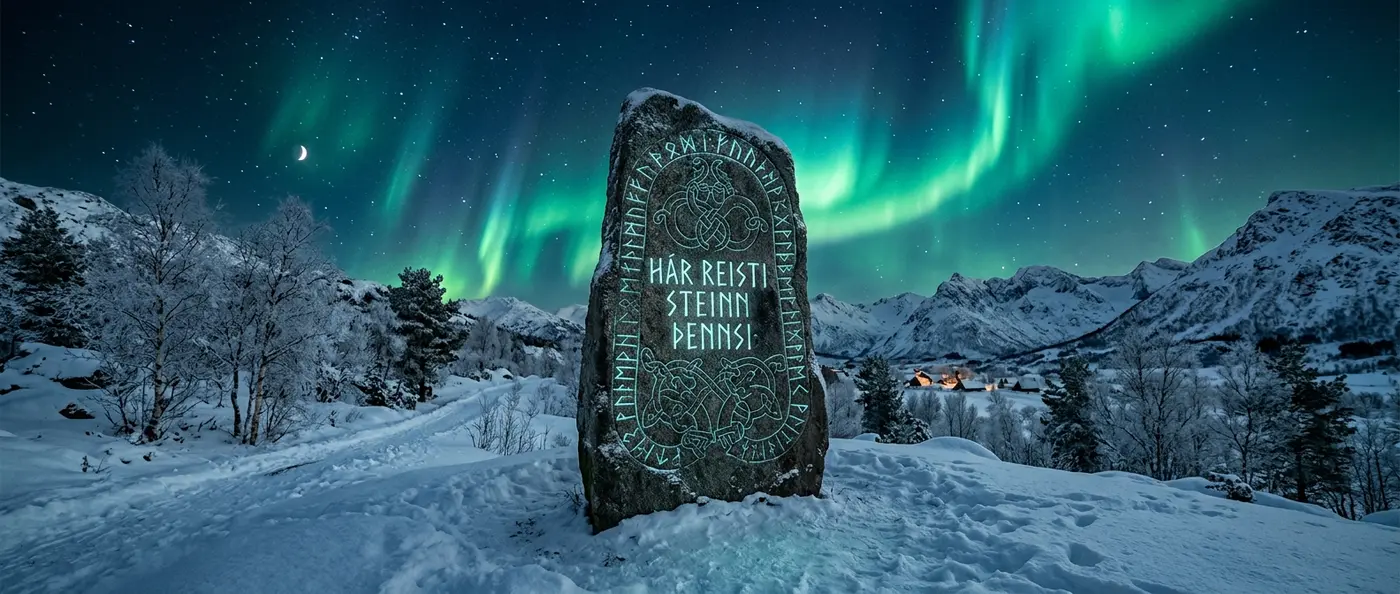
Of the more than 4,000 runic inscriptions that survive today, about 2,500 come from Sweden, mostly from the 11th century. These runestones are unique historical documents that give us information about Viking life, beliefs, and adventures across the known world.
💡 Did You Know?
The largest concentration of runestones is in Sweden's Uppland region, where over 1,300 inscriptions have been recorded. Many reference Vikings who died on distant journeys, from England to Byzantium. Some stones mark trade routes. Others record family feuds.
Runestones usually stood as monuments to the dead, but they contained far more information than simple epitaphs. They recorded journeys, battles, trade agreements, family relationships, and sometimes even legal provisions. A typical inscription might read: "Olaf raised this stone in memory of Erik, his brother, who died on the eastern journey with Ingvar."
📖 Read more: Viking Woman's Wagon Burial Stuns Danish Archaeologists
These weren't just memorials. They were newspapers carved in stone. Status symbols. Legal documents. Some recorded inheritance disputes. Others boasted about successful raids. A few even contained what appear to be early forms of advertising for local craftsmen.
✝️ Christianity Arrives and Changes Everything
The establishment of the Roman Catholic Church during the 10th and 11th centuries had significant linguistic impact on Scandinavia. It helped unify existing kingdoms, brought the North into the sphere of classical and medieval European culture, and introduced writing on parchment with Latin letters.
Despite the introduction of the Latin alphabet, runic writing continued for inscriptional purposes and general information. Thousands of inscriptions from this period survive, from Russia to Greenland. For more extensive literary efforts, the Latin alphabet was used — initially only for Latin texts, but soon for works in local languages as well.
📊 Rune Usage Before and After Christianity
The transition wasn't immediate or complete. Christian runestones often mixed pagan and Christian symbolism. Thor's hammer appeared alongside crosses. Old gods got new names. The cultural shift played out in stone, one inscription at a time.
🔮 Magic, Mysticism, and Modern Misunderstandings
Runes always carried an aura of mystery. In early inscriptions, some are clearly magical in content, with invocations for protection or curses against enemies. The word "rune" itself in Old Norse means "secret" or "mystery." This wasn't just writing — it was power made visible.
After the 12th century, runes were still used occasionally for amulets and memorial inscriptions until the 16th or 17th century, mainly in Scandinavia. This long connection with the mystical and magical has led to many modern misinterpretations and romanticizations of their role.
Today, runes have been revived in popular culture, often in ways that have little relationship to their historical use. From divination and tattoos to video games and fantasy films, these ancient symbols continue to captivate modern imagination. Most of it is complete nonsense, historically speaking. But the fascination is real.
🏛️ The Legacy of Runes in the Modern World
The study of runes continues to offer valuable insights into the history, language, and culture of Germanic peoples. Modern archaeologists and linguists use advanced techniques to decipher illegible inscriptions and better understand their historical context.
Universities in Scandinavia maintain active runology programs, and new discoveries are made regularly. Each newly discovered inscription fills gaps in our knowledge of medieval Scandinavia. Digital databases now record and make accessible thousands of inscriptions to researchers worldwide.
Runes remind us that writing isn't just a communication tool, but a carrier of culture, identity, and memory. From the first carved invocations on warriors' weapons to the imposing stones honoring the dead, the secret symbols of the North continue to speak to us across the centuries.
When archaeologists uncover a new runestone, they're reading Viking-age headlines carved in granite — stories of distant journeys, family disputes, and the dead who demanded to be remembered. The farmer who found those scratches in Norwegian soil had stumbled onto a direct line to the Viking age — a message carved in stone, waiting twelve centuries to be read.