📖 Read more: Viking Women Warriors Were Real, DNA Proves
🗿 The Åsum Cemetery That Shouldn't Exist
Fifty intact Viking skeletons in one place? That's archaeological gold. Scandinavia's acidic soils usually dissolve bones within decades, leaving archaeologists with empty graves and rusted metal fragments. But something about the earth near Åsum village preserved these remains for over a millennium.
Michael Borre Lundø from Museum Odense led the excavation team that uncovered this time capsule from around 900 AD. The burials date to the reign of King Gorm "the Old" and Queen Thyra, who ruled from their seat in Jelling, Jutland. Funen island sat squarely in their kingdom during an era when most Danes still worshipped Thor, Odin, and Freyr — before their son Harald Bluetooth claimed to convert the Danes to Christianity.
The cemetery sits at a crossroads in Danish history. The old gods still demanded elaborate funeral rites, complete with grave goods for the afterlife journey. Yet Christian influence was creeping northward, soon to transform Scandinavian burial customs forever.
⚓ The Woman in the Wagon-Boat
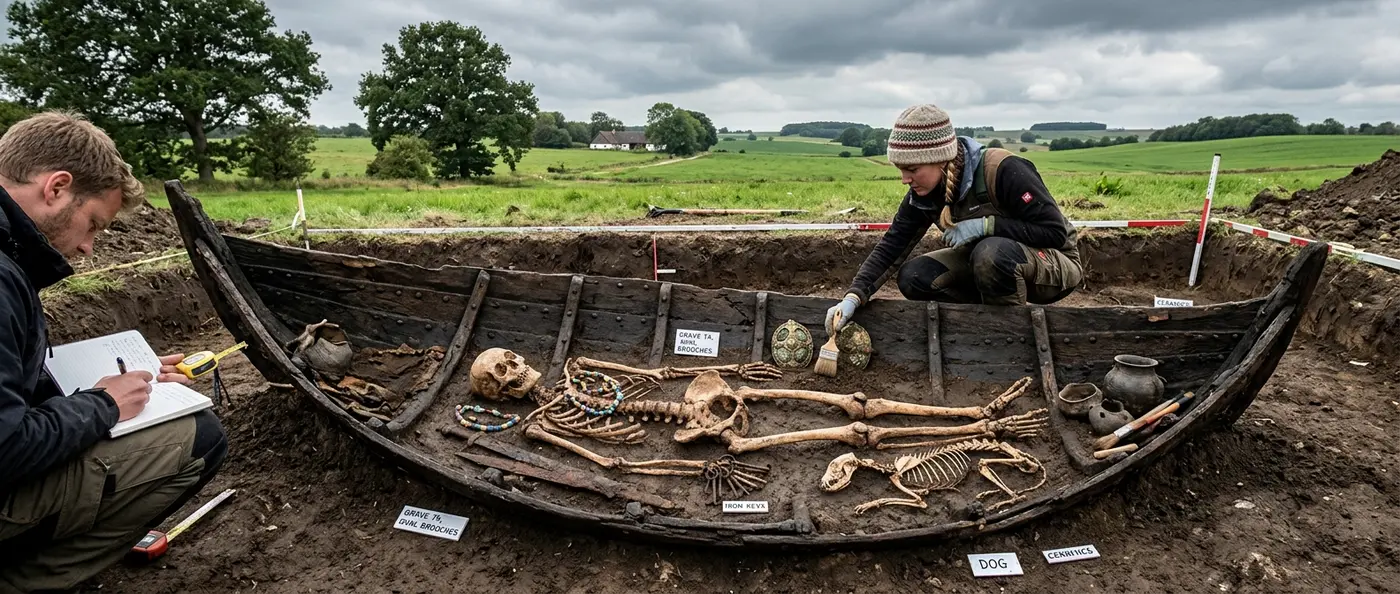
One burial stopped the excavation team cold. A woman lay cradled inside a wooden structure that resembled a bed-cradle — actually part of a Viking wagon. "She was buried in the wagon she likely traveled in," Lundø explains. This type of burial is vanishingly rare, reserved for individuals of extraordinary status.
Her grave goods tell the story of wealth and authority. Glass beads formed an elegant necklace around her neck. An iron key — the symbol of a household mistress — rested in her hands alongside a knife with a silver-wire decorated handle. Most intriguingly, she carried a small piece of glass that probably served as an amulet or protective charm.
Beside her lay an intricately decorated wooden box, its contents still a mystery. Each artifact speaks to a life of privilege in Viking Age Denmark, when controlling trade routes and managing large households required both political savvy and economic acumen.
💎 Luxury Goods and Global Trade Networks
The Åsum burials scream wealth. Another grave contained a striking trefoil bronze brooch, a red glass bead worn at the throat, an iron knife, and a small piece of rock crystal. The crystal reveals something important: Denmark has no natural deposits of this mineral.
"The rock crystal was likely imported from Norway," Lundø notes. Along with other exotic grave goods, it proves these Vikings plugged into the international trade networks that stretched from Greenland to Constantinople. Amber flowed south while silver, silk, and spices traveled north through Scandinavian hands.
These weren't isolated farmers scraping by on barley and fish. The Åsum dead belonged to Denmark's merchant-warrior elite, people who commanded ships, controlled territory, and accumulated wealth from ventures that spanned continents. Their graves mirror finds from major trading centers like Hedeby and Ribe, showing that Viking Age prosperity reached deep into rural Denmark.
📖 Read more: Viking Runes: The Secret Symbols of the North
Glass Beads
Elaborate necklaces of colored glass beads, indicating wealth and trade connections spanning from the Baltic to the Mediterranean.
Iron Keys
Symbols of power and responsibility, keys belonged to mistresses who managed households, storerooms, and valuable possessions.
Rock Crystal
Imported from Norway, crystal served as both precious object and likely protective amulet in Viking belief systems.
🔬 DNA Analysis Could Reveal Family Secrets
The bone preservation here is almost unheard of for Scandinavia. Scientists plan extensive analyses to extract information about health, diet, and ancestry from the bones. The real prize would be extracting DNA from multiple burials in one location — something never attempted at a Viking site.
"The analyses might even reveal if the buried Vikings were related to each other," Lundø explains. No one has ever examined family relationships in a Viking cemetery this way. The results could illuminate kinship structures and social organization in ways written sources never could.
Isotope analysis of teeth and bones will reveal where these people grew up, what they ate, and how far they traveled. Trace element studies might show exposure to metals from specific mining regions. The bones will tell individual life stories in ways no saga ever could.
🧬 What Ancient Bones Can Reveal
Modern scientific methods extract remarkable information from archaeological remains: isotopic analysis reveals diet and mobility patterns, DNA analysis uncovers family relationships and ancestry, paleopathological examination identifies diseases and injuries, and trace element analysis shows exposure to metals and other substances from specific geographical regions.
⚔️ Norway's Parallel Discovery
Denmark's wagon burial joins a growing collection of elite Viking women's graves across Scandinavia. Recently, on Norway's Senja island inside the Arctic Circle, archaeologists uncovered another high-status woman buried in a boat, dating between 900 and 950 AD.
The Senja woman rested in a 5.4-meter "sewn boat" — a primitive vessel built without iron nails, its wooden planks bound together with wooden pegs, plant fibers, or animal sinews. A small dog lay curled at her feet, suggesting the powerful bond between them extended into the afterlife.
Anja Roth Niemi from UiT The Arctic University of Norway explains that dogs were often buried whole with their owners, unlike horses which were typically sacrificed and buried in pieces. "This suggests dogs and humans had a close and beloved relationship, even 1000 years ago," she observes. The practice reveals emotional depths in Viking culture that saga literature only hints at.
📖 Read more: Vikings: Warriors, Explorers or Merchants?
🏺 Elite Women in Viking Society
Both the Danish and Norwegian discoveries illuminate women's elevated status in Viking Age Scandinavia. The Senja woman wore two oval brooches decorated with silver wire — objects never found in male graves from this period. Textile tools found with her — a spindle whorl and possibly a weaving "sword" made from whale bone — underscore the crucial importance of cloth production.
A Viking household mistress bore responsibility for producing high-quality textiles. Cloth was needed for clothing and blankets, but also for constructing sails for boats and ships. Beyond practical needs, the mistress had to create impressive garments and elaborate tapestries displayed during feasts and visits, demonstrating the household's wealth and status.
The iron keys found with elite women symbolized this authority. Keys controlled access to storerooms, treasure chests, and valuable goods. In a society where wealth meant survival through harsh winters, the key-bearer wielded life-and-death power over household members and dependents.
⚖️ Viking Women's Burials: Denmark vs Norway
🗺️ Rewriting Viking Age History
Together, Åsum and Senja sketch out how Viking society actually worked. Such wealthy burials confirm a hierarchical society with clear distinctions between social classes. Elite women enjoyed respect and wielded significant authority in household management and production.
The imported objects in these graves document extensive trade networks. Vikings weren't just warriors and raiders — they were merchants who maintained connections from Norway to the Mediterranean and beyond. The Åsum finds prove that even in areas far from major trading centers, local elites accessed luxury goods from distant lands.
Continued excavations and scientific analyses promise to reveal even more details about 10th-century Scandinavian life. As new technologies extract more information from ancient remains, our understanding of the Vikings grows richer and more complex. These weren't the one-dimensional raiders of popular imagination, but sophisticated people who built networks spanning continents and created societies that balanced warfare with commerce, tradition with innovation.
The woman in the wagon-boat represents this complexity. Her burial combines ancient pagan traditions with evidence of international trade, personal wealth with community status, individual identity with family connections. She embodies a pivotal moment when Viking Age Scandinavia stood poised between its mythic past and its Christian future.