📖 Read more: 5,000-Year-Old Skull Masks Reveal China's Dark Ritual Past
🗿 The Birka Grave That Rewrote History
On the small island of Birka, west of Stockholm, lies one of the Viking Age's most important burial grounds. There, in 1878, Swedish archaeologist Hjalmar Stolpe discovered an impressive underground tomb that would become known as Bj 581. The excavation used the crude methods of its time — dynamite and unskilled laborers — but the grave held a complete warrior's arsenal.
Inside the burial chamber, archaeologists found a human skeleton surrounded by a complete arsenal: a sword in its scabbard, a battle axe, a seax fighting knife, two spears, two shields, and more than 24 arrows. Beside the weapons lay two stirrups and riding equipment. At the back of the grave, on a ledge, two horses had been sacrificed — a stallion and a mare.
The most intriguing find was an ancient strategy board game discovered near the skeleton. This suggested the deceased wasn't just a warrior but likely a military leader who planned tactics. For 139 years, no one questioned that this was a man.
⚗️ Science Overturns Assumptions
The first hint something was wrong with the "Birka warrior's" identity came in 2014. Bioarchaeologist Anna Kjellström from Stockholm University carefully examined the pelvic bones and lower jaw of the skeleton. Their dimensions matched those of a woman, not a man. Her announcement at a conference stunned her colleagues.
Many archaeologists reacted with skepticism. Maybe the bones had mixed with other burials? Maybe there was an error in the records? The poor excavation conditions of 1878 left room for doubt. But Charlotte Hedenstierna-Jonson from Uppsala University decided to provide a definitive answer.
In 2017, her team extracted two types of DNA from the bones. Mitochondrial DNA would show if the bones belonged to one or multiple individuals. Nuclear DNA would reveal biological sex. The results left no room for doubt: no Y chromosome, and all mitochondrial DNA from a single individual. The skeleton belonged to one woman.
⚔️ Women Warriors Across Scandinavia
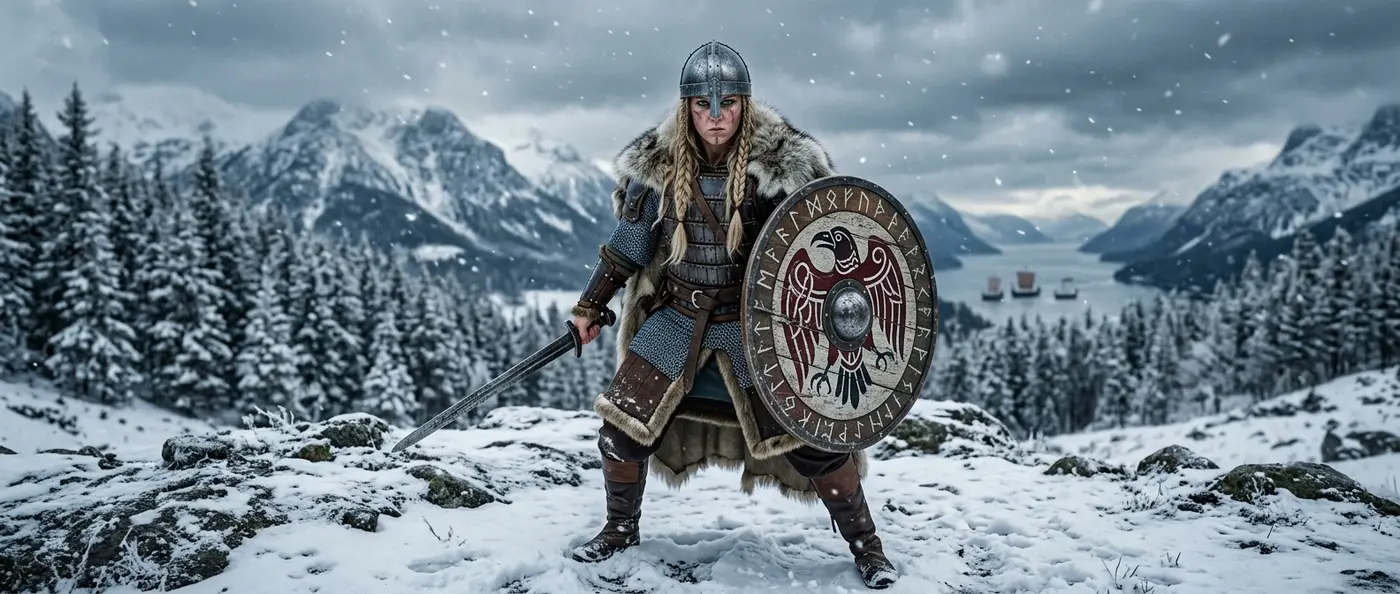
Birka wasn't alone. Across Scandinavia, at least 30 women's graves have been found containing military equipment like spear points and shields. Of these, only three contained swords — the most valuable and symbolic weapon of the age.
In Norway, the Nordre Kjølen grave in Solør has been characterized as a "shield-maiden" burial. It contained a woman buried with complete battle gear. Similar graves have been found in Denmark and Iceland, suggesting the phenomenon wasn't local but extended throughout the Viking world.
Archaeologist Leszek Gardeła from the University of Munich, author of "Women and Weapons in the Viking World," estimates that less than 1% of Viking Age warrior graves belong to women. The true number is likely higher, hidden by decades of archaeological assumptions.
📜 Written Evidence
A 10th-century Irish text mentions Inghen Ruaidh ("Red Girl"), a female warrior who led a Viking fleet in Ireland. Scandinavian sagas like the 13th-century Saga of the Volsungs are filled with references to "shield-maidens" who fought alongside male warriors.
🔬 The Problem of Archaeological Bias
For more than a century, archaeologists assumed the sex of the dead based on grave goods. Weapons meant male, jewelry and weaving tools meant female. The result was circular logic, as Marianne Moen from the University of Oslo explains.
"You excavate a grave in Norway, find a sword and say 'Ah, it's a man.' Then you say 'isn't it strange that all swords are buried with men?'" Moen comments. The logic is circular and self-confirming.
The problem worsens due to poor preservation of many graves. Scandinavia's acidic soil destroys bones, making DNA analysis or osteological examination impossible. Ole Kastholm from Denmark's Roskilde Museum notes that "we need very good preservation of skeletons to determine sex."
DNA Analysis
Modern technology allows extraction of ancient DNA from bones, revealing biological sex with accuracy that wasn't possible before.
📖 Read more: Angkor Wat: World's Largest Temple Reveals Ancient Secrets
Osteological Examination
Study of pelvic and skull dimensions can indicate sex, but requires good bone preservation.
Isotope Analysis
New techniques reveal diet and origin of the deceased, offering insights into their lifestyle.
🛡️ What the Findings Mean
The graves paint a different picture of Viking society. Hedenstierna-Jonson believes the Birka woman was not just a warrior but a military leader. "She had game pieces in her lap," she says. "This suggests she was the one planning tactics."
Davide Zori from Baylor University emphasizes that the discovery "goes to the heart of archaeological interpretation: that we've always projected our own ideas about gender roles." Birka was an international trading center where people from across the known world met. Perhaps this multiculturalism allowed greater flexibility in social roles.
Skeptics remain. Some argue the woman might have been buried with her husband's weapons or that the weapons were symbolic. But as Moen says: "Occam's razor — the simplest explanation is usually best. If you find a woman with a sword, you should interpret it the same way you would a man with a sword."
🌊 The Viking World Under Review
The finds are reshaping how we see the Viking Age (793-1066 CE). These northern seafarers traveled across at least eight seas, visited 36 countries, and encountered more than 50 different cultures, from Canada to Afghanistan.
In Eastern Europe, Viking trading expeditions traveled along the dangerous rivers of modern Russia, Belarus, and Ukraine to reach Constantinople and Baghdad. In 1021, exactly 471 years before Columbus, they had already established a base in Newfoundland, Canada.
⚖️ Changing Perceptions
💀 The Future of Research
As DNA and isotope analysis technologies improve, more revelations are expected. Gardeła points out that "there's nothing in biology that would prevent women from being warriors. Women can be just as strong, capable, and fast as men."
However, the significance of female warriors in broader Viking culture remains unclear. Were they exceptions or a recognized part of society? Kastholm warns that "it's an area where we can't find a safe answer."
What's certain is that Viking society was more complex than we believed. Rank and profession may have mattered more than gender when it came to who went to war. And as new discoveries show, Viking women weren't just housewives waiting for their men to return from battle. Some of them were there, on the battlefield, sword in hand.