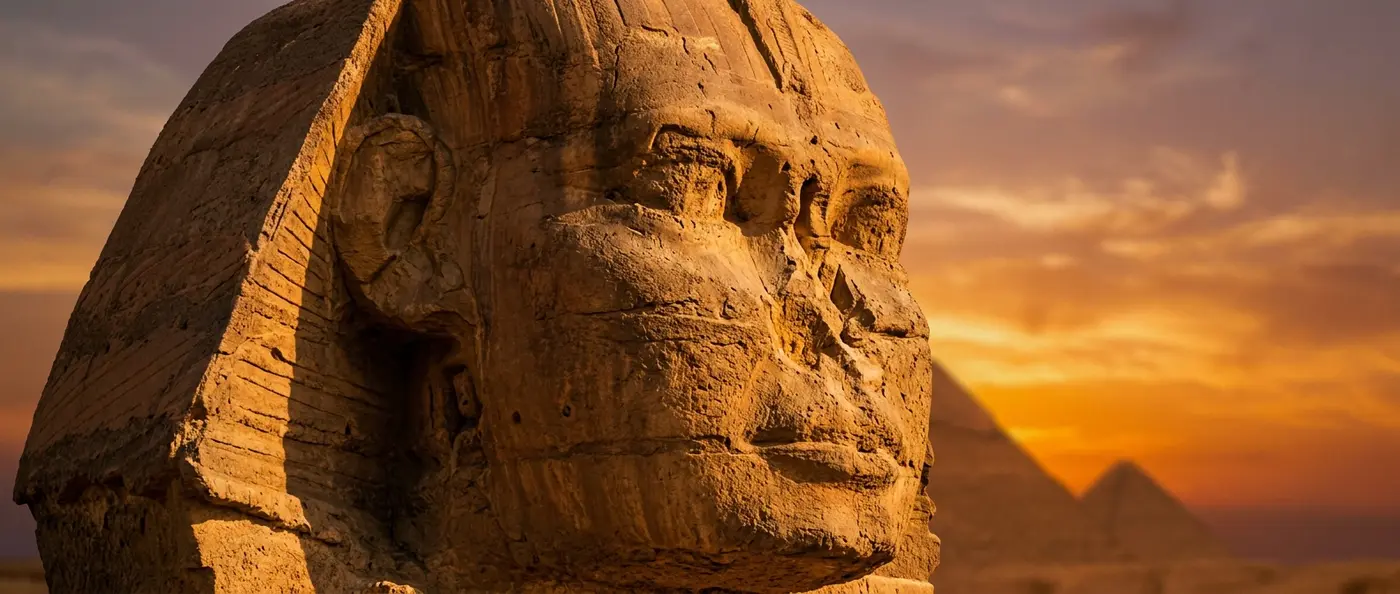
For millennia, it has stood there, its face eternally gazing toward the rising sun. The Great Sphinx of Giza, with its human head and lion's body, is perhaps the most enigmatic monument of ancient Egypt. Yet something is missing from its majestic face — its nose. How and when did it lose this defining feature? Theories abound, from Napoleon's soldiers to medieval fanatics. The evidence, however, points to deliberate destruction — and reveals how ancient Egyptians believed statues could be 'killed.'
🗿 The Mystery of the Missing Nose
The Great Sphinx of Giza, dating to around 2500 BCE, is the world's largest monolithic statue. At 73 meters long and 20 meters high, this monument has puzzled visitors since ancient Greek times. Its face, believed to represent Pharaoh Khafre, has suffered significant damage over time.
The absence of the nose is perhaps the most visible damage. Measurements show the nose would have been approximately one meter long. Marks on the face indicate that the destruction wasn't the result of natural erosion but deliberate action. Clear tool marks show where metal implements were used to chisel the nose away from the face.
Archaeologists have also identified damage to the chin and lips of the statue. The same targeted damage appears on hundreds of other Egyptian statues, suggesting a pattern that extends far beyond the Sphinx.
📜 The Myths and Theories
For centuries, various stories have circulated about how the Sphinx lost its nose. The most widespread — and incorrect — is that Napoleon's soldiers destroyed it with cannon fire during the French campaign in Egypt in 1798. However, drawings dating before Napoleon's arrival clearly show the Sphinx without its nose.
Another theory attributes the destruction to the Mamluks, the Muslim rulers of Egypt during the Middle Ages. According to 15th-century Arabic sources, a Sufi sheikh named Muhammad Sa'im al-Dahr became angry when he saw locals making offerings to the Sphinx. In 1378, he climbed the monument and destroyed the nose to stop these "idolatrous" practices.
There are also more exotic theories. Some claim that erosion from wind and sand is responsible, though tool marks contradict this explanation. Others suggest the nose collapsed due to seismic activity or was even deliberately removed by the ancient Egyptians themselves for unknown reasons.
🔬 The Scientific Approach
Modern archaeologists have carefully examined the evidence to understand the truth behind the destruction. Study of the marks on the Sphinx's face reveals that metal tools, likely chisels and hammers, were used to remove the nose. The marks are too specific and targeted to be the result of accidental damage.
Particularly interesting is that similar destruction has been found on many Egyptian statues. Recent research, such as studies published on Queen Hatshepsut's statues, shows that ancient Egyptians had a practice that modern archaeologists call "ritual deactivation" of statues.
According to ancient Egyptian beliefs, statues weren't merely decorative objects. They were considered living entities with supernatural powers. The destruction of specific parts — especially the nose, eyes, and ears — was believed to "deactivate" these powers. Without a nose, the statue couldn't "breathe" and therefore couldn't live.
Method of Destruction
Use of metal tools like chisels and hammers. The marks show systematic and targeted work, not random damage from natural causes.
Religious Significance
In ancient Egyptian cosmology, the nose was connected to breath and life. Its removal symbolically "killed" the statue.
Historical Testimony
15th-century Arabic texts name Muhammad Sa'im al-Dahr as responsible for the destruction in 1378 CE.
⚔️ Political and Religious Iconoclasm
The destruction of statues for political or religious reasons has a long history in Egypt. When a new pharaoh ascended to the throne, they sometimes ordered the destruction of their predecessors' monuments to erase their memory. This practice, known as "damnatio memoriae," was a way to rewrite history.
In the Sphinx's case, the destruction may be linked to religious conflicts. As Christianity and later Islam spread through Egypt, ancient monuments were seen as symbols of idolatry. The story of Muhammad Sa'im al-Dahr, if true, reflects this conflict between new monotheistic religions and ancient tradition.
The Sphinx wasn't the only victim. Many statues throughout Egypt have suffered similar damage. This suggests a systematic program of destruction that may have lasted centuries and had various motivations depending on the era.
🏺 The Sphinx Through the Ages
Even noseless, the Sphinx drew ancient tourists. Ancient Greek and Roman travelers wrote admiringly of the monument. Herodotus, who visited Egypt in the 5th century BCE, curiously doesn't mention the Sphinx, a fact that has sparked much speculation.
During the Roman period, the Sphinx was buried up to its neck in sand. The Romans made efforts to clear it and even built a small temple between its paws. Inscriptions from this period show that the monument continued to have religious significance.
💡 Did You Know?
The Sphinx was almost completely buried in sand for centuries. Only its head was visible until the great excavations of the 19th and 20th centuries revealed its entire body.
During the Middle Ages, Arabs called the Sphinx "Abu al-Hol," meaning "Father of Terror." Despite its deterioration, the monument continued to inspire awe. Local populations attributed magical properties to it and believed it protected the area from evil.
🗺️ Modern Conservation Efforts
Today, the Sphinx faces new challenges. Air pollution, rising groundwater levels, and tourism threaten the monument's structural integrity. Egyptian archaeologists work continuously to maintain and protect it.
Proposals have been made to restore the nose, but most experts agree this would be wrong. The Sphinx, with all its damage, is a historical document. Every scar tells a piece of its story — from ancient "ritual deactivation" to medieval iconoclasm.
🔱 The Lesson from History
Each civilization has treated the Sphinx according to its own beliefs about the past. For ancient Egyptians, statues were living entities that needed to be "deactivated" when power changed hands. For medieval Muslims, they were idols that needed to be destroyed.
Today we see these monuments as precious pieces of world heritage that must be protected. The Sphinx, even without its nose, continues to connect us to the past and remind us of the power and fragility of human creations.
The Sphinx's missing nose isn't the result of one destructive moment, but centuries of people reshaping the monument to match their beliefs — from ancient priests 'deactivating' statues to medieval Muslims destroying idols.
📊 The Sphinx in Numbers
💭 Conclusions and Reflections
The Sphinx's lost nose remains one of the most visible symbols of time's erosion and human intervention in ancient monuments. While we can't be absolutely certain about the exact time and method of destruction, evidence points to a deliberate act likely carried out for religious reasons during the Middle Ages.
What is certain is that the Sphinx, with or without its nose, continues to be one of humanity's most iconic monuments. Its story reminds us that monuments aren't static objects, but living pieces of history that evolve and change alongside the people who surround them.
The Sphinx today bears Roman inscriptions, medieval chisel marks, and 20th-century concrete repairs. Each scar records a different chapter of human ambition, faith, and preservation.