📖 Read more: Zoroastrianism: The Religion That Changed Everything
🔥 Birth of a Revolutionary Faith
Around 1700-1000 BCE, somewhere in Central Asia — likely in present-day Afghanistan or Tajikistan — Zarathustra received his revelation from Ahura Mazda, the Supreme Being. According to tradition, he was a disillusioned priest of the ancient polytheistic religion who sought something deeper. His new teaching upended the religious order: there was one supreme god, and the world was a battlefield between Good and Evil.
At first, only his cousin followed him. But by the 6th century BCE, Zoroastrianism had become the official religion of the Achaemenid Persian Empire, one of the ancient world's greatest superpowers. From the luxurious caravanserais of the Silk Road in western China to small mountain shrines in the Balkans, Zarathustra's teachings spread across the known world.
⚔️ The Cosmic Battle of Good and Evil
Zoroastrianism's central doctrine cuts straight to the core. Ahura Mazda, the god of light and truth, is locked in eternal conflict with Angra Mainyu, the Destructive Spirit. These aren't equal opponents — good is destined to triumph. But every human has a role in this battle.
Believers follow the triad "humata, hukhta, hvarshta" — good thoughts, good words, good deeds. The Zoroastrian god isn't a punisher or negotiator. He's like the force of gravity, indifferent to daily prosperity. Humanity's duty is to fight for asha (truth, justice, order) and against druj (impurity, lies, chaos).
After death, the soul (urvan) reunites with the guardian spirit (fravashi) and lives either in a world of song or in purgatory. At the end of times will come the final battle, where good will triumph definitively and all will be resurrected to live in a perfect world without war, hunger, and earthly desires.
📖 Read more: Oracle of Dodona: Zeus Speaks Through Sacred Oak
🏛️ The Influence on Abrahamic Religions
Zoroastrianism's impact on Judaism, Christianity, and Islam runs so deep that many scholars consider it the foundation of monotheistic religions. When Cyrus the Great, founder of the Achaemenid Empire, liberated the Jews from Babylon in 539 BCE and returned them to Jerusalem, he brought with him something more than political freedom.
Jewish exposure to Zoroastrianism in Babylon and Persia helped solidify key elements of Jewish faith, including the afterlife and final judgment. Ancient Greeks noted the wisdom of Zoroastrian magi, leading to the Three Wise Men of the New Testament. Scholars also point to similarities between Zoroastrian and Muslim practices of praying five times daily and ritual purifications.
Judaism
Concepts like resurrection, final judgment, and paradise appeared in Judaism after contact with Zoroastrianism in Babylon.
Christianity
The Three Wise Men, the battle of good vs. evil, and the idea of salvation have Zoroastrian roots incorporated into Christian theology.
📖 Read more: Philae Temple: Ancient Egypt's Last Sacred Sanctuary
Islam
Five daily prayers, ritual purifications, and the concept of paradise show clear Zoroastrian influence.
🔱 Sacred Texts and Oral Tradition
The Avesta, Zoroastrianism's holy book, is a collection of texts composed over a long period by different authors. Like the Bible, it underwent editing and revision at various points in its history. The text that survives today represents only a fraction of what remained in the 9th century from the Sassanid Avesta compiled under Khosrow I (531-579 CE).
The oldest sections are the Gathas ("Songs") by Zarathustra himself and much of the Yashts, hymns dedicated to various deities. The Gathas contain expressions of Zarathustra's religious vision, which is a complex reinterpretation of inherited Iranian religious ideas. Unlike other Middle Eastern religions, Iranian religions had no written texts in the ancient period — all religious "literature" was oral.
📜 The Dating Mystery
Scholars can't agree on when Zarathustra lived. Most scholars place him between 1200 and 600 BCE, but the exact date eludes historians.
📖 Read more: Sassanid Empire: Last Persian World That Ruled 427 Years
🏺 The Living Tradition in India
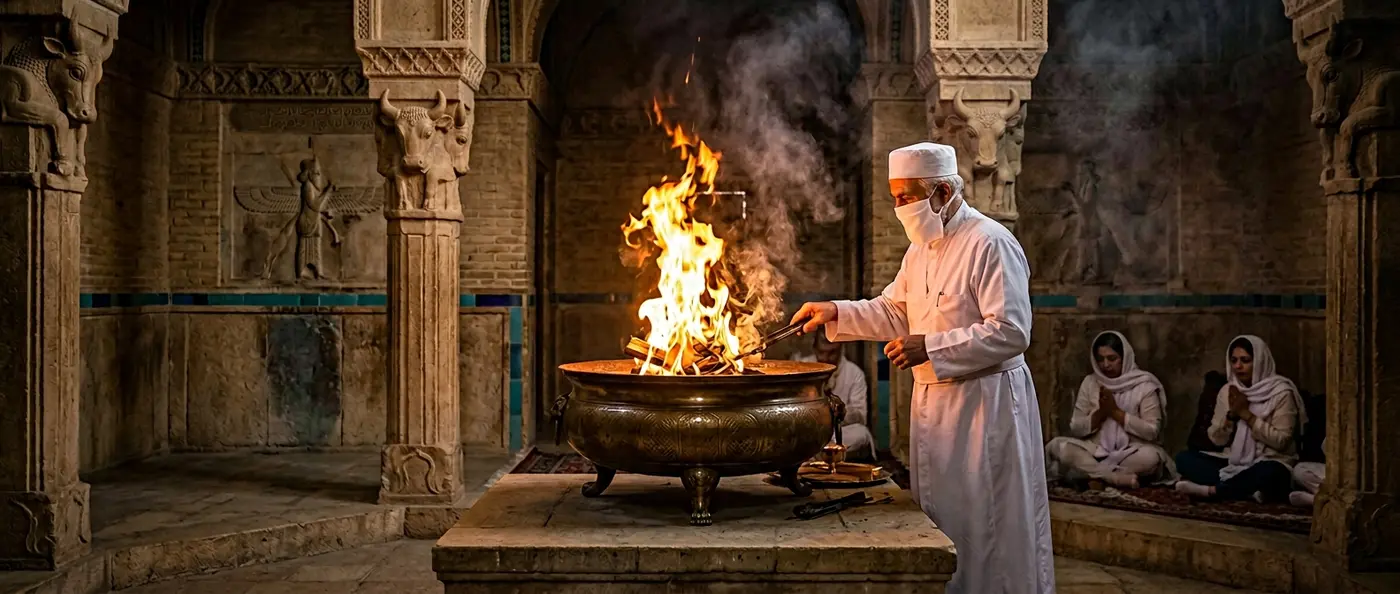
Today, fewer than 100,000 believers keep Zoroastrianism's flame alive. In the coastal town of Udvada, India, the Iranshah Atash Bahram houses a sacred fire that has burned continuously for 1,300 years. According to tradition, the Zoroastrian ancestors of today's Parsis arrived on Gujarat's shores 13 centuries ago, seeking protection from religious persecution by Arab Muslim invaders.
Here, on the shores of the Arabian Sea, they revived their faith's teachings and rituals. The sacred fire was created from 16 different fires — from a blacksmith's forge to lightning — and is carefully tended by white-robed priests (mobeds) who wear veils to protect its purity.
🌍 From Persia to the World
In the past century, Zoroastrianism has traveled far from its roots. New, progressive communities have emerged in places like Los Angeles, Mexico City, and Stockholm. In these communities, anyone who follows Zarathustra's teachings can be considered Zoroastrian, unlike more orthodox communities that require descent from Zoroastrian parents.
📖 Read more: 1,400-Year-Old Christian Cross Found in Abu Dhabi Desert
Despite its small number of believers, Zoroastrianism's influence remains enormous. The fundamental concepts it introduced — monotheism, the battle between good and evil, free will, resurrection, heaven and hell — became integral parts of global religious thought. Professor Jamsheed Choksy from Indiana University explains: "It created the 'bookends' of the Abrahamic religions. You start with the discussion of good versus evil and that humans have a role — that we don't just walk through life. And at the other end, the reward is that everything will be made right; evil will be defeated."
🔥 Zoroastrianism vs Other Monotheistic Religions
💫 The Continuing Legacy
Most people think of Zoroastrianism as ancient and exotic. Yet its core teachings shaped how billions think about good, evil, and the afterlife. The idea that the universe is a battlefield between good and evil, that every human has free will to choose sides, and that our actions have eternal consequences, permeates nearly every aspect of modern religious thought.
The ancient Greeks saw in Zoroastrianism the archetype of the dualistic view of the world and human destiny. Zarathustra supposedly taught Pythagoras in Babylon and inspired the Chaldean teachings of astrology and magic. Christians, following a Jewish tradition, identified Zoroaster with Ezekiel, Nimrod, Seth, Balaam, and Baruch, even with Jesus Christ himself.
Today, as new generations discover this ancient wisdom, Zoroastrianism continues to evolve. From the strict purity rules of orthodox Parsis in India to the open communities of the West, the flame that Zarathustra lit millennia ago continues to illuminate the path for those seeking truth, justice, and order in a world still struggling between light and darkness.