📖 Read more: Chilean Mummy Died in Mine Collapse 500 Years Ago
🔥 The Fire That Changed the World
Zoroastrianism isn't just another ancient religion lost to time. This Persian faith invented concepts we now take for granted: heaven and hell, final judgment, the battle between good and evil. The prophet Zarathustra (Zoroaster in Greek) lived around 1500 BCE and taught something revolutionary for his time: the existence of a supreme god, Ahura Mazda, the "Wise Lord."
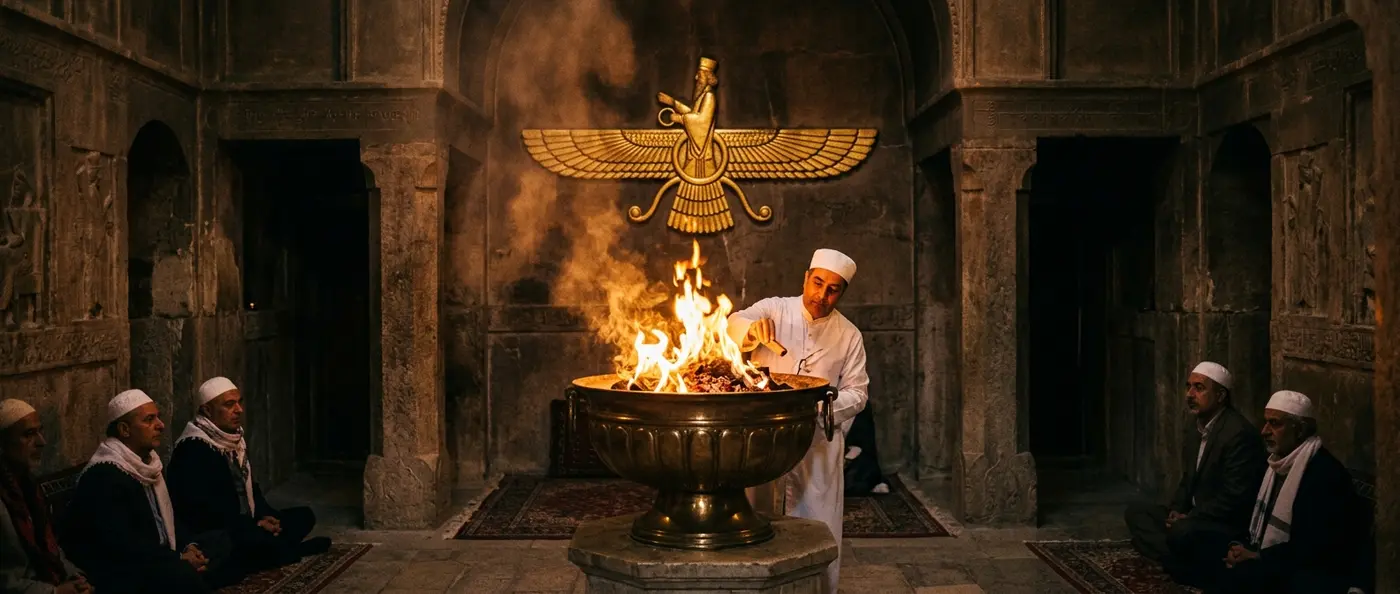
Fire became this religion's sacred symbol — not as an object of worship, but as the purest manifestation of divine light. In fire temples that spread from Persia to India, believers maintained eternal flames symbolizing Ahura Mazda's presence. Some of these fires have burned continuously for over 1,500 years.
But Zoroastrianism's real revolution wasn't just monotheism. It was introducing concepts that would become fundamental to Judaism, Christianity, and Islam: the idea of Heaven and Hell, the concept of Judgment Day, belief in the resurrection of the dead, the battle between Good and Evil. Even the figure of Satan has its roots in Angra Mainyu, Ahura Mazda's adversary.
🏛️ The Empire of Tolerance
For over 1,000 years, Zoroastrianism was the official religion of Persian empires — from Cyrus the Great's Achaemenids to the Sassanids who fell to the Arabs in the 7th century CE. Recent excavations in Iraq shattered assumptions about ancient religious warfare.
At Gird-î Kazhaw in northern Iraq, the team of Alexander Tamm and Dirk Wicke from German universities revealed a Christian monastery built around 500 CE. What stunned archaeologists: the monastery sits just meters from a Sassanid fortress where Zoroastrian priests conducted daily rituals. The buried stone columns and ceramic fragments bearing Christian crosses testify to a peaceful coexistence that defies stereotypes about religious conflicts.
Similar finds at Dedoplis Gora in Georgia reveal an even more complex mosaic of religious coexistence. There, in a 2,000-year-old palace, archaeologist David Gagoshidze discovered three different sanctuaries: one for Zoroastrian ceremonies with an altar for daily sacrifices, one for worshipping the Greek god Apollo with statuettes, and a third for local fertility rituals. The kings of Kartli worshipped "Iranian (Zoroastrian) gods merged with local Georgian astral deities," according to the study.
⚖️ The Revolutionary Ideas We Inherited
Zoroastrianism introduced concepts we now take for granted but were radical for their time. The most important? Free will. In a world where people believed they were playthings in the hands of capricious gods, Zarathustra taught that every human has the responsibility to choose between good and evil.
The triad "good thoughts, good words, good deeds" became the core of Zoroastrian ethics. Belief wasn't enough — you had to act. And your actions would be judged after death at the Chinvat Bridge, where the soul would pass to paradise or fall to hell depending on the weight of its deeds.
Free Will
First religion to teach that humans are responsible for their choices and aren't puppets of fate.
Judgment Day
The idea of a final judgment of all souls and the resurrection of the dead were born in Zoroastrianism.
Heaven & Hell
The concepts of paradise as reward and hell as punishment first appeared in Zarathustra's teaching.
🌍 The Influence on Major Religions
When the Jews found themselves in exile in Babylon in the 6th century BCE, they came into direct contact with the Zoroastrianism of the Persian empire. And it's no coincidence that after their return, Judaism began developing clearer ideas about the afterlife, angels and demons, the resurrection of the dead.
Christianity inherited and expanded these concepts. The battle between God and Satan, the promise of eternal life, the Second Coming — all have parallels in Zoroastrian eschatology. Even Islam, which appeared centuries later, incorporated many of these ideas.
But the influence didn't stop at theology. Zoroastrianism influenced philosophy, ethics, even political thought. The idea of human rights, the concept of social justice, belief in humanity's progress — all have roots in Zarathustra's teaching about a world moving toward the final victory of Good.
💡 Did You Know?
Friedrich Nietzsche chose Zarathustra as the central character of his work "Thus Spoke Zarathustra" precisely because he was the first to introduce the moral distinction between good and evil — something Nietzsche wanted to overturn.
🔬 New Discoveries, New Questions
Recent archaeological discoveries in Iraq and Georgia open new chapters in understanding Zoroastrianism. They show a religion that, despite its role as the official faith of empires, was tolerant and open to coexistence. The evidence contradicts everything we thought we knew about Persian religious policy.
At Gird-î Kazhaw, someone made a deliberate choice to build a Christian monastery within shouting distance of Zoroastrian priests. Archaeologists believe the two communities not only tolerated each other but likely had daily contacts and exchanges. This happened at a time when Byzantines and Persians were often at war, but at the borders people found ways to coexist.
The Dedoplis Gora palace reveals something even more interesting: the merger of religious traditions. The three worship spaces weren't isolated — they were in the same complex, suggesting the same people might have participated in different ceremonies depending on the occasion.
🌅 The Future of an Ancient Faith
Today, Zoroastrianism survives with just 120,000 believers worldwide, mainly in India (where they're known as Parsis) and small communities in Iran. After the Islamic conquest of Persia in the 7th century, the religion that once dominated from Egypt to India shrank dramatically.
But its legacy is everywhere around us. Every time we speak of heaven and hell, every time we discuss free will and moral responsibility, every time we believe that good will ultimately triumph over evil, we invoke ideas first articulated by a prophet in the steppes of Central Asia 3,500 years ago.
🔱 Zoroastrianism's Legacy
The buried stones at these sites tell a different story than the one in history books. It's a story of influences, borrowings, syntheses. Zoroastrianism wasn't just a religion — it was the cradle of ideas that shaped humanity's spiritual map.
And perhaps that's the most important lesson from the discoveries in Iraq and Georgia. In a world often divided by religious differences, archaeology shows us that coexistence and mutual influence were always part of the human experience. Zoroaster's fire may have been extinguished in many temples, but the light of his ideas continues to illuminate the world.