A Rock Face That Reads Like a Book
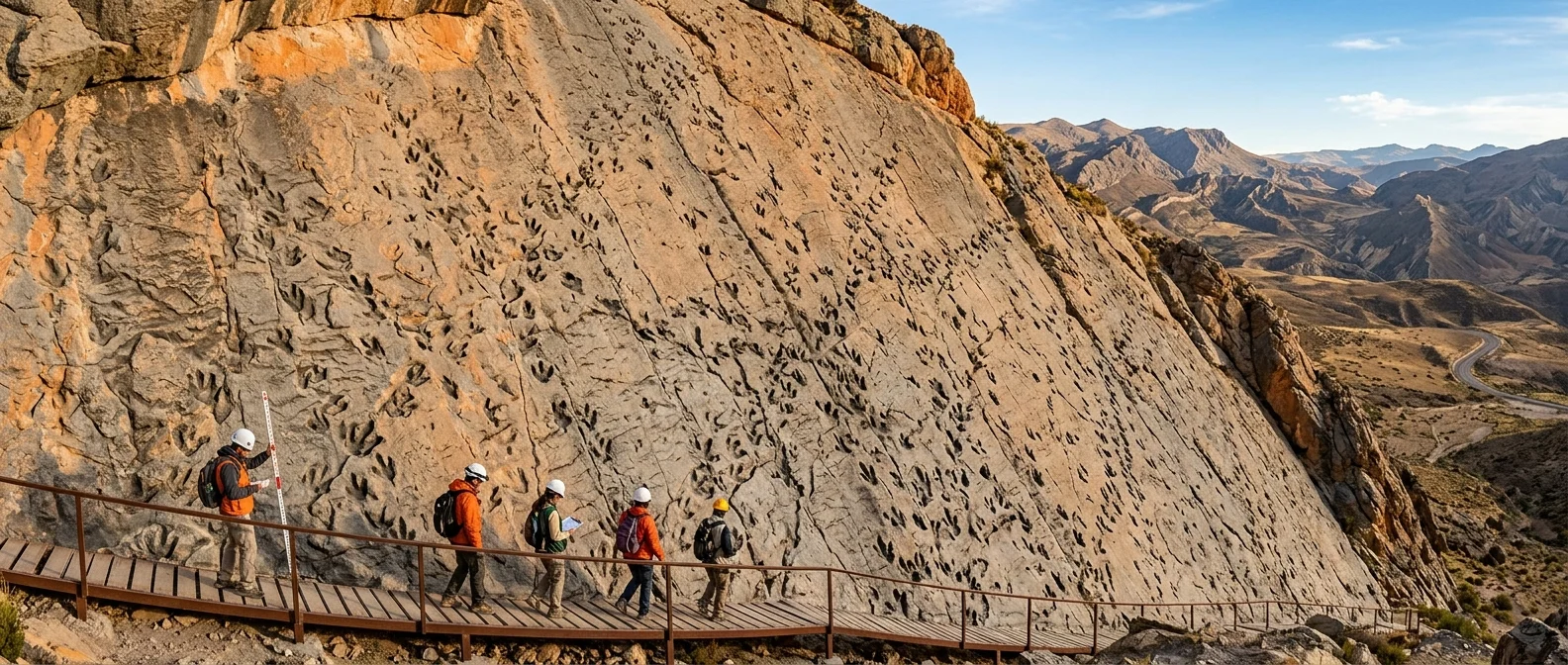
Five kilometers outside Sucre, Bolivia's constitutional capital, rises a limestone cliff unlike any other on Earth. It's not particularly tall — about 80 meters. It doesn't have any striking colors. But if you look carefully at its surface, you'll see thousands of depressions — footprints. Dinosaur tracks. More than 5,000 individual footprints, organized into hundreds of trackways, from at least 8 different species. Welcome to Cal Orcko, the largest collection of dinosaur tracks on the planet.
How a Prehistoric Meadow Was Discovered
The story begins in 1994, inside a cement quarry. The FANCESA company (Fábrica Nacional de Cemento S.A.) had been extracting limestone from the area for decades. As explosions revealed new layers of rock, workers noticed something odd: the rock surface wasn't smooth. It was covered with depressions — regular, repeating, in rows. You didn't need to be a paleontologist to realize that something had walked there.
News quickly reached the experts. Swiss paleontologist Christian Meyer, from the Natural History Museum of Basel, took charge of the site's scientific study. What he found was far larger than anyone expected. The rock face extended 1.2 kilometers in length and about 80 meters in height, and its surface was peppered with tracks. Each new survey revealed more footprints. Initial estimates spoke of thousands — today the numbers reach 5,000 confirmed tracks, while some counts report even more.
Why Are the Tracks on a Vertical Wall?
This is perhaps the most striking aspect of Cal Orcko: the footprints are located on an almost vertical rock surface, at an incline of about 72 degrees. How did dinosaurs walk on a wall? The answer, of course, is that they didn't. 68 million years ago, this surface was a flat, muddy shore beside a lake.
According to the Natural History Museum of London, "in some places, the fossilized tracks look as if the dinosaurs were walking on impossibly steep slopes." But this happens because the geology of the ground has changed dramatically over millions of years. The tectonic forces that created the Andes lifted and tilted the rock layers, transforming a horizontal surface into a vertical wall. It's like holding a book flat on a table and suddenly someone lifting it upright. The letters on the page don't change — but the viewing angle changes completely.
How Do Footprints Survive for 68 Million Years?
The preservation of dinosaur footprints is a miracle of precise conditions. According to the Natural History Museum of London, "for a perfect footprint to form, the ground must be neither too hard nor too soft." If it's too hard, the track will be shallow or won't form at all. If it's too soft, the footprint will collapse in on itself. The toes, instead of appearing clearly, will turn into narrow cracks.
At Cal Orcko, conditions were ideal. The muddy, wet lakeshore offered exactly the right texture. After the tracks were created, the sun hardened them — a process that could have taken days or months, depending on conditions. Subsequently, a layer of mud or ash covered the hardened footprints, sealing them under millions of years of sedimentation.
🦴 Fossilized Bones
- Show what an animal was
- Must be covered quickly after death
- Can be transported by water currents
- Don't show behavior
🐾 Fossilized Tracks
- Show what an animal did
- Must first dry in the sun
- Found where the animal lived
- Reveal movement, speed, behavior
What Dinosaur Species Walked Here?
Cal Orcko isn't just a place with many footprints. It's a snapshot of an entire ecosystem. Ichnologists — scientists who study trace fossils — have identified at least 8 different dinosaur species, and probably more. Among them:
Titanosaurs: Giant sauropods, the largest land animals that ever existed. Their footprints are circular, wide, with five toes on the feet — like enormous craters in the rock. Their hands leave smaller, crescent-shaped tracks.
Theropods: Carnivorous bipedal dinosaurs, possibly relatives of Tyrannosaurus. Their tracks have three long, narrow toes in a V formation, with clear claw marks. Some tracks belong to juveniles — the longest continuous trackway extends 347 meters, probably from a young theropod.
Ankylosaurs: Armored dinosaurs that walked on all fours. Their tracks have three or four toes, with palms pressed flat to the ground — unlike ceratopsians, who probably walked on their tiptoes.
Ornithopods: Herbivorous dinosaurs with more rounded feet without visible claw marks. Some species, like hadrosaurs, sometimes walked on two and sometimes on four legs.
What Do We Learn from the Tracks?
The tracks at Cal Orcko aren't just footprints — they're windows into behavior. As ichnology explains, the distance between successive steps reveals a dinosaur's stride length, and from this its speed can be estimated. Some tracks at Cal Orcko show dinosaurs walking slowly — perhaps grazing. Others show fast running — perhaps hunting or fleeing.
Parallel trackways suggest that some animals moved in groups — possible evidence of herding behavior. Other times, tracks of carnivores and herbivores are found at the same spot. This could be evidence of hunting — but the tracks could also have been made hours or weeks apart. Ichnology requires caution about temporal uncertainty.
In tracks with exceptional preservation, scientists can distinguish skin impressions, toe flexibility, even the angle at which an animal stepped — information that no bone can provide. Tracks are, literally, snapshots of movement — something that skeletal fossils can never offer.
The Quarry Threat
There's an irony in Cal Orcko's story: the same industrial activity that revealed the tracks threatens them. FANCESA continues limestone extraction, and each year the cliff erodes a little more. Rain, wind, and vibrations from explosions cause sections of rock to break away. Some tracks have already been lost.
In 2006, Parque Cretácico opens — a theme park and museum next to the quarry, with life-size dinosaur replicas and observation platforms. The site is on UNESCO's World Heritage tentative list, but hasn't been officially inscribed yet. The balance between economic necessity (the cement plant is vital to the local economy) and scientific preservation remains fragile.
"The tracks were created by dinosaurs moving through their environment — they are an important link between these prehistoric animals and the habitats in which they lived."
— Natural History Museum of LondonA Living Archive in Danger
Fossilized bones tell us what an animal was. Fossilized tracks tell us what it did. At Cal Orcko, we see dinosaurs walking, running, perhaps hunting or foraging. We see entire ecosystems imprinted in rock — titanosaurs alongside theropods, ankylosaurs alongside ornithopods. We see a lake that for millions of years was a crossroads of life.
A dinosaur can leave countless footprints during its lifetime, but only one skeleton. The tracks at Cal Orcko remind us that paleontology isn't just about bones in museums — it's about movement, action, life. And this vertical wall in Bolivia, which was once a quiet muddy shore, holds the memory of thousands of steps that no one believed would be preserved forever.