The 33-Foot Ghost Jellyfish That Haunts Ocean Depths Unseen
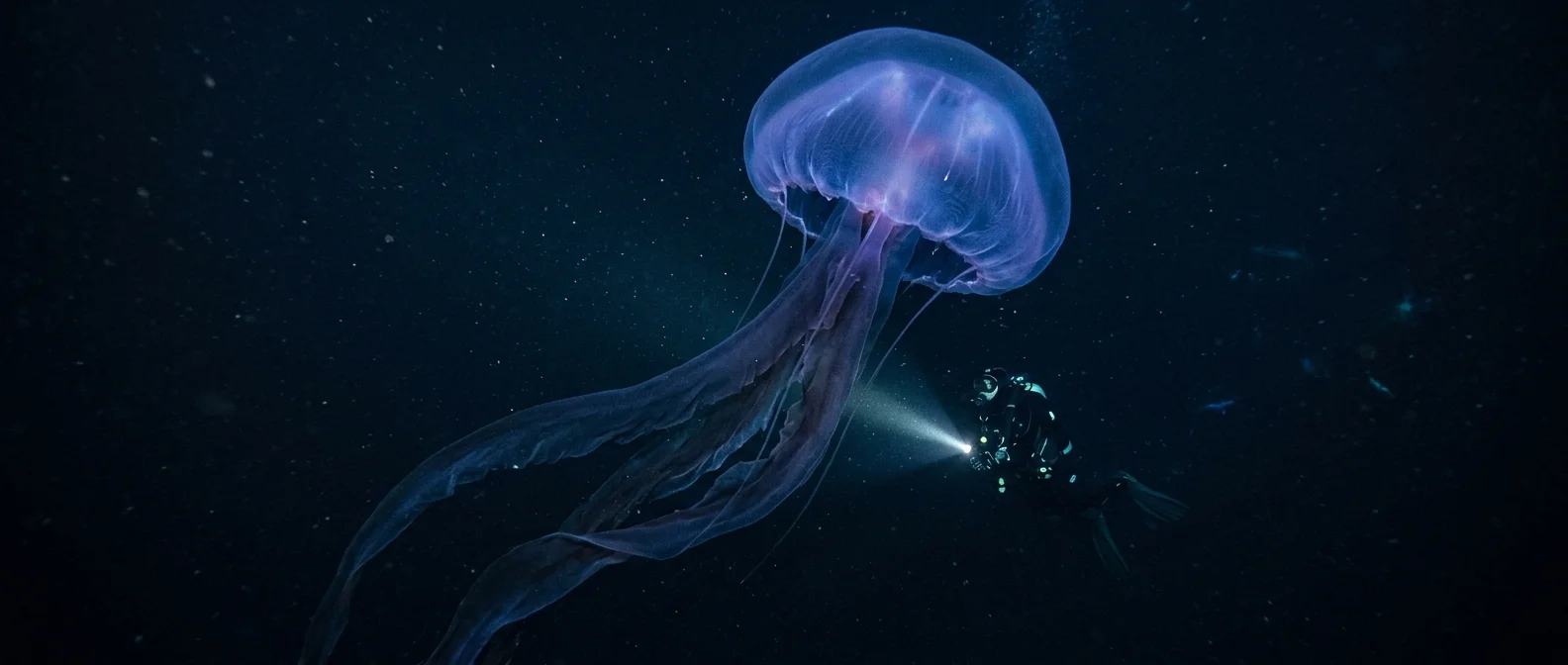
Picture a curtain of deep crimson velvet floating in absolute darkness. It doesn't move fast. It doesn't sting. It makes no sound. It simply exists — like a ghost from ancient seas, with a body stretching over 33 feet long, in the deepest layers of the ocean. Stygiomedusa gigantea — the giant phantom jellyfish — is a creature so rare that in 110 years of research, only 118 individuals have been recorded. This isn't a horror story. It's a ghost story. But the ghosts are real.
👻 First Appearance: 1899
The first Stygiomedusa gigantea specimen was collected in the late 19th century — 1899. It was a massive gelatinous organism weighing 88 pounds — like a small child in weight, but made almost entirely of water — found in research vessel nets. But no one understood what exactly it was. It took 60 full years — until 1959 — for scientists to recognize it as a new species. Its name comes from ancient Greek: Stygios (of the Styx, the underworld) + Medusa + gigantea (giant). Literally: the giant Medusa of the underworld.
It belongs to the family Ulmaridae (order Semaeostomeae, class Scyphozoa) — meaning it's a true scyphozoan jellyfish, related to familiar moon jellies and sea nettles. But unlike them, it doesn't swim in shallow waters or shine in sunlight. It swims in the midnight zone — where temperatures drop to 36°F and light no longer exists.

👻 Anatomy of a Phantom
What exactly do you see if — somehow — you manage to encounter one? First, a bell-shaped body over 3 feet wide. This structure resembles an umbrella or disc, made of spongy jelly so flexible it can stretch 4-5 times its size — possibly to engulf prey. The pressure at the depths where it lives reaches 40 MPa (390 atmospheres). This means this jelly organism withstands pressures that would crush metal.
Below hang 4 ribbon-like oral arms — in a flattened V-shape, with a wide base narrowing toward the tips — that can reach 33 feet in length. These arms don't sting. They have no nematocysts (stinging cells). Instead, they function as sticky trapping curtains — the organism uses them to ensnare plankton and small fish within their folds. The appearance resembles a moving deep-sea curtain — a crimson ghost.
It lacks gastric pouches or radial canals — a characteristic that places it in the Ulmaridae family rather than other jellyfish families. Its circular stomach has channels connecting to the sub-umbrella surface, and the bottom part is purposely thick — strong enough to support the weight of the massive arms.
👻 Invisible in Darkness
Why deep red? The answer is physics. At depths below 3,300 feet, red light doesn't penetrate. Anything red becomes invisible — disappearing into darkness without reflection. Stygiomedusa doesn't glow. It doesn't reflect. It simply doesn't exist — unless a submarine's light falls upon it. Then an otherworldly spectacle is revealed: a blood-red creature swaying slowly, like an old theater curtain on the ocean floor.
It lives everywhere on the planet except the Arctic Ocean, at depths from the surface to 22,000 feet. Typically in the bathypelagic zone — below 3,300 feet — but near Antarctica it's been observed in much shallower waters, even at 260 feet. One possible explanation: it rises there to expose itself to ultraviolet radiation that kills its parasites. Another hypothesis: upwelling cold water currents around Antarctica simply push it upward. The third theory: it follows zooplankton swarms that rise to the surface at night — part of the largest daily migration of living organisms on the planet.

👻 The Roommate: A Fish Living Inside the Ghost
In the open deep waters there are no rocks, caves, corals — nothing for a small fish to hide behind. Unless you use a living animal as home. Thalassobathia pelagica — a small pelagic fish — lives in symbiotic relationship with Stygiomedusa. MBARI researchers recorded this fish hovering above the bell and swimming in and out among the jellyfish's long arms. The jellyfish provides food and shelter. The fish removes parasites. Even if the two animals separate, the fish returns — using specialized low-frequency sensors (neuromasts) that detect water pulses emitted by the bell.
This is the first documented symbiosis between an ophidiiform fish and a jellyfish. A tiny fish, just a few inches long, depends entirely on a giant gelatinous curtain at depths of miles. This relationship shows that even in the most desolate places on the planet, nature finds ways to create partnerships.
👻 Reproduction: Babies Inside the Stomach
Stygiomedusa's reproduction is equally bizarre. It has 4 brood chambers protruding into the stomach. Inside these develop microscopic cysts — each containing a unique jellyfish embryo. The 4 genital pores are deliberately small — to avoid reducing the structural integrity of the stomach that must carry 33-foot arms.
Once sufficiently developed, the cyst forms a “T” shape and pushes against the chamber wall. Eventually a thin chorion forms — a capsule within which a complete miniature jellyfish develops. The “baby” detaches from the sub-umbrella wall, passes through the gastric cavity, and literally exits through the parent's mouth. Each parent is estimated to produce 50-100 new jellyfish during its lifetime. The babies — faithful miniature copies of the adult — become free-swimming planulae, then polyps, and finally adults.
👻 Why So Rare?
MBARI's ROVs (remotely operated vehicles) have made thousands of dives — and have seen Stygiomedusa only 27 times in 27 years. This doesn't necessarily mean it's rare — it means we can't find it. It lives at depths we almost never visit. The ocean below 3,300 feet remains less mapped than the surface of Mars. It's been found near hydrothermal vents — where zooplankton abounds and larger individuals congregate there, especially from spring to early summer — but also in open waters hundreds of miles from shore. In low-productivity areas, Stygiomedusa dominates, competing with squid and whales at the same trophic level. It's considered one of the largest invertebrate predators of the deep.
In 2022, Viking cruise passengers in Antarctica recorded three different individuals through tourist submarines — at depths of 260, 285, and 920 feet. Daniel Moore, the expedition's lead scientist, realized what they were seeing from a tourist's camera photo. "I recognized it immediately — and given its rarity, I was flooded with excitement," he said. Even these deep-sea specialists couldn't believe what had appeared before tourists.
Stygiomedusa gigantea doesn't need speed. It doesn't need venom. It doesn't need clever strategy. It needs only time — and silence. It's a creature that has existed continuously for millions of years, floating in darkness, invisible in the spectrum its prey can see. It moves slowly, rhythmically, with gentle contractions of the bell — without reacting to submarine lights, without fleeing. White gelatinous mucus has been found covering hydrothermal vents — suggesting they may travel in swarms, not just individually. The perfect ghost.