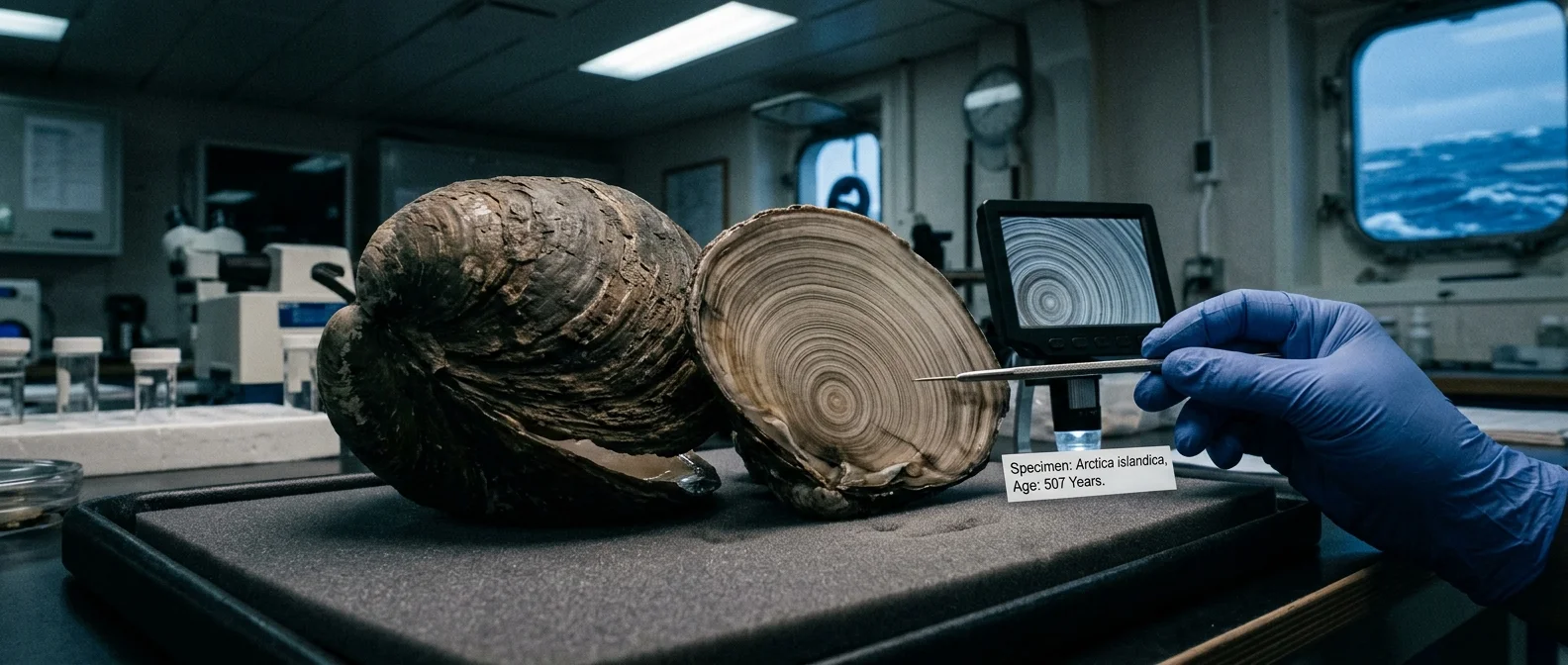
In 2006, researchers from Bangor University in Wales hauled up a dredge from the seafloor near Iceland. Among the sediment lay what appeared to be an ordinary bivalve mollusk: an Arctica islandica, known as an ocean quahog. No one suspected this creature had been born 507 years earlier, during China's Ming Dynasty. They named it “Ming” — and it became the longest-lived non-colonial animal ever recorded on the planet. This is the story of a creature that lived on the North Atlantic seafloor while Columbus had yet to discover America.
📖 Read more: Greenland Shark: 500-Year Superpowers in Freezing Waters

📜 Chapter 1: 1499 — Born on the Seafloor During the Ming Dynasty
Sometime around 1498 or 1499, a microscopic egg was fertilized in the frigid waters off northern Iceland. The larva floated in the water column for about 30 days before settling on the sandy bottom, beginning a life that would span five centuries. That year, the Ming Dynasty ruled China, Vasco da Gama had just reached India by sea, and Europe was living through its final years before the Renaissance changed everything.
Arctica islandica belongs to the family Arcticidae, order Venerida. It bears no resemblance to the spiny radial structure of a sea urchin. It's a bivalve mollusk — an “ocean clam” with two thick valves that close hermetically. The shell's exterior is dark gray, almost black, earning it the nickname “black clam.” Inside, the shell is white with purple margins. Most specimens in American waters measure 7–11 centimeters, but Ming was 87×73 millimeters — modest in size for a creature half a millennium old.
Each year, as Ming breathed and fed, its shell grew by one thin layer — exactly like tree rings. These annual growth lines are visible in cross-section and form the basis of sclerochronology: the science of reading time through hard animal tissues. Each line records that year's temperature, chemistry, and ocean conditions.
📜 Chapter 2: Anatomy of the Immortal — How to Build a 507-Year Shell
Ming was a filter feeder. Buried in sandy sediment at depths of 8 to 400 meters, it extended its siphons (breathing and feeding tubes) above the sediment surface. It pumped water, filtered microscopic algae and plankton, and expelled the waste. Feeding activity is regulated by light levels: in northern regions, the animal feeds actively only 8 months per year. The remaining months, it closes its shells and “sinks” into metabolic dormancy.
This slow pace of life isn't weakness — it's survival strategy. Dynamic Energy Budget (DEB) models show that A. islandica's extreme longevity results from low somatic maintenance costs and extremely slow acceleration of aging. They need an average of 5.8 years to reach reproductive maturity — and only then do somatic costs begin to decrease.
Geography plays a decisive role. In the deep, cold waters around Iceland, individuals routinely live over 300 years. But in Germany's Kiel Bay, where seasonal changes in salinity and temperature are greater, the same animals live only 30 years. In the German Bight, they reach 150. Temperature below 15.5°C (60°F) appears critical — they're rarely found where the bottom warms above this threshold.
📖 Read more: 10 Creatures That Glow in the Ocean's Darkness
📜 Chapter 3: Sclerochronology — Every Ring Tells a Story
Sclerochronology transformed Ming into a living climate archive spanning 507 years. Each annual growth line in the shell contains oxygen isotope data (δ¹⁸O) reflecting that year's water temperature. This means a single shell can function as a “thermometer” covering centuries.
An A. islandica specimen collected alive near Iceland in 1868 was 374 years old. Study of its rings revealed particularly variable growth during the peak of the Little Ice Age (1550–1620), milder climate around 1765–1780, and even recorded the volcanic eruption of Mount Tambora in Indonesia in 1815 — which caused the famous “year without a summer” of 1816. This data, locked inside a mollusk shell, is invaluable to paleoclimatologists.
Bangor University researchers, led by Paul Butler, managed to create a marine climate archive spanning 1,357 years based exclusively on annual growth lines from multiple A. islandica individuals — the longest such archive from marine fossils in history. This wouldn't be possible without the seemingly mundane ability of these mollusks to live for centuries.

📜 Chapter 4: Iceland, 2006 — Discovery and Death
In October 2006, researchers from Bangor's School of Ocean Sciences deployed a dredge in waters off northern Iceland. Their goal was collecting samples for climate studies — not hunting for records. Along with dozens of other mollusks, they hauled up Ming. No one knew its age. The samples were catalogued, frozen — and Ming died, without anyone suspecting they had just killed the oldest individual animal on Earth.
In 2007, the initial estimate was 405 years, based on counting annual lines in the hinge area of the shell. The media — led by Sunday Times journalists — dubbed it “Ming,” since it was born during the Ming Dynasty (1368–1644). Icelandic researchers called it Hafrún, a feminine name meaning “mystery of the ocean” (haf = ocean, rún = mystery). The animal's actual sex remains unknown.
In 2013, new assessment by Butler and Scourse counted lines on the shell's outer margin — a more reliable method — and revised the age to 507 years. The estimate was confirmed with carbon-14 radiodating and cross-matching patterns with other shells that lived during the same period. Marine biologist Rob Witbaard stated that this estimate's accuracy is within 1–2 years.
📖 Read more: 33-Foot Ghost Jellyfish: Deep-Sea Phantom No One Sees
📜 Chapter 5: Negligible Senescence — The Body That Refuses to Age
How does something live half a millennium? The answer lies in a biological condition called negligible senescence. A study of individuals aged 4–192 years showed that antioxidant enzymes decline rapidly in the first 25 years — the phase of growth and reproductive maturation. But afterward, levels stabilize and remain constant for over 150 years. The A. islandica body doesn't show typical signs of aging: no gradual organ weakening, no increasing mortality rate with age.
This opens fascinating questions for aging biology: can we copy low somatic maintenance mechanisms in more complex organisms? Ming, a creature without a brain, without eyes, and without lungs, may hold keys to human aging. Professor Richardson of Bangor stated that such long-lived species can help scientists discover how certain animals reach such ages.
📜 Chapter 6: The Irony — We Killed the Oldest Animal to Learn Its Age
Ming's fate harbors deep irony. To count annual lines, the shell must be opened and cut in cross-section — a process that inevitably kills the animal. Ming died because someone wanted to know how old it was. Researchers froze it routinely, unaware they had just terminated half a millennium of life.
The ethical dimension remains open. Was the death necessary? Today, non-destructive techniques can roughly estimate age, but the 1–2 year accuracy achieved by Butler's team requires sectioning. NOAA reports the species isn't overfished in American waters — it produces 15 million pounds of meat annually, worth $12 million (2022 data). Ocean quahogs are harvested with hydraulic dredges that use water jets to dislodge them from sandy bottoms.
But beyond their commercial role, these creatures constitute living archives of the planet. Ming wasn't just an old mollusk — it was a 507-year witness to oceanic history. Locked inside its shell were encrypted data from the Little Ice Age, volcanic eruptions, current changes. Each ring, a diary page. And we opened that diary — but to read it, we had to kill the author.
Ming's true legacy isn't the record. It's the reminder that in the dark, frozen depths, there are creatures living at a pace entirely alien to our own — and that every time we drag a dredge, we might be erasing centuries of information without even knowing it.