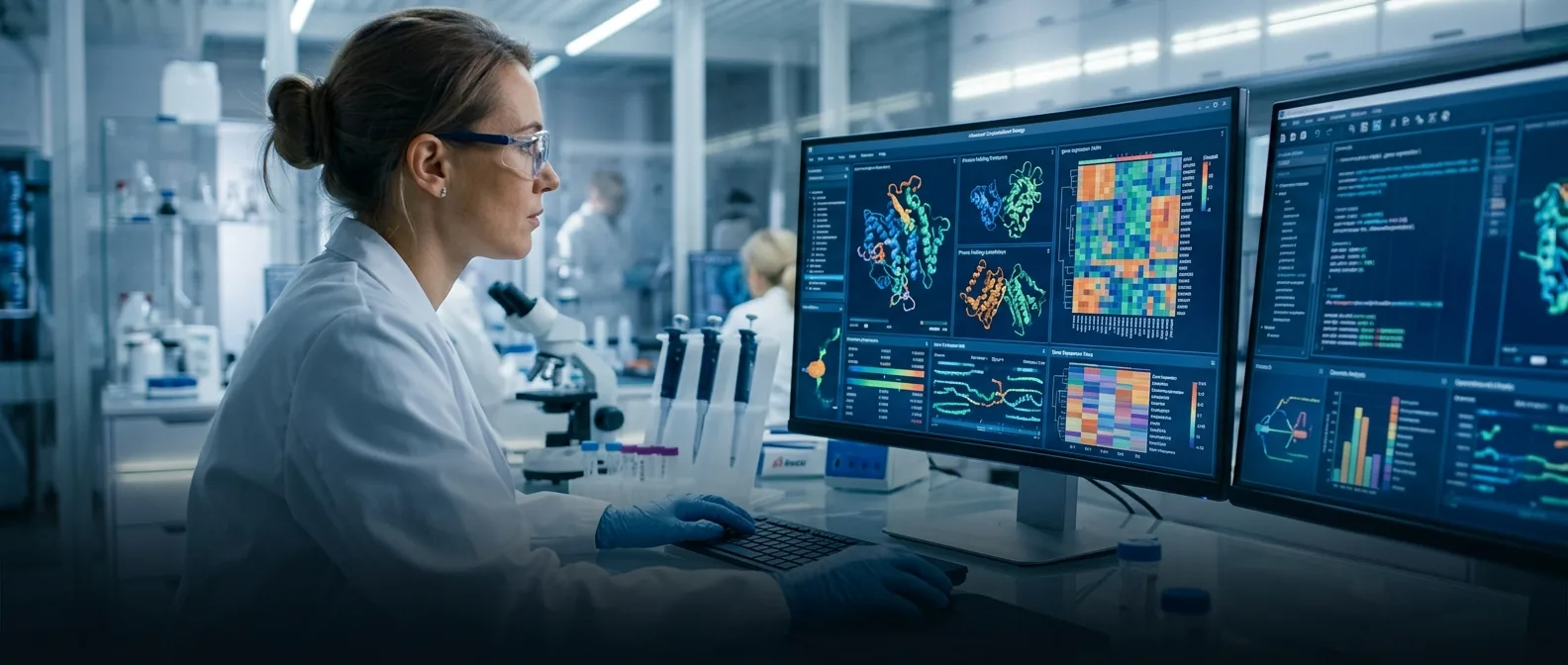
Look at a chemical formula. Predict exactly how it will rewire your genes. GPS delivers on this promise (Gene expression Profile Predictor on chemical Structures), a deep learning system from Michigan State University that learned from 200 million experiments to predict which compounds can reverse disease at the genetic level. Published in Cell in 2026, the AI drug discovery platform has already identified promising compounds for two notoriously difficult diseases.
📖 Read more: 2,000-Year-Old Seed Sprouts: Date Palm from Herod's Era
🧬 When AI Reads Chemical Formulas Like Genetic Code
Picture this: you feed a chemical structure into an algorithm, and it spits out a prediction of exactly how that compound will alter the behavior of thousands of genes in your cells. No lab work. No animal testing. Just pure computational prediction. That's GPS in action. The system trained on more than 200 million experimental data points to crack the code between molecular structure and gene expression. "Instead of looking at cats or dogs, we want to know if the compound will regulate up or down the expression of a specific gene," explains Bin Chen, professor at Michigan State University and lead researcher. The logic sounds simple. The execution is anything but.How GPS works: The system analyzes a chemical compound's structure and predicts how it will affect the expression of thousands of genes simultaneously. Think GPS for gene expression — hence the name.
From Cellular Chaos to Order
Inside a diseased cell, genes run wild. Some get signals to overproduce proteins. Others dial down their activity to abnormal levels. Up becomes down, down becomes up. The right compound could restore order by reversing dysfunction in specific genes. Traditionally, finding that "right compound" meant screening millions of chemicals for their effects on hundreds or thousands of genes. A process costing billions and taking decades.The Gene Expression Reversal Revolution
GPS changes the game. Instead of blindly hunting for drugs that treat symptoms, it targets the root problem: pathological gene expression. When a gene has "gone rogue," the system can predict which chemical compound will bring it back to normal levels.📖 Read more: Artificial Photosynthesis 2026: Clean Fuel from Sun & Water
📊 First Results: Cancer and Pulmonary Fibrosis
Chen's team picked two particularly nasty diseases to test their theory. Hepatocellular carcinoma (HCC), the third leading cause of cancer death worldwide, and idiopathic pulmonary fibrosis (IPF), a chronic lung disease with a median survival of three years from diagnosis.20+ researchers involved
200M experimental data points
16,000 genes analyzed
Testing on Human Tissue
The research gains credibility because for IPF, the tests started with mice but extended to samples of human lung tissue. Thanks to collaboration with the lung transplant program at Corewell Health in Grand Rapids — the busiest in Michigan — researchers had access to enough explants for testing as living cultures. "This is the best way to advance medical knowledge, for clinicians to work side by side with biologists, and now, computational scientists," says pulmonologist Reda Girgis, medical director of the transplant program.📖 Read more: Dream Recording Technology: Neuroscience Breakthrough 2026
⚡ The Technology Behind the "Chemical GPS"
GPS isn't just an algorithm — it's a complete ecosystem combining chemistry, genetics, and computational biology. Jiayu Zhou, formerly at MSU and now at University of Michigan, explains the challenges: "Biological data is rarely clean. Imagine trying to learn from a massive pile of examples where some are clear, some are blurry, and some might even be misleading."The innovation: The system learns to separate strong signals from weak ones, so it can learn from the data without getting fooled by all the "noise."
From Theory to Practice
Discovering compounds in theory is one thing. They still need to be validated in the real world, says Edmund Ellsworth, director of the MSU Medicinal Chemistry Facility. His team was responsible for creating related compounds discovered by the platform and optimizing them into safe and effective drugs. "To move forward, it must be recognized that drug discovery is a team sport, and not for the faint of heart," Ellsworth says. "It's complex, all kinds of things happen, and you need the diversity of experts to overcome and be successful."📖 Read more: Human Evolution: 7 Million Years from Ape to Homo sapiens
🔬 Next Steps: Open Platform for Everyone
What makes this research even more encouraging is that the team has shared their code and developed a web portal for researchers to use GPS for virtual compound screening. "It's like a major shift for people to drive discovery," Chen says.Platform with Potential for Multiple Diseases
Xiaopeng Li, also from MSU and specialized in lung diseases like IPF, shares this ambition: "I think it has already been proven that this platform can be applied to two completely different diseases. So this platform can be used for other diseases, to unleash the potential."We know this disease is hard to tackle. There have been so many failures in finding new drugs in the last 20 years. And I think the AI element helped us approach the problem differently and more systematically.
— Xiaopeng Li, MSU
From 6 Billion Compounds to First Drugs
The system's speed is impressive. Transcripta Bio, a biotechnology company in Palo Alto working on similar technology, completed virtual screening of 6.5 billion drug-like compounds in a few days. When they synthesized 21 compounds predicted to reduce expression of a specific gene, they found that 20% were active in cells.🎯 Frequently Asked Questions
How does GPS differ from traditional drug discovery?
Traditional drug discovery focuses on a specific target protein and tries to find a molecule that will inhibit or activate it. GPS examines the effect on the entire transcriptome — meaning all genes expressed in a cell — and predicts how a compound will change the expression of thousands of genes simultaneously.Can the system detect side effects?
Yes, that's one of the major advantages. Because GPS predicts effects on thousands of genes, it can identify potential off-target effects that could cause side effects, even before the drug reaches clinical trials.When will we see actual drugs from this technology?
The team has already identified existing drugs that can be repurposed for new indications — these could reach patients relatively quickly. For completely new drugs, clinical trials will still be needed, but the process will be much faster than conventional drug discovery. GPS marks a new approach to drug discovery. Instead of looking outward at symptoms, we're looking inward at the genetic code that determines our cells' behavior. And if AI can truly "read" this code as well as it promises, the future of medicine looks brighter than we imagined.Sources: