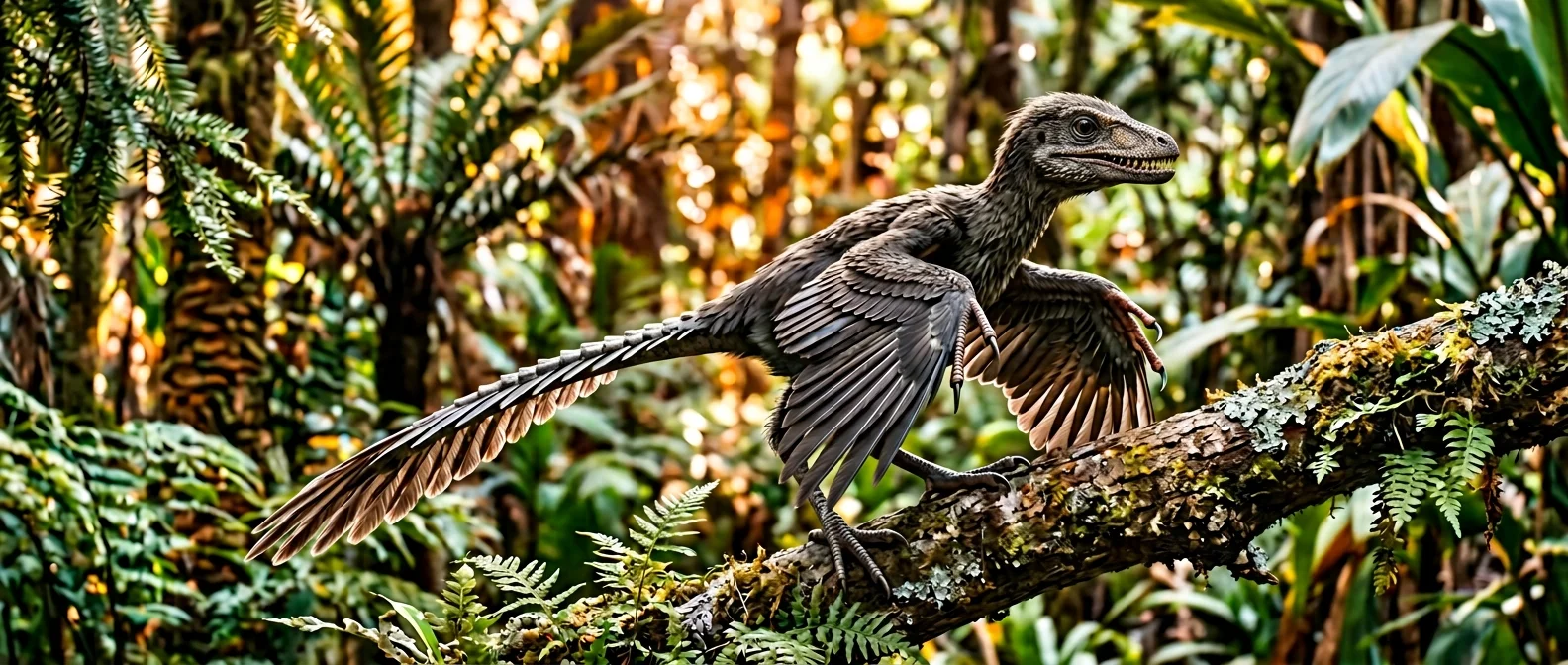
Some fossils change how we see life. Others change how we see everything. Archaeopteryx — half dinosaur, half bird — holds a unique position in paleontological history. It was discovered precisely when the world needed proof that evolution was real. And that proof, etched in 150-million-year-old limestone, spoke for itself.
1860: A Feather in Limestone
It all began with a single feather. Around 1860, in the limestone quarries near Solnhofen, Bavaria, a worker discovered the impression of a feather in 150-million-year-old rock. A feather from the Jurassic Period — an era when, according to contemporary knowledge, no bird had ever walked the Earth. The Solnhofen limestone, an extremely fine-grained rock formed on the bottom of a tropical lagoon, was an ideal preservation medium — so good that even individual feather structures were imprinted with stunning detail.
A year later, in 1861, came the first skeleton — incomplete, missing head and neck — near Langenaltheim. A doctor acquired it as payment and eventually sold it to London's Natural History Museum, where it remains today as the “London Specimen.” The timing was historic: Darwin had just published “On the Origin of Species.” And here, as if on cue, appeared a creature that was exactly what evolutionary theory predicted — a transitional fossil, a bridge between two worlds.
The scientific community's reaction was seismic. Thomas Henry Huxley — “Darwin's Bulldog” — immediately used Archaeopteryx as evidence for evolution, arguing that birds descended directly from dinosaurs. On the other side, Richard Owen, founder of London's Natural History Museum and fierce Darwin opponent, pushed back. Their battle over a small fossil from Bavaria laid the groundwork for a debate that would outlast both their lives.
1875: The “Berlin Specimen” Changes Everything
The most crucial moment in Archaeopteryx history came between 1874 and 1875, when a farmer named Jakob Niemeyer discovered near Eichstätt the most complete skeleton — and the first to include an intact head. Through a series of sales, the fossil ended up at Berlin's Museum für Naturkunde, where it's displayed today.
What the “Berlin Specimen” revealed was stunning: an animal that combined reptilian and avian features in ways no one expected. It had sharp teeth like a dinosaur, three clawed fingers on its wings, a long bony tail — but simultaneously developed feathers with asymmetrical flight feathers, a wishbone, hollow bones, and air sacs like a modern bird. It was like watching the moment dinosaurs transformed into birds.
Dinosaur Features
- Sharp-toothed jaws
- Three clawed fingers on wings
- Long bony tail
- Hyperextensible second toe
Bird Features
- Asymmetrical flight feathers
- Wishbone (furcula)
- Hollow, thin-walled bones
- Air sacs in vertebrae
Could It Fly or Not?
This is perhaps the most fascinating question surrounding Archaeopteryx. And the answer, after more than 160 years of research, is: yes, but not how you'd imagine. A major 2018 study in Nature Communications used synchrotron microtomography — technology that creates three-dimensional representations with exceptional clarity — to examine bone structure. The results were revealing: Archaeopteryx bones withstand low torsional forces, allowing short bursts of energetic flight — like a pheasant suddenly taking off to escape a predator.
"Archaeopteryx's bones match more closely with birds like pheasants, which use burst flight — not with raptors or seabirds optimized for long flights," explained Emmanuel de Margerie, a researcher at CNRS in Toulouse. The creature was lightweight — Archaeopteryx weighed just 1.8-2.2 pounds, the size of a common raven — and its primitive shoulder construction limited its capabilities. It wasn't a bird that soared carelessly through the skies — it was a dinosaur that had just discovered it could fly.
The question of whether it could take off from the ground without running also occupied researchers. At a 2016 Society of Vertebrate Paleontology meeting, it was reported that Archaeopteryx could likely fly without prior ground momentum — meaning it could launch directly into the air. This makes it even more remarkable: an animal with primitive shoulder anatomy, lacking the developed sternum of modern birds, managed to fly using every method at its disposal.
Colors of an Ancient Plumage
One of modern paleontology's most impressive achievements is deciphering the colors of extinct animals. A 2011 study in Nature Communications examined melanosomes — microscopic melanin granules within cells — and revealed that Archaeopteryx feathers were black. The melanosome structure even indicated they provided structural reinforcement to feathers, helping with flight — exactly as happens in modern birds.
However, a newer 2013 analysis challenged this conclusion, suggesting flight feathers might have been light-colored (perhaps white) with black tips. The truth probably lies somewhere between: studies of related theropods and primitive birds show these animals had complex color patterns, possibly with iridescent hues. Their feathers didn't just serve flight — they functioned for individual recognition, courtship, and camouflage.
Archaeopteryx's size is itself impressive. At just 20 inches long and weighing 1.8-2.2 pounds, it was about the size of a modern common raven. Its feathers were developed across multiple body regions: beyond flight feathers on wings and tail, the well-preserved “Berlin Specimen” revealed it had body plumage, including impressive “trouser-like” feathers on its legs — something we see in some modern raptors. Simultaneously, no specimen has shown feathers on the upper neck or head — possibly due to the fossilization process, though some researchers wonder if these areas were actually bare.
Remarkably, though only 12 specimens have been found in 165 years, each revealed something new. The “Maxberg Specimen” mysteriously disappeared after its owner's death. The “Haarlem Specimen” was considered a pterodactyl for decades before being recognized as Archaeopteryx. The 11th specimen remains in private collection, creating concern in the scientific community about access to such important material.
"The contour feathers on Archaeopteryx's wings and tail have asymmetrical shapes — something almost always associated with high aerodynamic performance. It's very likely it could fly, but it's difficult to judge whether it flapped or glided."— Christian Foth, paleontologist, University of Fribourg (LiveScience)
Archaeopteryx's World
150 million years ago, Europe wasn't a continent — it was an archipelago. Hundreds of islands scattered across shallow seas, much closer to the equator than today, at roughly Florida's latitude. The climate was warm, probably dry, and the lagoons around present-day Solnhofen teemed with life: small fish, amphibians, lizards, insects — and somewhere among them, a tiny 20-inch hunter with feathers and claws.
Archaeopteryx was carnivorous. It likely hunted small reptiles, amphibians, mammals, and insects, grabbing smaller prey with just its jaws and using claws for larger targets. Its stereoscopic vision — a predator's trait — and short-flight capability made it extremely effective in this island environment. Its long legs suggest it moved primarily on the ground rather than hanging from branches — confirmed by its claw structure, which doesn't resemble modern climbing birds.
But the relationship between feathers and flight isn't as simple as it appears. Analysis by Foth and colleagues (2014) showed that contour feathers already existed in non-flying dinosaurs — meaning they initially evolved for other reasons: temperature insulation, egg incubation, impressing mates. In Archaeopteryx, these pre-existing feathers acquired a second function — aerodynamics. Flight, in other words, wasn't invented from scratch; it was a bonus on top of a system that had existed for millions of years.
The Reversal: Still the “First Bird”?
For nearly 150 years, Archaeopteryx held the title of oldest known bird. Until China began revealing its secrets. In 2011, the discovery of Xiaotingia zhengi in Liaoning deposits triggered surprise: character analysis placed both Xiaotingia and Archaeopteryx not in group Avialae (primitive birds), but in group Deinonychosauria — close to dromaeosaurs and troodontids, alongside Velociraptor!
Restoration came quickly. The Foth et al. (2014) study in Nature re-analyzed dozens of characteristics and returned Archaeopteryx to the base of the bird lineage. But the truth proved more complex: Anchiornis and Aurornis xui, living 5-10 million years earlier, were found even deeper in the evolutionary tree. Archaeopteryx is no longer the “first bird” — but remains, according to Foth, “the first demonstrably flight-capable representative” of the lineage.
Twelve specimens — a small number for 165 years of excavations — make Archaeopteryx one of the rarest and most valuable fossils. Each new find brings surprises: the latest discovery, the 12th specimen, was found in 2010 and announced four years later — but hasn't been scientifically described yet. A recent 2026 study revealed new unique characteristics in Archaeopteryx's mouth: oral papillae on the palate, a bill-tip organ similar to modern birds, and a flexible but robust hyoid bone. These findings suggest Archaeopteryx had a more sophisticated mouth than anyone believed — one designed for efficiency, possibly even helping flight by reducing air resistance. After a century and a half, this small dinosaur-bird continues to surprise.