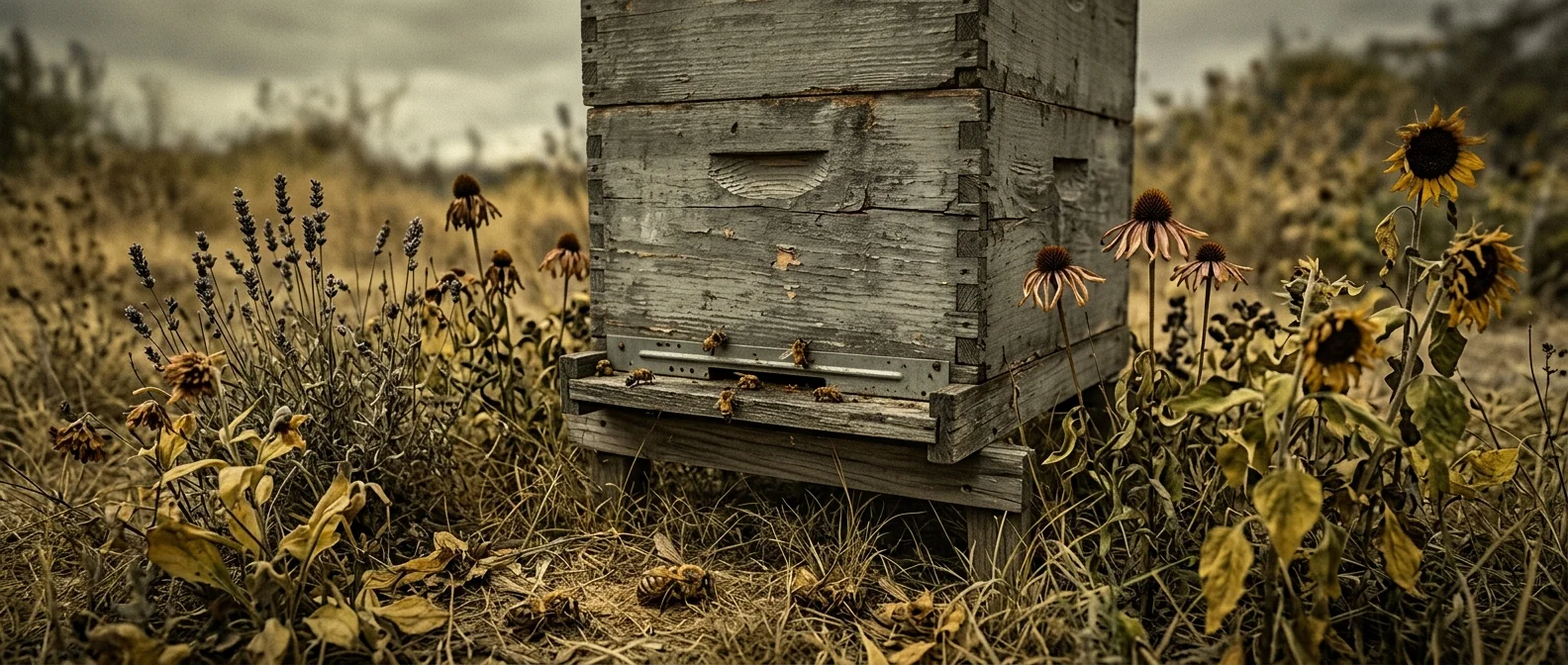
Imagine a morning without coffee, no apples on the table, no almonds in your yogurt. This isn't a dystopian movie — it's the world without bees. Nearly 90% of wildflowers and over three-quarters of the planet's essential crops depend on pollinators. And these pollinators are disappearing at a rate no one predicted two decades ago.
📖 Read more: 2 Marsupials Thought Extinct for 6,000 Years Found Alive
🐝 The Planet's Silent Engine
Bees don't just produce honey. They're the mechanism behind every third bite of food you eat. When a bee visits a flower, it transfers pollen to the pistil — a process worth billions. In the US alone, the economic value of pollination is estimated at $15 billion annually. Globally, 75% of food crops depend partially or entirely on animal pollination — apples, cherries, almonds, coffee, cocoa, tomatoes.
Beyond agriculture, bees support entire ecosystems. The wildflowers they pollinate become food for birds, rodents, and insects, which in turn feed larger animals. Without bees, the chain breaks at multiple points.
⚠️ Colony Collapse Disorder: The First Warning
In the winter of 2006-2007, beekeepers across the US opened their hives to find them empty. Worker bees had vanished — no dead bodies around, no signs of attack, no explanation. The queen was still there, along with a few young bees and food stores. No one understood what happened.
The phenomenon was named Colony Collapse Disorder (CCD) and marked a turning point. Some beekeepers lost 30-90% of their colonies in a single winter. This wasn't normal winter mortality. It was something new, and the scientific community was forced to confront a truth it had overlooked: bees were already in danger.
🧪 Neonicotinoids: The Invisible Poisoning
Neonicotinoids — imidacloprid, clothianidin, thiamethoxam — are the world's most widely used insecticides. Applied to seeds before planting, they're absorbed by the plant and permeate every part: stem, leaves, pollen, nectar. A bee feeding from a neonicotinoid-treated crop doesn't die immediately. Worse.
It struggles to navigate. It loses its way back to the hive. Its ability to learn routes diminishes, memory weakens, disease resistance drops. The European Union banned three neonicotinoids for outdoor crops in 2018, but in many countries — US, Latin America, Asia — they're used freely. The University of Reading's Bee:wild report (2025) warns that “pesticide cocktails” — combinations of multiple substances — pose an even greater threat, especially in developing countries.

🦠 Varroa destructor: The Mite That Kills Colonies
Before pesticides, there was Varroa destructor. This microscopic mite, smaller than a pinhead, is considered the most destructive parasite in beekeeping. It originates from Asia, where the Asian honey bee (Apis cerana) has learned to defend against it. The European honey bee (Apis mellifera) wasn't so fortunate.
The mite attaches to the bee's body and feeds on its fat tissue — not blood, as previously believed. Simultaneously, it transmits viruses: deformed wing virus (DWV), acute paralysis virus, and others. A hive can collapse within 2-3 years without treatment. Varroa acts simultaneously as parasite, immunosuppressant, and disease vector. In many regions, beekeepers are forced to use chemical treatments against the mite, creating a vicious cycle of chemical dependency that further weakens colonies.
🌡️ Climate, Light Pollution, and Microplastics
The climate crisis adds even greater pressure. Temperature changes alter flowering times — flowers bloom earlier, but bees don't always emerge at the same rate. This mismatch, known as “phenological decoupling,” means bees arrive at a food bank that's already empty. The Souther et al. study (PLOS ONE, 2024) recorded declining bee and butterfly populations in western North America, with strong correlation to prolonged drought and land use change.
But climate change isn't the only new threat. The Bee:wild report (2025) reveals that light pollution reduces nighttime pollinator visits to flowers by 62% — moths and other nocturnal pollinators that once quietly pollinated at night become disoriented. Meanwhile, microplastics were found in 315 bee colonies across Europe — synthetic materials like PET inside hives. Their impact on bee health is still being studied.
📖 Read more: Frogs Beat Deadly Fungus Using Mini-Saunas & Hot Rocks

🌎 The Crisis in Global Numbers
The crisis doesn't only affect honey bees (Apis mellifera). More than 20,000 bee species live on the planet — the vast majority wild, solitary, without hives. And these are declining. A 2020 study in One Earth showed that 94% of interaction networks between wild bees and plants in North America have been lost over 125 years. Fourteen bee species were found to be declining, with only eight increasing.
In Europe, one in ten bees faces extinction risk. The bumblebee Bombus affinis — the rusty patched bumblebee — was the first pollinator listed as endangered in the US, in 2017. And while managed honey bee colonies are increasing in some regions, this increase may mask biodiversity loss — because commercial bees compete with wild ones for resources.
💡 12 Solutions — What Science Says
The Bee:wild report evaluated 12 actions by innovation and impact. Professor Simon Potts (University of Reading) and Dr. Deepa Senapathi emphasize that the most effective solutions address multiple problems simultaneously.
Antibiotic Laws
Stricter regulations against antibiotic pollution that harms bees
Electric Vehicles
Transition to EVs to reduce air pollution affecting pollinators
Flowering Solar Farms
Creating blooming habitats within solar panel installations
RNAi Therapies
Targeted parasite elimination without harming beneficial insects
Among the solutions: crops with enhanced pollen and nectar for better bee nutrition, AI-powered population mapping, and protection of stingless bees — bees that pollinate in tropical regions. Creating urban gardens and rewilding natural habitats are additional actions with immediate impact.
🌻 What Everyone Can Do
You don't need to be a beekeeper to help. A balcony with lavender, thyme, and oregano becomes a refueling station. Avoid pesticides in your garden — even “natural” ones can harm. Leave a bowl of shallow water with pebbles for thirsty bees. By buying organic products and local honey, you support a chain that starts with the pollinator.
Eva Kruse, director of Bee:wild, puts it clearly: "It's getting harder for our pollinators, but we can all play a role in protecting them." The crisis is real. But it's not irreversible — as long as we don't take bees for granted.
🔔 The One-Bite Rule
Every third bite of food on your plate depends directly or indirectly on bees. If pollinators disappear, we don't just lose honey — we lose coffee, chocolate, almonds, apples, cucumbers, tomatoes, and hundreds more foods. Protecting them isn't just an environmental issue. It's a survival issue.