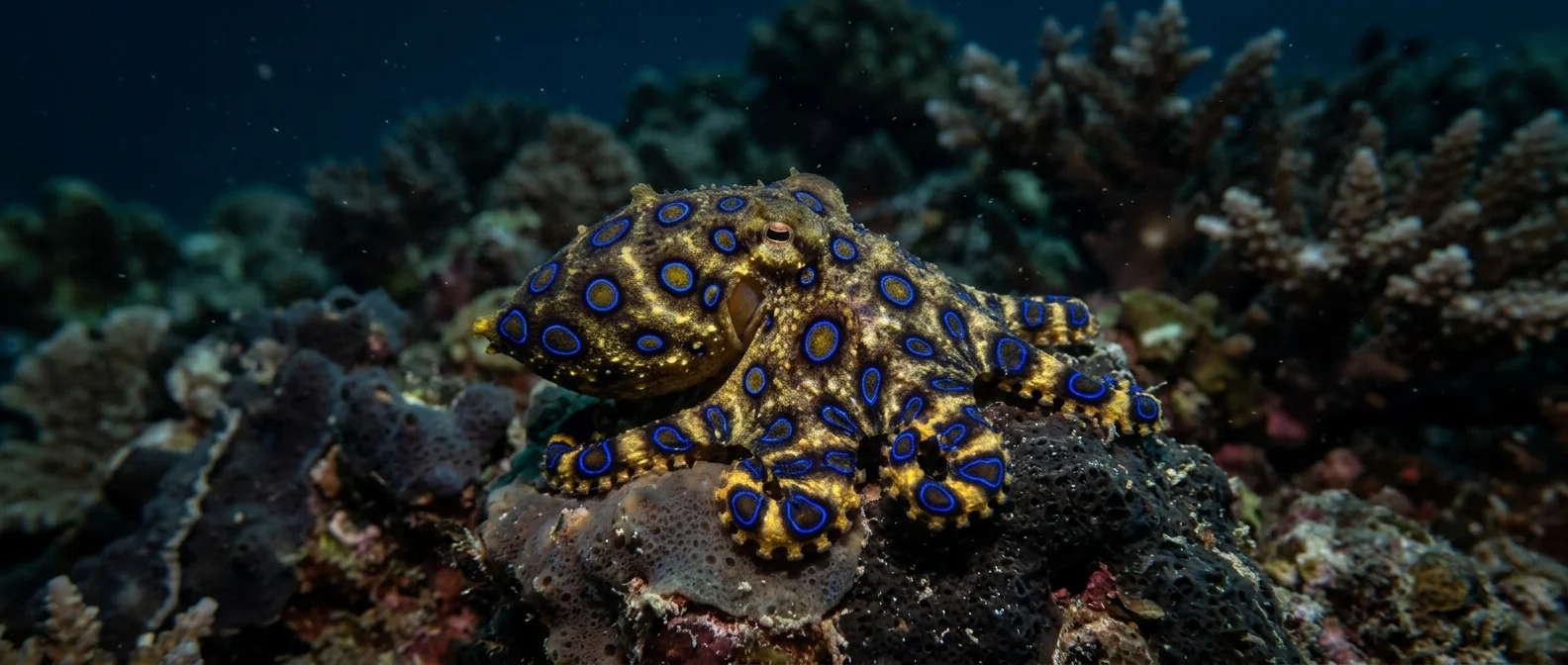
In the shallow waters of the Indo-Pacific, hidden among shells, pebbles, and coral crevices, lurks something you should never touch. It weighs less than an egg. Fits in your palm. And can kill you in under thirty minutes. This isn't a natural history piece. It's a toxicological case file — a forensic manual for a creature that rewrites every rule about size and power.
📖 Read more: First Video of Colossal Squid: Ocean's Ultimate Predator
The blue-ringed octopus (genus Hapalochlaena) belongs to the cephalopod order Octopoda. Four recognized species, all minuscule, all lethal. The substance they carry — tetrodotoxin — is a thousand times more potent than sodium cyanide. No antidote exists. The only treatment is respiratory support until the toxin clears the body. Let's open the file.
🧪 Section 1: Suspect Identity — Size & Variation
Four species are classified in the genus Hapalochlaena, and none exceeds 22 centimeters in length — including arms. H. lunulata (greater blue-ringed octopus) reaches 12 cm and weighs just 55 grams. It lives in shallow tidal pools around Indonesia, Papua New Guinea, Philippines, Vanuatu, Solomon Islands, and Sri Lanka.
H. maculosa — the southern or lesser blue-ringed octopus — reaches 22 cm but weighs only 26 grams, about as much as a heavy coin. Found at depths up to 50 meters along southern Australian coasts and around Tasmania. H. fasciata (blue-lined octopus) measures 15 cm and lives in shallow coastal waters from southern Queensland to New South Wales. And there's the mysterious H. nierstraszi — known only from two specimens: one found in the Bay of Bengal in 1938 and a second near the Andaman Islands in 2013.

🧪 Section 2: Weapon — Tetrodotoxin (TTX)
Tetrodotoxin isn't produced by the octopus itself. Symbiotic bacteria in its salivary glands — primarily the posterior salivary glands — synthesize this neurotoxin. TTX blocks sodium channels in nerves, preventing electrical signal transmission. The result: muscle paralysis. The diaphragm stops working. Breathing ceases.
The terrifying part: the victim remains fully conscious. They see, hear, feel — but cannot move or breathe. Without artificial respiration within minutes, death from asphyxiation follows. As of 2026, at least three deaths in Australia have been attributed to blue-ringed octopus bites. The toxin is so potent that a single octopus can carry enough to paralyze ten adult humans.
But TTX doesn't serve only as defense. The octopus “sprays” venom into the water around its prey — crabs, shrimp, small fish — numbing them before even touching them. Like a chemical warrior. Females coat their eggs with TTX, deterring predators. The toxin distributes throughout the entire body, but the highest concentration is found in the salivary glands — where every hunt begins.
🧪 Section 3: Camouflage Mechanism & Warning Signal
At rest, the blue-ringed octopus looks innocent: a beige or brown creature with rough skin, covered in small bumps (papillae). It sits in rock crevices, empty mollusk shells, even discarded bottles. Makes no noise, attracts no attention. It waits.
But once disturbed, something spectacular happens. Dozens of iridescent blue rings (or lines, depending on species) flash across its entire body. The mechanism depends on two layers of specialized cells. Below are the chromatophores — cells with pigments (black-brown, red-orange, yellow) that are neurally controlled and change color in fractions of seconds. Above these are the iridophores — structures without pigment, made from stacked thin plates that reflect intense blue-green light.
The contrast is spectacular: brilliant electric blue over dark brown background. The entire display functions as aposematism — a universal message in nature: “Don't eat me, you'll die.” Muscle contraction opens the skin folds that hide the iridophores. Relaxation closes them. Concealment and revelation work like an on/off switch — automatic, reflexive, in milliseconds.

📖 Read more: Great White Shark: The Truth Behind the Myth
🧪 Section 4: Reproduction — One Life, One Cycle
Blue-ringed octopuses live only two years. They become sexually mature at four months. Their reproduction is simultaneously violent and tender — and always fatal.
During mating, the male transfers spermatophores to the female's oviduct through a modified arm (hectocotylus). Laboratory studies on H. fasciata revealed something chilling: the male may bite and inject venom into the female during mating, keeping her immobile. After sperm transfer, the male dies shortly after.
The female may not lay eggs immediately. When she does, she deposits 50 to 100 eggs — only one clutch in her entire life. She holds them under her arms (literally), guarding them, cleaning them with her suckers, aerating them with water currents, for nearly two months. During this brooding period, she stops eating entirely. And once the eggs hatch, she dies. The newborns — microscopic planktonic larvae — drift in the water before settling on the bottom. Each parent literally sacrifices itself for the next cycle.
🧪 Section 5: Hunting & Diet — Chemical Warfare
The blue-ringed octopus's hunting strategy differs radically from its larger relatives. It doesn't need physical strength. It doesn't need speed. It needs only patience and chemistry. The ambush begins with stillness: the octopus waits camouflaged, invisible inside a shell or crevice. Once a crab passes close enough, a lightning-fast bite follows. The beak (a horny structure analogous to a parrot's beak) pierces the prey's exoskeleton. The toxin acts in seconds.
Beyond direct biting, some experts believe blue-ringed octopuses release venom into the water around them, creating a “numbing cloud” that disorients small prey. This technique — if fully confirmed — would place them among the few animals that use chemical warfare at range, not just on contact.
They feed primarily on crabs, shrimp, and small fish. Their beak is used not only for biting but also for drilling shells — combined with the radula that scrapes flesh. Despite their microscopic size, they are effective hunters: the combination of camouflage, bite speed, and chemical arsenal gives them a success rate that much larger predators would envy.
🧪 Section 6: Threats & Human Impact
As of 2026, the IUCN doesn't consider the three main species (H. lunulata, H. maculosa, H. fasciata) as threatened. But the picture isn't so rosy. Climate change, ocean acidification, coastal urbanization, and pollution threaten the shallow-water ecosystems where they live. Specifically, coral reef substrates — essential habitat — are already suffering.
There's also a unique problem: their beauty. The blue rings that make them deadly simultaneously make them extremely attractive to aquarium collectors. Illegal or unsustainable fishing feeds an exotic pet market. The irony: people buy an animal that can kill them precisely because what makes it lethal — the blue rings — is what makes it “beautiful.” As oceanographer Jenny Hofmeister noted, most human bites occur when people collect shells thinking they're empty — and put them in their pockets. The octopus hidden inside has no intention of attacking. It's defending itself.
The connection to popular culture isn't missing: in the James Bond film Octopussy (1983), the octopus that appears is a blue-ringed species. But beyond Hollywood, these creatures are subjects of serious pharmacological research. Tetrodotoxin is being studied as a potential analgesic — capable of blocking pain without the narcotic side effects of morphine. Nature, once again, holds the greatest secrets in the smallest hands.