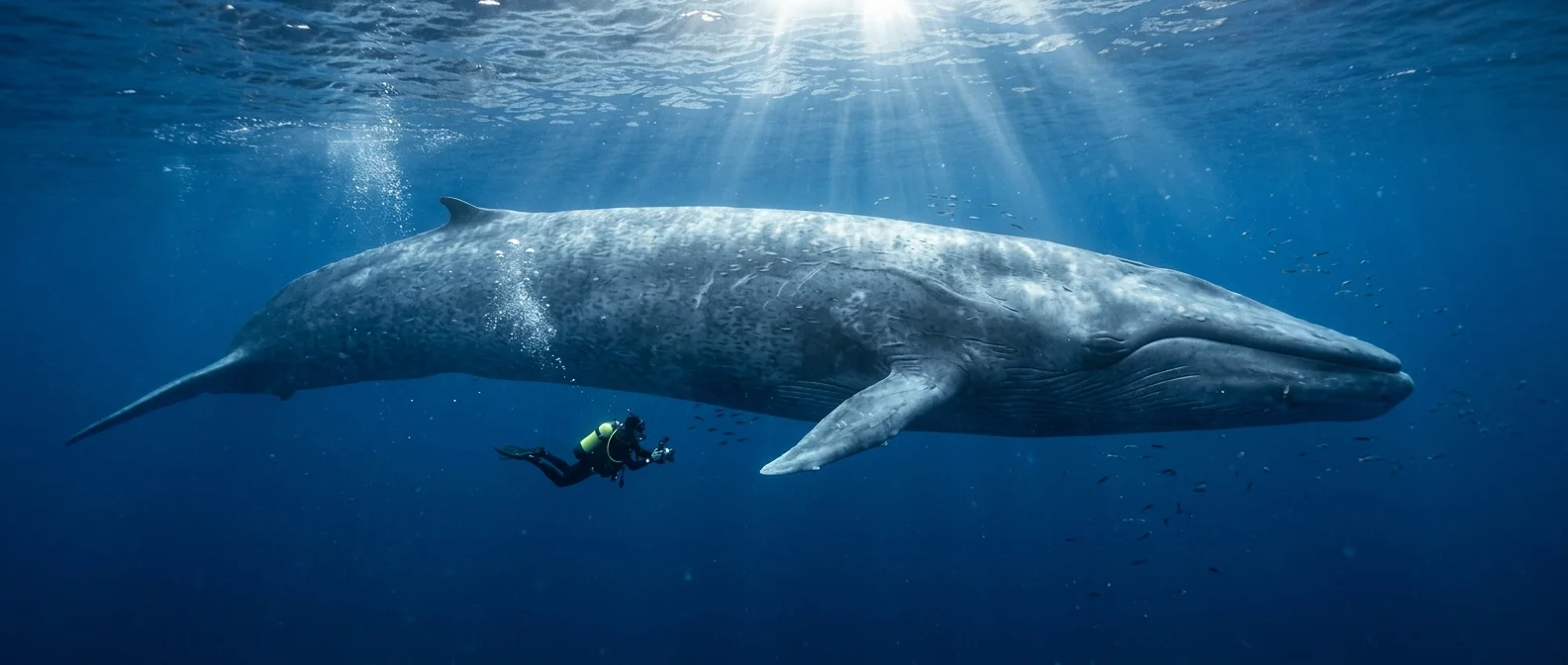
Imagine an animal so massive that its tongue weighs as much as an elephant. Its heart, the size of a small car. A newborn calf emerges larger than most adult animals on Earth. This creature isn't extinct, isn't mythological — it's swimming in some ocean right now. Meet the blue whale, Balaenoptera musculus, and this exploration is dedicated to every impossible statistic that defines it.
🏛️ Hall 1 — Scale: Dimensions That Defy Comprehension
Length exceeding 100 feet. Some females reach 108 feet — longer than a Boeing 737 aircraft. Weight averaging 150 tons. The largest blue whale precisely measured was a 97-foot female weighing 180 metric tons — but 108-foot catches have been reported that may have reached 200 tons. Females are generally larger than males, and the largest individuals live around Antarctica.
For perspective: the largest dinosaur (Argentinosaurus) is estimated to have weighed 70-80 tons. The blue whale weighs twice as much. It's not simply the largest living animal — it's the largest animal that has ever existed in Earth's 4-billion-year history of life. This isn't hyperbole. It's paleontological fact.
❤️ Hall 2 — The Heart: An Engine in Slow Motion
A blue whale's heart weighs approximately 400 pounds — the largest heart of any animal that ever lived. In size, it fits inside a small car. During deep dives, the heart rate drops to just 2 beats per minute — controlling oxygen flow in a body that must function under tremendous water pressure.
The blue whale simultaneously holds the title of the “slowest” and “strongest” cardiovascular system in the animal kingdom. Broad head, small dorsal fin near the tail, 80-100 long grooves on the throat and chest — this is a body designed exclusively for efficiency in the depths.

The blue whale's heart — 400 pounds, the size of a small car, with a rate that drops to 2 beats per minute during dives.
🦐 Hall 3 — The Diet: 4 Tons of Shrimp Daily
The largest animal on Earth feeds almost exclusively on one of the smallest: krill (Euphausiacea) — tiny shrimp-like crustaceans measuring just inches. An adult blue whale consumes 4 to 8 tons of krill daily, depending on the season. During summer in polar waters, consumption skyrockets.
The feeding method is spectacular. The whale opens its massive mouth, gulping a oceanic “bottle” — thousands of gallons of water along with krill. The pleated grooves on its throat expand like an accordion. Then the enormous tongue pushes water out through 800 plates of baleen — a filter made of keratin, like our fingernails. Krill gets trapped behind and swallowed. During this process, the whale performs 360° turns and rapid pirouettes to locate the densest krill concentrations. The coloration of these creatures? Blue-gray at the surface, true blue underwater. Their bellies acquire a yellowish tint — thanks to millions of microorganisms (diatoms) living on their skin, earning them the nickname “sulfur-bottom whale.”
🔊 Hall 4 — The Voice: 1,000 Miles Away
Blue whales are among the loudest animals on the planet. They emit series of pulses, moans, and groans at low frequencies — so low that human ears cannot hear them. Under ideal conditions, one blue whale can “hear” another at a distance of 1,000 miles. This means a whale near the Azores could theoretically communicate with a whale near Madeira.
Scientists believe these sounds are used for both communication and a form of sonar navigation — biological GPS in lightless oceans. During breeding season, males emit long “songs” that can last for hours. The ocean isn't silent — and the blue whale is its loudest performer. Sound intensity reaches 188 decibels — louder than a jet engine. But the frequency is so low (below 20 Hz) that oceans become literal invisible “sound highways” — wavelengths that travel without significant energy loss.
🍼 Hall 5 — The Babies: Born the Size of Cars
After a 12-month gestation, the mother gives birth to a calf already weighing 3 tons and measuring 23-26 feet. The newborn is larger than almost any adult land animal. And it grows at a rate that exceeds all imagination: gaining 200 pounds per day drinking its mother's extraordinarily rich milk — one of the fattiest milks in nature.
Weaning occurs at 7-8 months when the calf reaches 50 feet. Fifty feet — longer than a school bus. And that's still a “child.” The mother-calf migration, from polar feeding waters to warm tropical breeding waters, can cover thousands of miles each year.

A blue whale mother nurses her calf — 200 pounds of milk daily, during a journey spanning thousands of miles.
🩸 Hall 6 — The Slaughter: 360,000 Dead in 60 Years
The blue whale's 20th-century story is one of industrial extermination. Between 1900 and the mid-1960s, 360,000 blue whales were killed for their oil. In the 1930-31 season alone, over 29,000 were slaughtered. A death record for an animal that reproduces one calf every 2-3 years was equivalent to a extinction proposal.
The International Whaling Commission (IWC) protected them in 1966. But recovery is extremely slow. Today, the global population is estimated between 10,000 and 25,000 individuals — a fraction of the pre-whaling population. The IUCN still classifies them as Endangered. The blue whale won the war against extinction — but barely. The population increases slowly, so slowly that it needs decades more to reach even half its historical size. A female reproduces every 2-3 years. The ocean doesn't easily forget the loss of 360,000 titans.
🔭 Hall 7 — The Mysteries: What We Still Don't Know
How long exactly does a blue whale live? The most reliable measurement method — counting layers in ear wax — gave an age of 110 years for the oldest recorded individual. The average is estimated at 80-90 years. But no one can be certain — data comes mainly from dead animals, and whaling pressure eliminated the oldest individuals long before we could study them.
Blue whales travel in all oceans except the Arctic, swim at 5 mph but reach 22 mph when threatened, dive to 1,640 feet. Natural predators? Very few — only large sharks and killer whales (orcas). But the greatest danger today doesn't swim: it's ship strikes and marine noise that interferes with their low-frequency communications.
Somewhere right now, at some depth, a blue whale is emitting a sound that travels 1,000 miles through darkness. Its tongue weighs like an elephant. Its heart beats twice per minute. It has lived for 80 years already. And we still don't know exactly what it's singing, why it sings, or who it's talking to. This isn't mystery — this is awe.