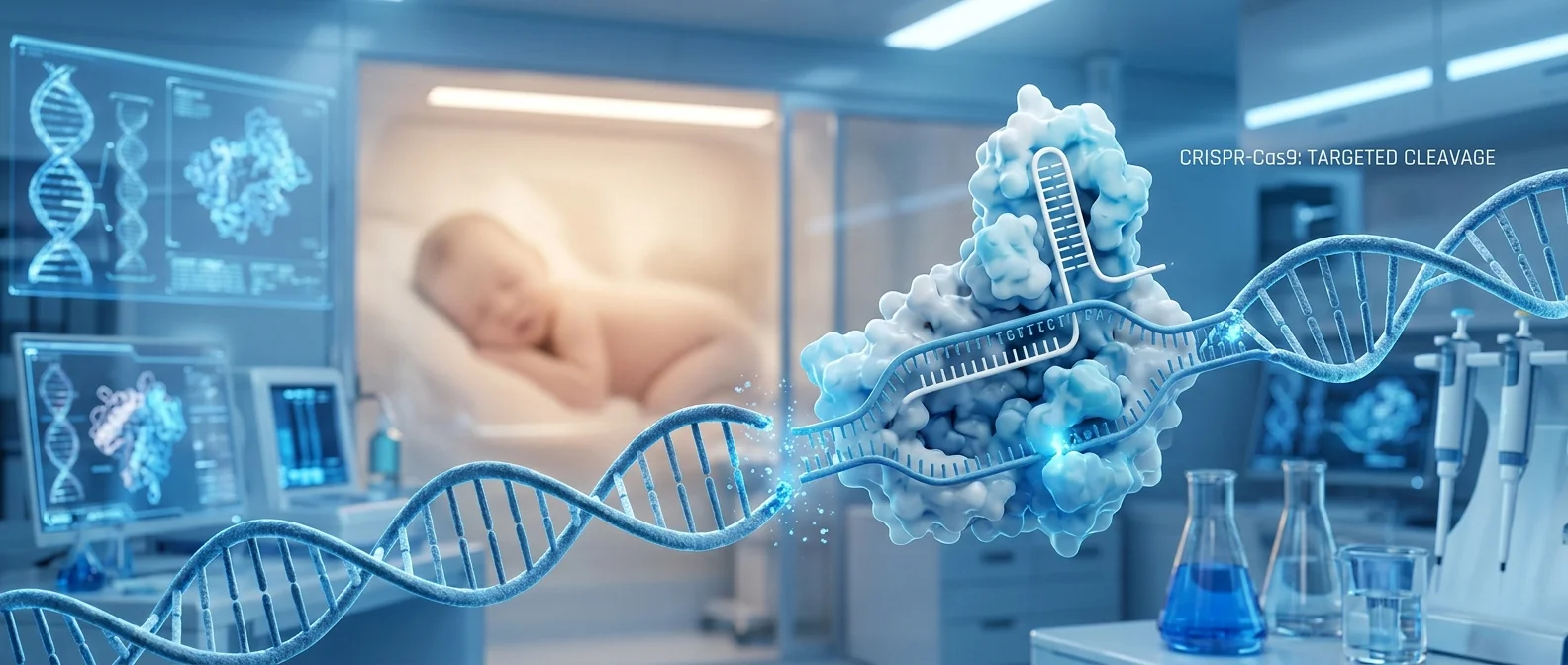
In November 2018, a Chinese researcher announced that twin girls — Lulu and Nana — were born with CRISPR-modified genes, sparking global outrage. Meanwhile, a completely different application of the same technology was treating sickle cell disease patients for the first time in history. CRISPR-Cas9 is simultaneously the most promising and most controversial discovery in modern genetics — a molecular “scissors” that can cut, correct, or rewrite the code of life itself.
📖 Read more: GM Mosquitoes: Saviors or Ecological Disaster?
What Is CRISPR: The Molecular Scissors
CRISPR (Clustered Regularly Interspaced Short Palindromic Repeats) is a natural immune system found in bacteria. When a virus infects a bacterium and it survives, it stores a piece of the viral DNA in its own genome — like a “police file.” If the same virus attacks again, the bacterium uses this file to guide the Cas9 protein, which cuts the invader's DNA at a specific location.
Jennifer Doudna (UC Berkeley) and Emmanuelle Charpentier (Max Planck Institute) realized this bacterial defense mechanism could be transformed into a powerful gene editing tool. In 2012, they published in Science that they had engineered a synthetic “guide RNA” that directs Cas9 to any point in the genome with precision down to a few nucleotides. The protein cuts both DNA strands, and then the cellular machinery repairs the break — either by simply gluing the ends together (NHEJ) or using a “template” provided by researchers (HDR). They were awarded the 2020 Nobel Prize in Chemistry.

The He Jiankui Case: The First “Designer” Babies
In November 2018, He Jiankui from Southern University of Science and Technology in Shenzhen announced he had genetically modified human IVF embryos, disabling the CCR5 gene — a receptor HIV uses to invade cells. The twin girls were born apparently healthy, but the scientific community's reaction was devastating.
Over 120 Chinese scientists signed an open letter of condemnation. He Jiankui was sentenced to 3 years in prison and fined 3 million yuan. The problem wasn't just ethical: the CCR5 modification was mosaic (didn't work in all cells), there was no real medical need (the father was HIV-positive, but safer prevention methods exist), and this change is inherited by future generations — a decision made without the consent of those who would be affected.
Disappearing Chromosomes: The Columbia Study
In a 2020 Cell study, Columbia scientists discovered that using CRISPR on human embryos can cause loss of entire chromosomes — a result far more serious than the expected small changes.
Dieter Egli and his team at Columbia University tested CRISPR on human embryos carrying a mutation in the EYS gene, responsible for inherited blindness. Instead of precise correction, they discovered a third, unexpected outcome: DNA cutting often led to loss of entire chromosomes or large segments.
"We learned that in human embryonic cells, a single DNA break can lead to loss of an entire chromosome, and this loss is very frequent," explained Michael Zuccaro, co-first author of the study. The team even reanalyzed results from a 2017 study that had reported “successful correction” of a cardiac mutation: they suggested that instead of correction, the chromosome with the mutation had simply been lost entirely. "If our results had been known two years earlier, I doubt anyone would have proceeded," Egli commented.
The First Approved Therapy: CASGEVY and Sickle Cell
In December 2023, the FDA approved CASGEVY (exagamglogene autotemcel) — the first CRISPR-based therapy — for sickle cell disease and beta-thalassemia. This is an ex vivo therapy: hematopoietic stem cells are removed from the patient, modified with CRISPR to produce fetal hemoglobin (HbF) instead of defective HbS, and reinfused into the body.
Sickle cell disease is caused by a single mutation in the HBB gene, which makes red blood cells deform into a sickle shape, causing chronic pain, anemia, and organ damage. About 100,000 Americans suffer from the disease. CASGEVY “awakens” a gene that naturally shuts off after birth, producing fetal hemoglobin that functionally replaces the defective version.

In Vivo CRISPR: Therapy Inside the Body
The next step is in vivo therapy — gene editing directly inside the body. According to a study published in the New England Journal of Medicine in February 2024, Intellia Therapeutics' NTLA-2002 therapy uses CRISPR/Cas9 to modify the KLKB1 gene directly in the liver of patients with hereditary angioedema — a rare genetic disorder (1 in 50,000) that causes dangerous swelling.
Hilary Longhurst from the University of Auckland, who led the research, reported that a single intravenous injection reduced plasma kallikrein levels by 95% and swelling attacks by 95%. Patients stopped their medications and will be monitored for 15 years. Unlike CASGEVY, here the editing happens inside the body — a significant step toward more accessible therapies without transplantation.
Base Editing and Prime Editing: The Next Generation
Classic CRISPR cuts both DNA strands, creating risk of unwanted changes. That's why newer, more precise techniques were developed. Base editing, invented by David Liu at the Broad Institute in 2016, changes a single DNA “letter” (e.g., C→T or A→G) without cutting the double helix — like changing one letter in a word instead of rewriting the entire page.
Prime editing (2019, also David Liu) goes even further: it can insert, delete, or replace small DNA sequences without double-strand breaks and without external DNA templates. It's believed to correct up to 89% of known pathogenic mutations. An even more recent development, epigenome editing, changes gene expression without even modifying the sequence — “turning on” or “off” genes without permanent changes to the code.
Designer Babies: Where Is the Red Line?
The key distinction is between somatic and germline editing. Somatic therapies like CASGEVY affect only the patient — they're not inherited. Germline editing, conversely, changes eggs, sperm, or embryos, affecting every future generation. Today, over 70 countries ban or strictly regulate germline editing of human embryos.
The Selmecki et al. 2019 study showed that even “embryo selection” based on polygenic traits (height, intelligence) can't reliably predict outcomes. A couple wanting the tallest child would statistically gain only 2.5 centimeters — while environmental effects dominate. Avoiding monogenic diseases (Huntington's, cystic fibrosis) through PGD is already established practice — but “enhancing” healthy embryos remains ethically and technically in the realm of science fiction.
To date, more than 50 CRISPR-based clinical trials are underway globally, targeting cancer, HIV, blindness, muscular dystrophy, beta-thalassemia, and dozens of rare genetic diseases.
The Future: Therapy or Design?
CRISPR technology is evolving rapidly. New systems like CasΦ (discovered in bacteriophages and 50% smaller), Cas12, and Cas13 (which targets RNA instead of DNA) are expanding capabilities. Lipid nanoparticle (LNP) technology, the same used in mRNA vaccines, now makes it possible to deliver CRISPR to specific organs without viral vectors.
The big question is no longer “can we?” but “should we?” Treating genetic diseases is ethically justified and medically revolutionary — no one disputes that eliminating sickle cell disease or cystic fibrosis would be a victory for humanity. “Enhancing” healthy humans — increased muscle mass, disease resistance, even cognitive enhancement — opens Pandora's box. As Egli said after his study: "Our hope is that these results will discourage premature clinical application, but will also guide responsible research toward safe and effective use."
Sources:
- Zuccaro, M.V. et al. «Allele-specific chromosome removal after Cas9 cleavage in human embryos.» Cell, 2020 — ScienceDaily, Columbia University Irving Medical Center
- Longhurst, H.J. et al. «CRISPR-Cas9 In Vivo Gene Editing of KLKB1 for Hereditary Angioedema.» New England Journal of Medicine, 2024 — ScienceDaily, University of Auckland