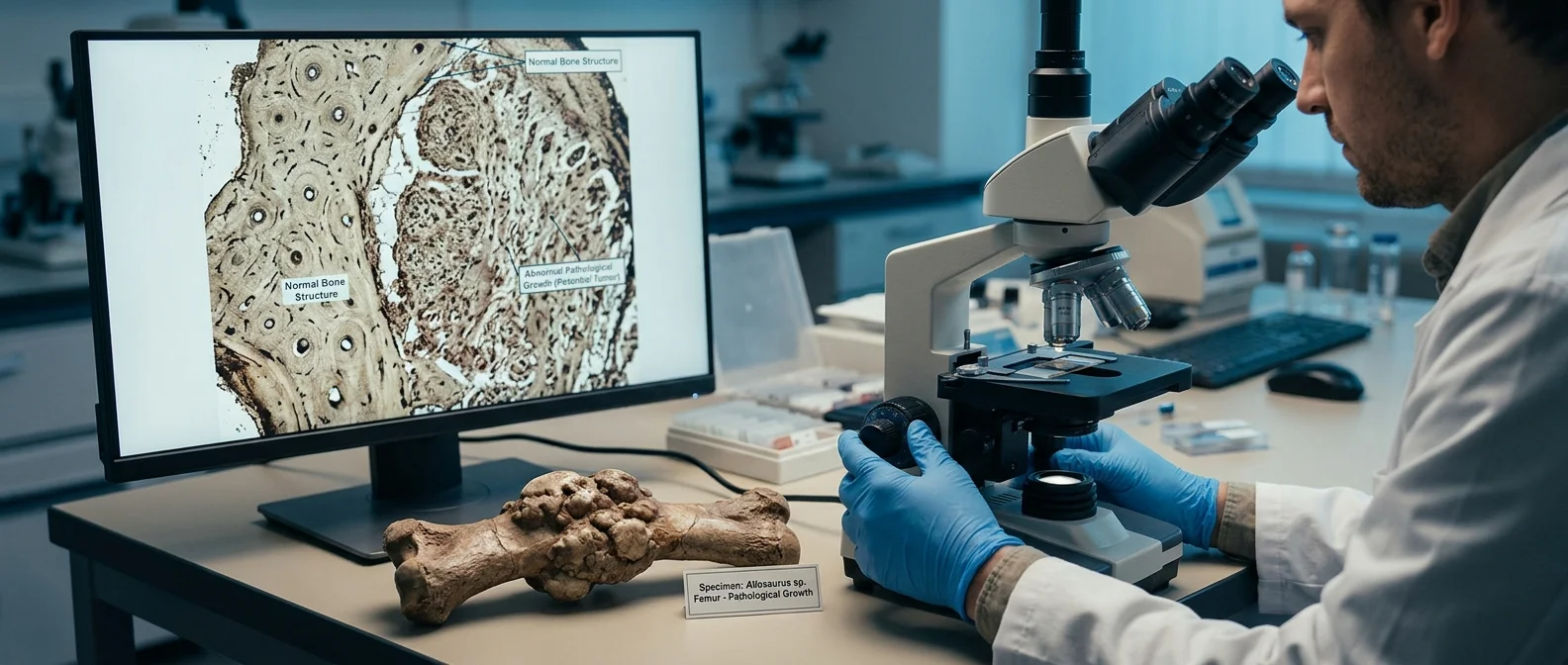
Cancer isn't a modern disease. It wasn't born from industrial pollution, processed foods, or contemporary lifestyles. Cancer has been here for hundreds of millions of years — and dinosaur bones are the proof. In 2020, a team of researchers did something unprecedented: they diagnosed osteosarcoma — the most aggressive bone cancer — in a 76-million-year-old dinosaur bone. This is a medical report from deep time.
📖 Read more: Feathered Dinosaurs: Discovery That Rewrites History
📋 Patient File #1: Centrosaurus — A Fibula That Screamed
The “patient” was a Centrosaurus (Centrosaurus apertus) — a ceratopsian dinosaur measuring 20 feet long and weighing about 1 ton, with a distinctive horn on its nose and spikes around its neck frill. It lived during the Late Cretaceous, 76-74 million years ago, in what is now Dinosaur Provincial Park in Alberta, Canada.
The critical finding was its fibula — a bone in the lower leg. It wasn't simply broken or deformed. It displayed a massive, irregular growth that paleontologists initially thought was the result of injury — a fracture that had healed poorly. But a team of researchers decided to look deeper.
🔬 The Diagnosis: CT Scan on 76-Million-Year-Old Bone
The research team — led by pathologist Mark Crowther from the Royal Ontario Museum and oncologist-orthopedists who normally treat human patients — subjected the fossilized bone to high-resolution CT scanning. They examined thin sections under microscopes. They compared the tumor structure with human osteosarcoma samples.
The diagnosis was unequivocal: osteosarcoma — a malignant tumor originating from osteoblastic cells, those that normally build new bone. Instead of creating healthy bone mass, these cells had escaped all regulatory mechanisms and multiplied uncontrollably, forming a chaotic mixture of abnormal bone and vascular tissue.
🦴 Patient File #2: Hadrosaurs with Tumors
The Centrosaurus isn't the only dinosaur “patient” on record. Several hadrosaurs (duck-billed dinosaurs) have been found with bone abnormalities suggesting benign or malignant tumors. Hadrosaurs — herbivorous dinosaurs from the Late Cretaceous Period — had sophisticated chewing systems with hundreds of teeth in dense “batteries” that formed grinding surfaces. They lived in large herds, which meant a sick or injured individual could survive under the protection of the group.
This explanation seems to fit the Centrosaurus as well: the tumor found was quite advanced, meaning the animal lived with cancer for a considerable time before dying. Something remarkable: a dinosaur with aggressive bone cancer managed to stay alive long enough for the disease to progress to an advanced stage. In human patients, untreated osteosarcoma progresses rapidly — but the Centrosaurus lived within a herd, protected by its companions.
Herd life offered a unique advantage: even if the sick Centrosaurus limped or couldn't run as fast, the presence of dozens or hundreds of companions around it protected it from predators. This explains how the cancer had time to evolve to such a serious stage. Without the herd, a lame ceratopsian wouldn't last long against the massive predators of the Cretaceous.
🧬 Why Does Cancer Exist? A 500-Million-Year Question
Cancer is defined as the uncontrolled growth of abnormal cells. It's essentially a failure in the cellular growth control mechanism — a “bug” in the software that determines when a cell should grow, stop, or die. These mechanisms exist in every multicellular organism — from sponges and corals to dinosaurs and humans.
This means cancer is as old as multicellular life. From the moment cells began cooperating in bodies — about 600 million years ago — the possibility of a cell “defecting” always existed. Every time a cell divides, there's a small chance of error in DNA replication. Most errors are corrected or lead to cell death. But rarely, a mutation “escapes” — and that's the beginning of a tumor. The findings in dinosaur bones don't just tell us that dinosaurs had cancer — they tell us that cancer is a fundamental characteristic of multicellular life.
⚕️ Ancient vs Modern Cancer
Cancer in Dinosaurs
- Osteosarcoma in Centrosaurus (76 million years)
- Benign tumors in hadrosaurs
- Zero environmental pollution
- Causes: cellular aging, random mutations
Cancer in Humans
- ~20 million new cases annually (2022)
- >100 different forms
- 30-50% potentially preventable
- Causes: aging + environmental factors
🩻 The Technology of Paleopathology
Paleopathology — the study of diseases in ancient specimens — has taken off thanks to modern technology. CT scanners reveal the microstructure of fossilized bones without destroying them. Microscopic thin sections show the arrangement of cellular structures. Even comparison with modern pathological samples is now done with digital image analysis.
What makes the Centrosaurus study special is that for the first time, a complete oncological diagnostic protocol was used on a dinosaur fossil — exactly the same protocol that would be applied to a human patient. Orthopedic surgeons, pathologists, and oncologists worked together with paleontologists — a novel interdisciplinary combination that bridged 76 million years of medical history.
🌍 What Sick Bones Teach Us
The discovery of cancer in dinosaurs isn't just a paleontological curiosity. It has practical significance for modern medicine. By understanding which forms of cancer appeared in organisms without any modern risk factors — without tobacco, without chemicals, without radiation — we can separate which cancer is “inherent” to multicellular life and which is due to environmental factors.
According to the World Health Organization, 30-50% of modern cancers could be prevented through prevention strategies — mainly avoiding known risk factors. But a percentage will always exist, regardless of how healthily we live — because cancer is an elementary characteristic of every organism with dividing cells. Dinosaurs remind us of this fundamental truth.
— Encyclopaedia Britannica, Cancer"Cancer is a group of more than 100 different diseases characterized by the uncontrolled growth of abnormal cells in the body. Although cancer has been known since antiquity, some of the most significant advances in understanding it occurred after the mid-20th century."
🔮 Epilogue: Cancer as Evolution's Legacy
The story of the Centrosaurus with osteosarcoma is both tragic and illuminating. Tragic, because it shows us that even creatures without any “modern” health risks faced the horror of a disease we know all too well. Illuminating, because the same knowledge helps us understand what is truly preventable and what is an unavoidable characteristic of our biology.
The fibula of a Centrosaurus, buried for 76 million years in the red earth of Alberta, gave us a unique lesson: the war between body and uncontrolled cells didn't start with us. It began the moment life decided to become multicellular. And that was half a billion years ago.