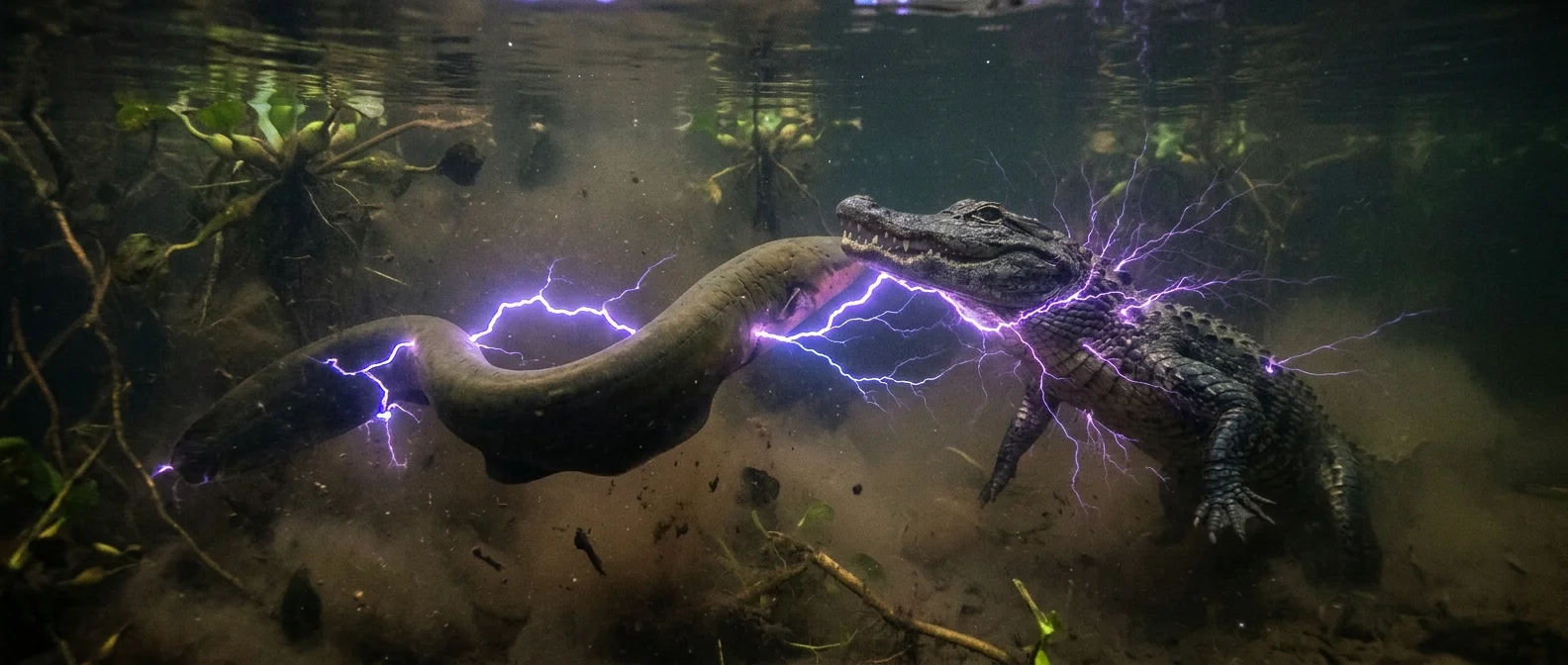
Picture yourself swimming in the murky waters of the Amazon when suddenly a 2.5-meter creature unleashes 860 volts of electricity into your body. The shock lasts just two milliseconds, but it's enough to knock you unconscious. This isn't a movie scenario — it's the daily reality of Electrophorus voltai, the most powerful bioelectric organism on the planet.
📖 Read more: New Giant Anaconda Species Found in Amazon After 200 Years
⚡ Three Species Hidden in One
For over 250 years, scientists believed only one species of electric eel existed. This assumption was completely overturned in September 2019, when researcher C. David de Santana from the Smithsonian Institution analyzed 107 specimens from Brazil, French Guiana, Guyana, and Suriname. Genetic analysis revealed three distinct species that evolved from a common ancestor millions of years ago.
The three species differ both genetically and morphologically. Each has a unique skull shape, different characteristics in the pectoral fin, and distinct pore arrangements on the body. The results were published in Nature Communications and sent shockwaves through the ichthyology community.
🔋 860 Volts: The Ultimate Biological Record
Electrophorus voltai, one of the two new species, shattered every previous bioelectric discharge record. With a maximum voltage of 860 volts, it exceeds the old record of E. electricus (650 volts) by 210 volts. This is the most powerful bioelectric generator ever recorded in nature.
E. voltai
860 volts — Brazilian Shield, clear highland waters. The undisputed king of bioelectricity.
E. electricus
650 volts — Guiana Shield, clear mountain waters. The only known species for 250 years.
E. varii
Murky lowland waters rich in metals — excellent conductivity, less need for high voltage.
Scientists believe the high voltage of E. voltai is an evolutionary adaptation. The highlands of the Brazilian Shield have waters with low conductivity, meaning electrical discharge loses power quickly. To compensate for this disadvantage, the eel evolved a much more powerful “battery.”

📖 Read more: Blue-Ringed Octopus: Tiny but Deadly Ocean Predator
🐺 Pack Hunting: The Discovery That Changed Everything
In August 2012, researcher Douglas Bastos traveled five days by boat to explore the Iriri River in Brazil's Pará state. In a small lake fed directly by the river, he discovered something unthinkable: more than 100 adult electric eels in one location. Electric eels were considered strictly solitary creatures — this sight was impossible, until that moment.
Field Observation
The team recorded 72 hours of continuous observation across two expeditions (2012 and 2014). During dawn and dusk, the eels began a hunting ritual lasting one hour and involving 5 to 7 coordinated electrical attacks.
Their strategy resembles military tactical planning. First, dozens of eels swim in a large circle, pushing thousands of small fish (tetras) into increasingly tight spheres. Then, groups of 2 to 10 eels break away from the main circle, surround the prey sphere, and unleash simultaneous electrical attacks. The small fish are launched from the water and fall back stunned and defenseless.
"If 10 eels discharge simultaneously, they could theoretically generate up to 8,600 volts of electricity — enough to power 100 light bulbs," explained de Santana. Group hunting is extremely rare in fish: only nine other fish species worldwide exhibit this behavior, making this discovery even more remarkable.

🗺️ Geography of Evolution: Three Worlds, Three Eels
The geographic distribution of the three species reveals an evolutionary story that unfolded over millions of years. 7.1 million years ago, a common ancestor split into two branches: highland eels and lowland eels. Later, 3.6 million years ago — around the time the Amazon changed course crossing mountainous regions — the two highland species separated from each other.
Guiana Shield
E. electricus — Ancient geological formation with clear waters, waterfalls, and rushing currents.
Brazilian Shield
E. voltai — Highlands with low-conductivity waters, leading to evolution of higher voltage.
Amazon Lowlands
E. varii — Murky, slow waters full of metals, natural electrical conductors.
📖 Read more: Bonobos Play Pretend: No Longer Just a Human Thing
💡 From Amazon to Your Home Outlet
The relationship between humans and electric eels isn't limited to curiosity. In 1799, Alessandro Volta was inspired by the electric eel to design the first battery in history — the voltaic pile. Today, as scientists study the unique electrogeneration mechanisms of each species, new possibilities emerge.
Scientific Significance
Because the three species separated millions of years ago, they likely evolved different enzymatic systems for electricity generation. The E. voltai system is completely unexplored — de Santana believes it could contain enzymes and compounds useful in medicine or new energy technologies.
Simultaneously, this discovery underscores how little we still know about Amazon biodiversity. "If you can discover a new 2.5-meter fish after 250 years of scientific exploration, imagine what remains to be discovered in this region," said de Santana. With the Amazon threatened by deforestation, fires, and climate change, the urgent need to catalog biodiversity becomes increasingly critical.
🔬 A Living Laboratory in Amazon Waters
Electric eels aren't true eels — they belong to the order Gymnotiformes, known as “knifefish.” They resemble eels externally, but evolutionarily they're closer to catfish and carp. Of the approximately 250 electric fish species in South America, only electric eels use their electricity for hunting and self-defense — the rest use it only for navigation and communication.
A particularly important trait of E. voltai is that it breathes air — perhaps its most critical adaptation. The waters it inhabits often have low dissolved oxygen levels, so the eels regularly surface. This habit makes them vulnerable to predators — but their electrical shield makes even alligators think twice.
The research team is preparing new expeditions to the Iriri River, with plans to place radio tags on individual eels and directly measure electrical discharges during group hunting. They also plan to transport 8-10 adult eels to a special facility in Germany — the first time adult E. voltai will be kept together in captivity.