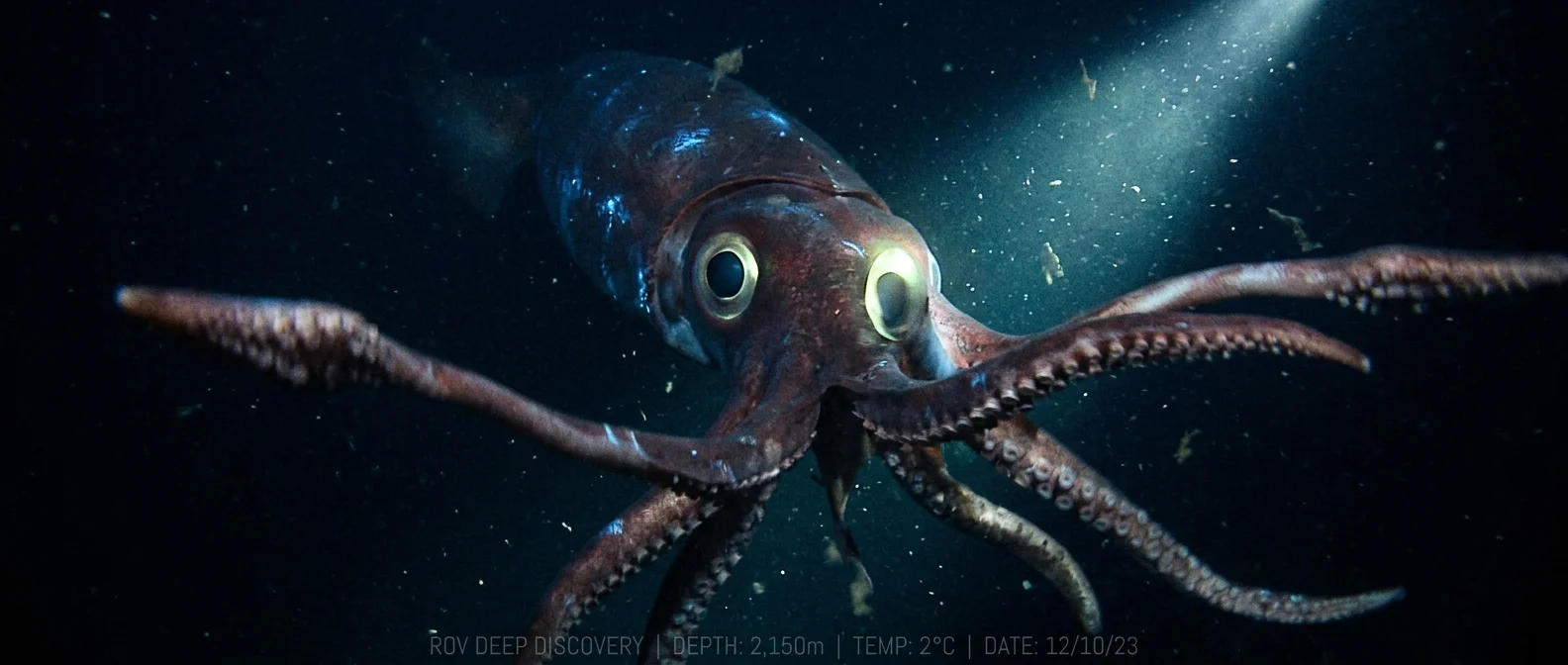
For centuries, sailors told tales of sea monsters with tentacles that could snatch entire ships. Science dismissed them as myths — until we proved the monsters were real. The colossal squid (Mesonychoteuthis hamiltoni) isn't folklore. It lives in the coldest, darkest depths of the Southern Ocean. And we've only just managed to see it alive.
📖 Read more: Ocean's Darth Vader: Giant Isopod Survives 5 Years Unfed
🎬 Scene 1 — First Appearance: 1925
The story begins with a sperm whale's stomach. In 1925, British biologist Guy Cooke Robson examined the partially digested contents of a hunted sperm whale and found tentacle fragments that matched no known species. Their teeth weren't suction cups — they were hooks. Rotating, razor-sharp, designed to grab and never let go. He named the new species Mesonychoteuthis hamiltoni — then it vanished back into darkness for decades.
What he'd discovered was a creature even larger than the giant squid (Architeuthis). While the giant squid can reach 18 meters (mostly due to long tentacles), the colossal has a larger and heavier body. It's estimated to reach 14 meters total length and 500+ kilograms. For comparison: the giant squid (Architeuthis), its “cousin,” shares the title of world's largest invertebrate. But while the giant is longer (mainly thanks to whip-like tentacles), the colossal is heavier and more massive — a titan built for power, not reach.
👁️ Scene 2 — The Eyes: Largest on Earth
Each eye of the colossal squid measures 27 centimeters in diameter — roughly the size of a dinner plate. They're the largest eyes of any animal that lives or ever lived. Its brain features two massive optic lobes dedicated exclusively to image processing. In depths below 1,000 meters, where not a trace of sunlight penetrates, these eyes detect bioluminescence — the faint lights emitted by other deep-sea organisms.
Why does it need such enormous eyes? The most likely explanation: to spot its main enemy — the sperm whale (Physeter macrocephalus). A diving sperm whale can trigger warning flashes of bioluminescence in surrounding creatures. The colossal squid's massive eyes provide reaction time — precious seconds to escape the predator. Consider this: at 1,500 meters depth, without a single photon from the sun, these eyes distinguish the difference between life and death. Evolution doesn't waste resources — if an eye needs to be dinner plate-sized, it means survival pressure in the depths is relentless.

The colossal squid's eyes — 27 cm diameter, largest in the animal kingdom — designed to detect bioluminescence in absolute darkness.
🪝 Scene 3 — The Weapons: Rotating Hooks and Suction Cups
The colossal squid has 8 arms (0.85-1.15 meters each) and 2 tentacles (~2.1 meters). But what sets it apart from every other cephalopod is the weaponry: the arms bear two rows of sharp hooks flanked by toothed suction cups. The tentacles — with clubs at the tips — feature 22-25 rotating hooks among microscopic suckers.
The key word: rotating. While hooks on other squids are fixed, the colossal's rotate around their axis — possibly increasing grip on slippery prey. No one knows yet if the animal actively controls this rotation. Its diet: likely large fish (mainly toothfish), other squids, and perhaps — in dark irony — members of its own species. The hunting method remains uncertain — it may ambush from the depths and strike, or hunt slowly, using tentacles as snares. It belongs to the Cranchiidae family — the “glass squids” — and taxonomically remains the only species in the genus Mesonychoteuthis.
📹 Scene 4 — The Video: The Moment We Saw the Invisible
For nearly 100 years since the 1925 discovery, no one had ever seen a living colossal squid in its natural environment. Everything we knew came from carcasses: in sperm whale stomachs, in fishing nets, on shorelines. In 2007, New Zealand fishermen caught a living 4.2-meter, 470-kilogram female in the Ross Sea — but it was at the surface, outside its habitat.
The first documented video footage in the depths — in its actual home — came nearly a century later. Deep-sea cameras finally captured what generations of marine biologists had imagined: a massive silhouette with tentacles moving slowly through absolute darkness, its rotating hooks faintly reflecting the lens. A few seconds. Enough to make history. The significance? Enormous. Until that moment, science studied an animal exclusively through dead specimens. We didn't know body posture, movement speed, how it used tentacles in action. Everything was guesswork. Now, for the first time, we could see how this creature moves in its real world.
🐋 Scene 5 — The Eternal Enemy: Sperm Whale vs. Colossal Squid
The sperm whale (Physeter macrocephalus) is the primary predator of adult colossal squid. The clash of these two giants in the depths — in absolute darkness, under crushing pressure — is considered one of nature's most dramatic confrontations. Sperm whales return to the surface with circular scars on their skin — imprints of suction cups and hooks from the battle.
Young colossal squid face other dangers: pilot whales, elephant seals, albatross, even large toothfish. No one knows how long a colossal squid lives — estimates range from 2 to 5 years, though this remains completely unclear. We only know that eggs are fertilized internally and deposited in a floating mass. The reproductive cycle, social structure, migration patterns — nothing is known. Unlike many other squids that rise at night to feed (vertical migration), there's no evidence the colossal does this. It lives and hunts permanently in the depths.

Sperm whale with battle scars — circular wounds from colossal squid suction cups and hooks.
🌍 Scene 6 — The World It Lives In: Southern Ocean, Antarctica
The colossal squid's geographic distribution is circumpolar: it lives mainly south of the Antarctic Convergence, though some individuals reach the cold waters near New Zealand. Depth: from 20 to 2,000 meters. Larvae live in shallower waters (20-500 meters), while juveniles and adults descend deeper (500-2,000 meters).
The IUCN classifies it as Least Concern — not because we know the population is healthy, but because its habitat isolation makes it relatively safe from human threats. It's also protected by the Antarctic Treaty. Only a few specimens exist globally in museums — the most famous at New Zealand's Te Papa Museum.
Somewhere beneath Antarctic ice, at depths the sun will never reach, a 14-meter creature with dinner plate-sized eyes and rotating hooks hunts in darkness. It doesn't need myths. The truth is terrifying enough. The colossal squid reminds us of something fundamental: our planet's depths still hide creatures we've never seen alive. The ocean — covering 70% of Earth — remains more uncharted than the surface of Mars. If we want to find alien life, perhaps we should first look down.