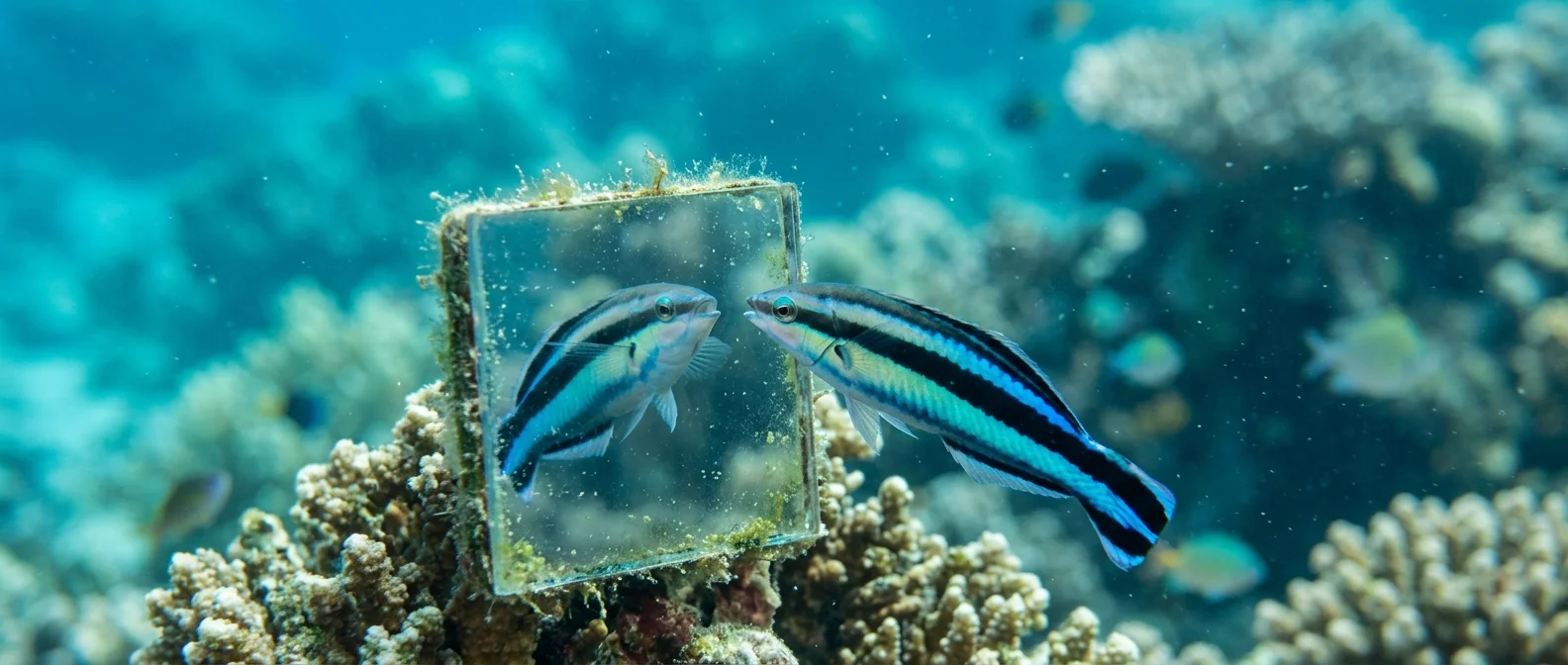
In February 2019, a paper in PLOS Biology sent shockwaves through neuroscience. Japanese ethologist Masanori Kohda announced that a tiny tropical fish — the cleaner wrasse (Labroides dimidiatus), just 4 inches long — had passed the mirror test, the gold standard for measuring self-recognition that until then only great apes, dolphins, elephants, and magpies had achieved. A creature without a neocortex, without a complex brain, appeared to recognize its own reflection. The scientific community split — and the debate over animal consciousness would never be the same. The paper has garnered over 1,200 academic citations in five years — among the most discussed publications in comparative psychology. The research opened the door for similar experiments on octopuses, crows, and parrots — expanding self-awareness research across the entire animal kingdom.
The Mirror Test: Measuring Self-Awareness
The mirror test (Mirror Self-Recognition, MSR) was invented by Gordon Gallup Jr. in 1970 (Science). The logic is simple: if an animal can recognize that the reflection in the mirror is itself (not another individual), then it possesses some form of self-awareness. The protocol involves three stages: first, habituation to the mirror (social reaction toward the “stranger”), then transitional behavior (exploration, moving back and forth), and finally the critical “mark test” — an invisible-to-the-animal mark is placed on a spot visible only through the mirror. If the animal directs movements toward the mark while looking at the mirror, it's considered to have “passed.” Gallup's chimpanzees were the first non-human organisms to pass — touching the red mark on their foreheads with their fingers.

A Fish Changes Everything
Masanori Kohda (Osaka City University) worked with Labroides dimidiatus, known as the “cleaner” — a species that lives on coral reefs and removes parasites from larger client fish. This exceptional ecological specialization requires extraordinary social intelligence: individual recognition, memory of interactions, and strategic behavior that demands theory of mind (they sometimes “cheat” clients by eating mucus instead of parasites — but only on clients that can't retaliate, while behaving impeccably with larger clients that can punish them with aggressive pursuit). Kohda placed mirrors in aquaria with 10 individuals. Initially, the fish attacked their reflections — typical social reaction. Within 5-7 days, aggression disappeared and was replaced by unusual behaviors: head movements up and down, lateral turns, swimming upside down in front of the mirror — as if testing that the reflection followed their movements precisely. This phase of “contingency testing” had been observed before only in apes and dolphins — never in fish. This observation was the first indication that the fish no longer treated the reflection as a rival, but as something related to themselves.
The Experiment Step-by-Step
After habituation, Kohda applied the mark test. A small brown mark was placed under the chin — a spot invisible without a mirror but visible in the reflection. The results were striking: the marked fish, upon looking at the mirror, began scraping their chins against the substrate — attempting to remove the mark. This behavior didn't occur in: a) unmarked fish in front of mirrors, b) marked fish without mirrors, c) fish with transparent marks (same sensation, but invisible). In 2023, Kohda went further: fish that saw photographs of themselves with marks tried to remove them — but ignored photos of other fish with marks, proving they specifically recognize themselves.
Reactions and Skepticism
The publication sparked controversy. Frans de Waal (Emory University) supported the findings, proposing that self-recognition isn't binary (yes/no) but a spectrum — with gradations from basic bodily awareness to full self-consciousness. Gordon Gallup, however, questioned: scraping could be an irritation response, not self-recognition. Others claimed fish react to the mark's color (brown = parasite = must be removed). Kohda responded that fish did NOT scrape without mirrors — visual confirmation was necessary. The debate reflects a deeper problem: we define consciousness with anthropocentric criteria — perhaps fish have a form of self-awareness completely different from ours, but equally functional in their ecological context. Convergent evolution may have produced similar cognitive abilities in very different brains — from teleosts to primates.

The Self-Recognition Elite
Before Kohda's fish, the list was small and exclusive. Chimpanzees (Gallup, 1970) — the first to pass. Orangutans (1981) — passed, but gorillas often fail (possibly because they avoid eye contact). Bottlenose dolphins (Reiss & Marino, PNAS, 2001) — used mirrors for self-examination. Asian elephants (Plotnik et al., 2006) — Happy at the Bronx Zoo recognized a mark on her forehead by looking in the mirror and repeatedly trying to remove it with her trunk. Magpies (Pica pica, Prior et al., 2008) — the first non-mammal. Each new species on the list revises the boundaries of intelligence. A fish, with a brain smaller than a pea (just 0.08 grams), overturns everything — suggesting self-recognition doesn't require a neocortex, but possibly more ancient subcortical networks present in all vertebrates.
What Does This Mean for Consciousness?
The philosophical implications are enormous. The prevailing theory (Cambridge Declaration on Consciousness, 2012) recognizes that many animals possess neurological substrates of consciousness. But what exactly does the fish “know”? De Waal proposes three levels: bodily self-awareness (I know where I end and the world begins), social self-awareness (I know my position in the group), and metacognitive self-awareness (I think about thinking). Fish are likely still at the first level — but even that overturns decades of assumptions that only mammals and birds can reach there. The evolutionary interpretation means self-awareness appeared much earlier in evolution — perhaps 400-500 million years ago, in the common ancestor of fish and mammals. This means the basis of self-knowledge may be a fundamental property of vertebrates, not a privilege of a few evolved species. Consciousness, like vision or hearing, may have evolved multiple times independently.
Why a Cleaner Fish?
It's no coincidence that this particular species passed the test. Labroides dimidiatus are social “geniuses” of the reef: they maintain cleaning stations where dozens of client species wait in line. They must remember who they've cleaned, how recently, and which client to prioritize (those who can leave elsewhere are prioritized). This social pressure led to development of a complex telencephalon — homologous to the cortex in mammals. The “social brain hypothesis” (Dunbar hypothesis) predicts that social complexity drives cognitive abilities — and cleaner fish have perhaps the most complex social relationships among all fish on the planet — with over 2,300 clients daily at each station.
Future Research
Kohda's team is planning experiments with fMRI on living fish — a technically challenging but feasible endeavor. Optogenetics — activating neurons with light — could reveal exactly which brain regions activate during self-recognition. The implications extend beyond basic research: if fish have self-awareness, fishing and aquaculture practices need revision from an animal welfare perspective — the European Food Safety Authority (EFSA) already recognizes that fish feel pain (2009). In Greece, with over 400 fish species in the Aegean and Mediterranean, cognitive fish ethology is in early stages but developing — researchers at the Hellenic Centre for Marine Research (HCMR) study behavioral ecology and cognitive ethology of Mediterranean species. The cleaner fish story reminds us that intelligence doesn't need a large brain — but the right evolutionary pressures and appropriate social complexity.
Sources:
- Kohda, M., Hotta, T., Takeyama, T., et al. (2019). "If a fish can pass the mark test, what are the implications for consciousness and self-awareness testing in animals?" PLOS Biology, 17(2), e3000021.
- Gallup, G.G. Jr. (1970). “Chimpanzees: Self-recognition.” Science, 167(3914), 86-87.