Picture walking into a supermarket in 2050. No steaks on the shelves — just cricket burgers, spirulina packets, and meat grown in bioreactors without a single animal dying. Sound like science fiction? It's not. The planet will host 10 billion people, and today's agriculture can't feed them without destroying what's left. The solution isn't one technology — it's a combination of breakthroughs already being tested today. Best part: they don't need a new planet, just a new way of thinking.
📖 Read more: Electric Eel: 860 Volts That Kill Alligators
📖 Read more: Insect Apocalypse: Is the Food Chain About to Collapse?
The Problem: 10 Billion Mouths to Feed
Today's agriculture devours 50% of habitable land, guzzles 70% of freshwater, and pumps out 26% of global greenhouse gases. Livestock alone produces more CO₂ than all transportation combined. The FAO predicts food demand will spike 60% by 2050 — but arable land shrinks yearly from desertification, salinization, and urban sprawl. Every minute, 23 hectares of fertile soil vanish to erosion. Meanwhile, 800 million people already starve today. This mathematical dead end demands radical new solutions — and science has six of them ready. The Poore & Nemecek study (2018) in Science, the largest meta-analysis of food's environmental impact, proved even the "greenest" beef emits multiples more CO₂ than plant foods.
Algae: Ocean Superfood Revolution
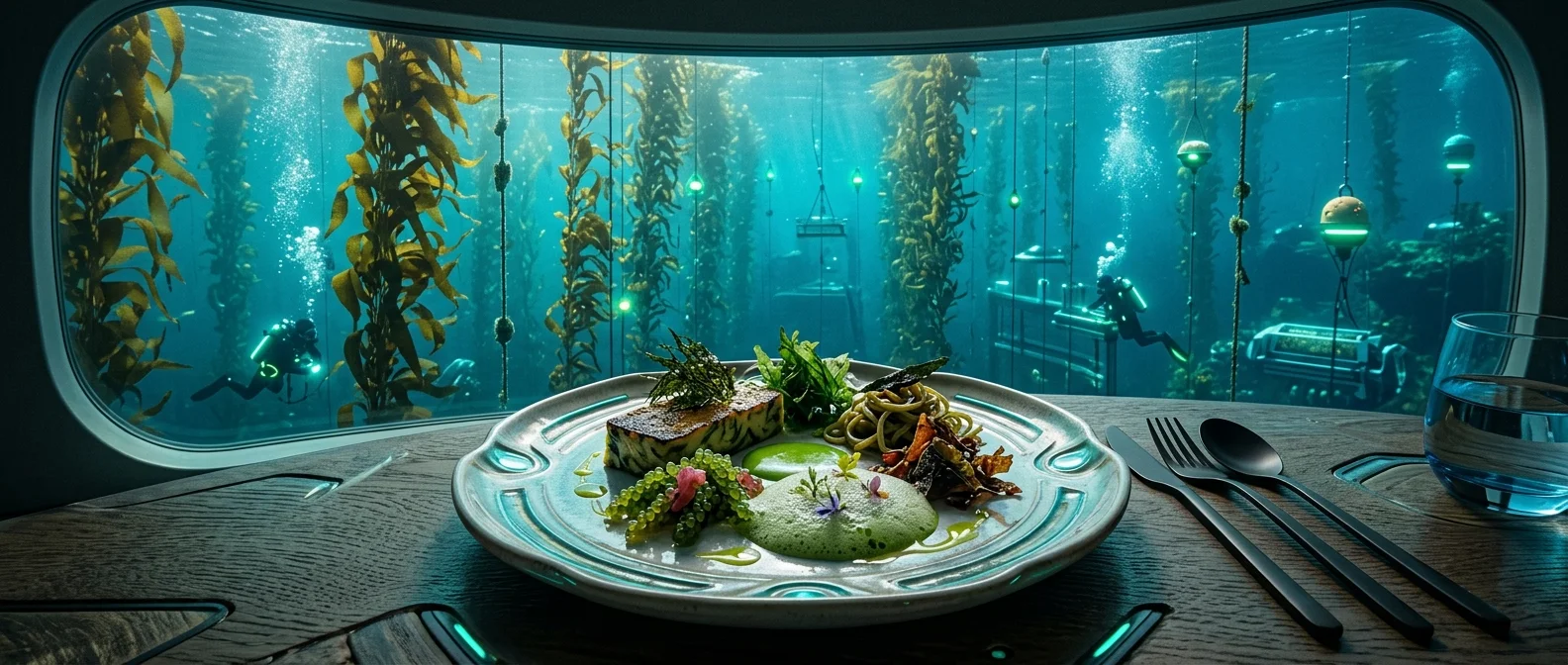
Asia has farmed algae for millennia, but the West is just catching on. Spirulina (Arthrospira platensis) packs 60-70% protein — triple that of meat — plus iron, B12, and antioxidants. Chlorella (Chlorella vulgaris) actually captures CO₂ while growing, making cultivation carbon-negative. NASA studies spirulina as Mars mission food — it grows fast, needs little space, and recycles carbon dioxide. In oceans, giant brown algae like Saccharina latissima (kelp) need zero freshwater, fertilizer, or farmland. One hectare of sea kelp produces up to 30 tons of biomass yearly — five times more than wheat. Indonesia already leads global algae production with 12 million tons annually. In Europe, Norway pioneers kelp farms in fjords while Ireland taps its long tradition of harvesting dillisk and carrageen.

Insects: 2 Billion People Already Eat Them
Over 2 billion people already eat insects — crickets, mealworms, locusts — and it's not some extreme habit. It's normal across much of Africa, Asia, and Latin America. House crickets (Acheta domesticus) contain 65% protein, need 12 times less water than beef, and produce 100 times fewer greenhouse gases per protein gram. The European Food Safety Authority (EFSA) approved mealworms (Tenebrio molitor) as safe food in 2021. The insect market should hit $8 billion by 2030. The biggest barrier isn't nutrition — it's psychology: the "disgust factor" Western consumers feel. But companies like Ÿnsect in France and Protix in the Netherlands already convert crickets into flour, protein bars, and animal feed — avoiding the visual shock of whole insects.
📖 Read more: Caterpillars That Hear Without Ears: How Do They Do It?
📖 Read more: World Without Bees: The Collapse That Changes Everything
Lab-Grown Meat: No Animal, No Slaughter
In 2013, Mark Post unveiled the first cellular agriculture burger — it cost $250,000. Today, companies like Upside Foods and Eat Just produce lab-grown meat under $10 per patty. The technology uses animal stem cells that multiply in bioreactors with nutrient media. No animal required, no slaughter, 92% fewer emissions, and 95% less land use. Singapore became the first country to approve lab-grown meat in 2020 — hundreds of thousands of citizens tried it without negative reactions. But mass production depends on cutting nutrient media costs — currently 50-80% of production expenses. Estimates show prices will reach competitive levels with conventional chicken by 2030. Israel leads as a global cellular agriculture hub with over 15 startups, while Aleph Farms already demonstrated 3D-printed ribeye steaks. The big challenge remains structure: a burger patty is easy, but a steak with fat and muscle fibers needs scaffolding that isn't perfected yet.
Vertical Farming: Skyscraper Agriculture
Vertical farming grows plants in controlled indoor environments, on stacked shelves with LED lighting and hydroponics or aeroponics. A 1,000-square-meter vertical farm can produce as much as 10,000 square meters of traditional fields. It uses 95% less water, zero pesticides, and zero transport costs — since it sits inside the city. AeroFarms in New Jersey operates one of the largest facilities, while Emirates Flight Catering in Dubai uses vertical farms for airplane salads. The downside? Energy consumption — especially if electricity doesn't come from renewables. Still, vertical farming produces crops 365 days yearly, eliminating seasonal limits. In Japan, Spread Co. runs a fully automated lettuce facility with robots — zero workers in the production area.

📖 Read more: Mantis: 0.025 Seconds Is Enough to Grab You
📖 Read more: 18,000 Dinosaur Tracks on Bolivia's Vertical Rock Wall
Precision Fermentation: Proteins from Air
Precision fermentation uses microorganisms — fungi, bacteria, yeasts — to produce proteins, fats, and flavors without any animal or plant. Finland's Solar Foods makes Solein protein using only CO₂, water, electricity, and bacteria — literally "food from air." Perfect Day creates whey protein without cows — already used in US ice cream. Within a decade, precision fermentation should replace much of the dairy industry. This technology isn't new — insulin has been made this way for 40 years. Now it's just applied to food. The potential is massive: the sector should reach $36 billion by 2030. Precision fermentation can produce any molecule — from casein to collagen — without animal exploitation.
Greece and Mediterranean: Opportunity or Threat?
Greece sits at a crossroads. The Mediterranean diet — olive oil, legumes, vegetables — is already considered a sustainability model. But climate change threatens traditional crops: olives migrate north, droughts intensify, sea levels threaten farmland. Meanwhile, Greece has huge potential in marine algae — an industry virtually nonexistent today. NCSR researchers already study kelp cultivation in the Aegean, while the Agricultural University of Athens researches edible macroalgae from Crete. Greek insect farming takes first steps too, with Thessaloniki startups producing cricket flour. The transition doesn't mean abandoning tradition — it means evolving within it.
Cultural Shock: Will Our Relationship with Food Change?
Technology can solve production problems — but culture resists. In France, the term "lab meat" was legally banned for animal-free products. In Italy, the government tries to block cultured meat to protect livestock farmers. Consumer surveys show 60% of Europeans would try lab-grown meat if cheaper, but only 20% would fully replace conventional meat. Insects face even greater Western resistance, despite their nutritional superiority. Change will come gradually — first through processed products (cricket flour in bars, spirulina in smoothies) and then, perhaps, as habit. History shows many foods now considered "normal" — sushi, avocado, quinoa — were strange a generation ago. Truth is, the planet doesn't ask for perfect solutions — it asks for fast ones.
"We don't need a new planet — we need a new way to feed ourselves on this one."
— Hans-Otto Pörtner, IPCC Working Group II, 2022Sources:
- Poore, J. & Nemecek, T. — "Reducing food's environmental impacts through producers and consumers", Science, 2018
- Van Huis, A. et al. — "Edible insects: future prospects for food and feed security", FAO Forestry Paper, 2013