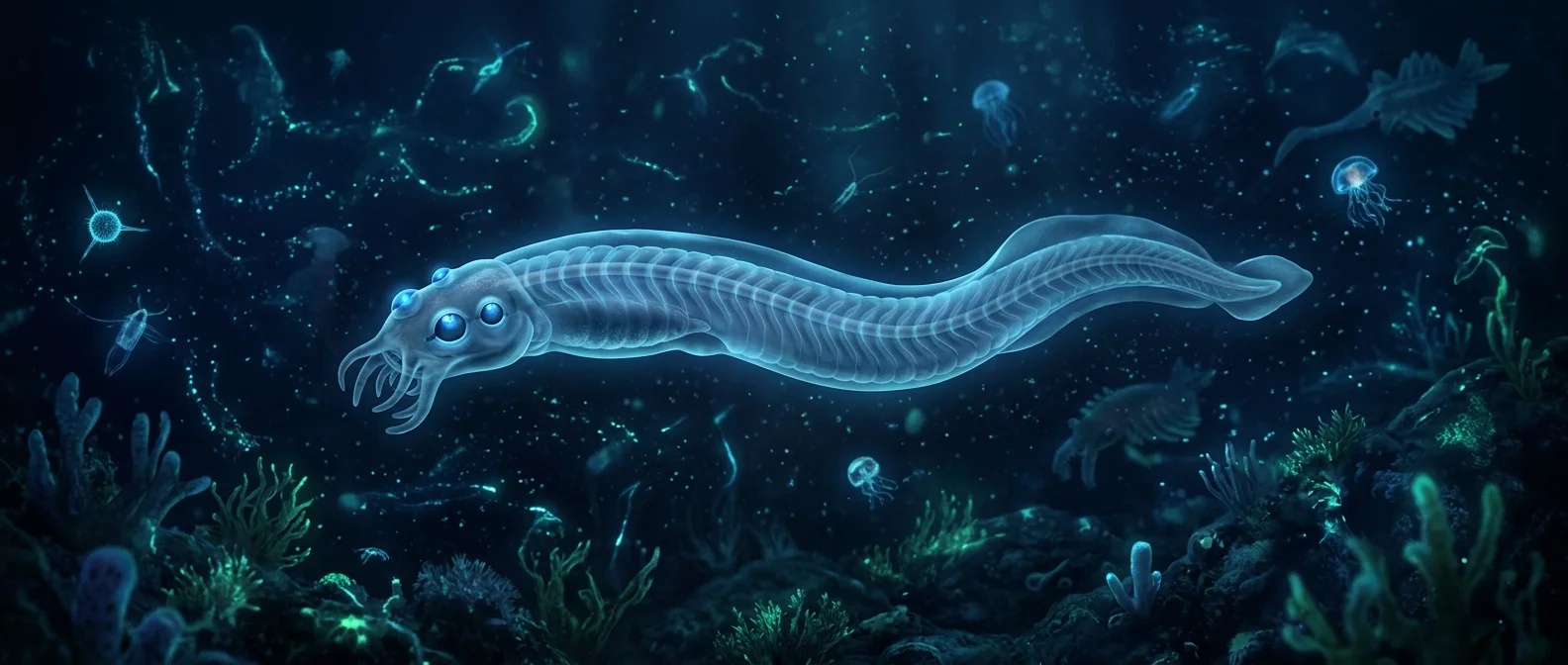
Close your eyes. Now imagine opening two more — right on top of your head. One watches the sky. The other measures how much light falls. It sounds like science fiction, but tens of millions of years ago, some of our ancestors had exactly this ability — four eyes. And the most unsettling part? We still hide the remnants of those eyes inside our brains.
📖 Read more: Galápagos Tortoises Return Home After 175 Years
The Discovery That Made Scientists Rethink Everything
In 2018, paleontologist Krister Smith and his team examined a 49-million-year-old fossil — an ancient lizard named Saniwa ensidens — using high-resolution CT scanning. What they found exceeded every expectation: on top of the skull were two distinct holes, each designed for a different “eye.” Not two, not three — four eyes total.
Until that moment, scientists believed that the two exotic “eyes” on top of certain reptiles' heads — the pineal and parapineal organs — were essentially the same thing, just positioned differently depending on the species. Saniwa proved otherwise: they were two completely separate structures, functioning simultaneously. Our ancestor didn't have a “third eye.” It had a third AND fourth.
What Exactly Was Discovered?
In the Saniwa ensidens fossil (Eocene, ~49 million years ago), CT scanning revealed two distinct holes in the skull — one for the pineal organ and one for the parapineal. This means the animal had four functional "eyes": two normal lateral ones + two on top of its head.
What Is the “Third Eye”?
To understand the fourth eye, we first need to explain the third. Many modern reptiles possess an organ on top of their heads that looks remarkably like an eye — the parietal eye. This isn't a myth. It's not a metaphor. It's a real biological structure with a rudimentary lens.
The most impressive example is found in an animal that looks like a lizard but isn't exactly a lizard: the tuatara (Sphenodon punctatus) of New Zealand. This reptile — the sole survivor of an ancient order (Rhynchocephalia) that first appeared in the fossil record during the Middle Triassic Period — has a parietal eye on top of its head with a rudimentary lens. While it can't “see” in the traditional sense, this eye functions as a light sensor that regulates the animal's hormones.
The Tuatara: Living Fossil with a Third Eye
The tuatara is one of the most peculiar creatures on Earth. It lives exclusively on about 30 small islands around New Zealand's North Island and a few islands in Cook Strait. It looks like a lizard — about 20 inches long, weighing 1-2 pounds — but belongs to an entirely different order of reptiles.
The Rhynchocephalia lineage it belongs to split from lizards and snakes 250 million years ago. This means the tuatara is more “ancient” than dinosaurs. Among its unique characteristics — active at low temperatures (down to 55-57°F), reproduction every 4 years, longevity over 60 years — the most impressive is that little “eye” on top.
The Tuatara's Parietal Eye
The tuatara's parietal eye doesn't see objects. It functions like an external light sensor that “tells” the organism how many hours the day lasts. This information activates or deactivates hormonal processes — reproduction, metabolism, sleep. Think of it as a biological light meter, positioned at the most strategic spot: where nothing can shade the sky.
From Eye to Gland: Evolution of the Pineal
Here's where the story becomes truly fascinating. This “third eye” never disappeared. In every vertebrate animal on the planet — from fish to humans — there's a remnant of this structure. In humans it's called the pineal gland, because of its pinecone-like shape.
The pineal gland sits in the center of the brain, behind the third ventricle, on the midline between the two hemispheres. In adult humans it's just 0.3 inches long and weighs about 0.004 ounces — a piece so small that René Descartes in the 17th century called it “the seat of the soul,” believing its uniqueness (it doesn't exist in pairs, unlike most brain organs) meant something deeper.
What the Pineal Does Today
The pineal produces melatonin — a hormone that plays a central role in regulating circadian rhythm, the 24-hour cycle of biological activities. Melatonin was first isolated in 1958 by Aaron B. Lerner at Yale University, who named the substance based on its ability to lighten frog skin color.
Melatonin production is controlled by light: the retina detects light/darkness → sends signal to the suprachiasmatic nucleus of the hypothalamus → this activates or inhibits the pineal gland. At night, melatonin increases → body temperature drops → breathing rate decreases → you get sleepy. During the day, light suppresses melatonin → you wake up.
The Evolutionary Line
Ancient vertebrates → 4 eyes (2 lateral + pineal + parapineal) → Saniwa ensidens (49 million years ago) → 4 eyes proven → Tuatara → 3 eyes (1 parietal, 2 lateral) → Lizards/Snakes → 2 eyes + rudimentary parietal → Mammals/Humans → 2 eyes + pineal (internalized)
In Some Vertebrates, the Cells Are Still Photosensitive
The pineal hasn't completely lost its relationship with light. In lower vertebrates — fish, amphibians, reptiles — the pineal gland retains an “eye-like” structure that responds directly to light. In some species, the gland's cells are photosensitive — they can “see” light without the retina's mediation. In mammals, however, the gland sank deep into the brain and lost this ability. It now needs the regular eyes as “intermediaries.”
This gradual transformation — from external eye to internal gland — is one of the most impressive examples of evolutionary metamorphosis. Nothing was lost. It simply “went inside.” Your body still knows when it's night — it just uses an eye you didn't know you had.
Melatonin: The Hormone of Darkness
Melatonin doesn't just regulate sleep. In birds, rodents, and seasonally breeding mammals, pineal removal (pinealectomy) seriously disrupts reproduction. In these species, melatonin controls gonadotropin secretion — hormones that act on ovaries or testes. This means the same mechanism that tells the tuatara “now is breeding time” tells modern mammals “now is mating season.” The language is chemical — the hormone melatonin — and comes from the same gland.
"In some lower vertebrates, the gland has a well-developed eye-like structure. In others, though not organized as an eye, it functions as a photoreceptor." — Britannica, Pineal Gland
Why This Matters to Us
The discovery of the fourth eye isn't just a paleontological curiosity. It changes how we understand our own biology. Every time you feel drowsy as darkness falls, every time your sleep is disrupted by phone light, every time seasonal changes affect your mood — that's the pineal. The internalized third eye of a creature that lived hundreds of millions of years ago.
Melatonin also functions as an antioxidant, neutralizing harmful oxidative radicals, and plays a role in immune system regulation. Its production gradually decreases with age — and this decline is linked to several age-related diseases. Researchers are studying melatonin as a potential anti-aging therapy.
The Four-Eyed Key to Understanding
Ultimately, the story of the fourth eye is a story about connection. From a primitive vertebrate with four eyes, evolution didn't “remove” the extra two — it transformed them. One became our sleep regulator. The other disappeared at some point, but in some creatures — like the tuatara, living on dozens of New Zealand islands, active mainly at night, capable of living over 60 years — it remains there, on top of the head, watching the sky.
Next time you see a lizard in the sun, look carefully at the top of its head. That tiny, almost invisible spot? It might be what remains of a fourth eye — an eye that once watched the Eocene sky, and now hides inside your own brain, silently counting the hours of darkness.