Imagine a tiny frog deep in a tropical rainforest that, instead of laying eggs in a pond, brings live tadpoles into the world — something no other amphibian on Earth does. Or picture hundreds of frog species that completely bypass the tadpole stage, with microscopic froglets popping directly from eggs. Frog reproduction doesn't follow a single path — and evolution has written scenarios that surpass any imagination.
The Rule That Isn't a Rule
When we think of frogs, the image is always the same: eggs in water, tadpoles with tails, metamorphosis, adult frog. This “classic” life cycle has existed for over 220 million years and continues to characterize thousands of species. But a major study of 720 frog species, published in the journal Evolution, revealed something remarkable: roughly half of all frog species globally don't follow this typical life cycle. Professor John J. Wiens of Stony Brook University and his team analyzed phylogenetic data showing an astonishing variety of reproductive strategies — from foam eggs to eggs on the female's back or throat, and hundreds of species without a tadpole stage.
This diversity isn't an exotic fringe — it represents nearly half the world of frogs. The rule we learned in school turns out to be simply the most common version of a much larger story.

The Frog That Births Living Tadpoles
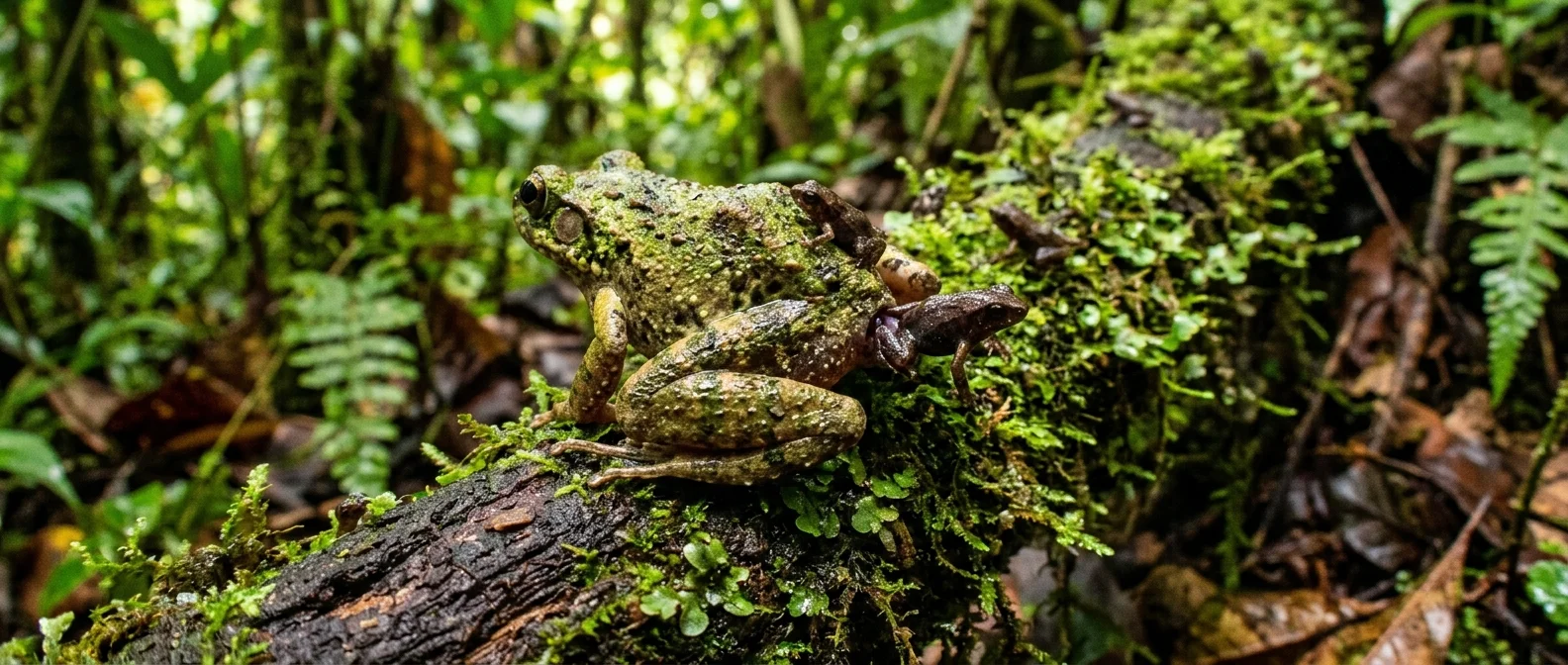
In summer 2014, herpetologist Jim McGuire from UC Berkeley was walking through the tropical rainforest of Indonesia's Sulawesi island when he caught what he thought was a male frog. Instead, he found himself holding a female along with dozens of fresh tadpoles slipping between his fingers. It was the first recorded instance of live tadpole birth in frogs. The new species was named Limnonectes larvaepartus and described in PLOS ONE. It's the only frog in the world that gives birth to living tadpoles — not eggs, not tiny froglets, but actual tadpoles, directly from the mother's body.
It belongs to the group of “fanged frogs” — species with characteristic bony projections on the lower jaw used in combat. L. larvaepartus weighs just 5-6 grams and prefers to give birth in small pools away from streams, likely to avoid the larger frogs that dominate there.
Internal Fertilization: The Great Exception
The vast majority of frogs — over 6,000 species — use external fertilization. The male embraces the female in a position called amplexus and releases sperm as she lays eggs. Only 10-12 species worldwide have developed internal fertilization — and L. larvaepartus is the only one among them that births tadpoles instead of froglets or fertilized eggs.
How Rare Is It?
Of the over 6,000 frog species, only 10-12 have internal fertilization. And only one — L. larvaepartus — gives birth to living tadpoles. The others birth tiny froglets or deposit fertilized eggs under rocks, like California's tailed frogs, which have developed a penis-like organ for sperm transfer.
Direct Development: No Tadpole, No Problem
Even more remarkable: hundreds of frog species completely bypass the tadpole phase. This reproductive mode is called “direct development” — from the egg emerges directly a microscopic froglet, identical to the adult. The study by Wiens, Gomez-Mestra (Doñana Biological Station, Seville) and Pyron (George Washington University) showed this transition occurred multiple times independently in frog evolution.
The most striking finding? For decades scientists believed direct development evolved gradually — first eggs moved out of water, then intermediate stages appeared, and finally the tadpole was lost. Phylogenetic analysis revealed that in many cases, species with aquatic eggs and tadpoles transitioned directly to direct development, without the supposed intermediate steps. Evolution didn't follow the linear path we expected.
The Strangest Reproductive Tricks
The variety doesn't stop at direct development. Some frogs carry eggs in pouches on their backs, while others hatch tadpoles inside their vocal sacs or mouths. The Surinam toad (Pipa pipa) embeds fertilized eggs into the skin of its back, where they develop in specialized chambers. And there were the gastric-brooding frogs (Rheobatrachus) of Australia, two species that swallowed their fertilized eggs, hatched them in their stomachs, and gave birth to froglets through their mouths. Unfortunately, both species are extinct.
In West Africa, Nimbaphrynoides occidentalis is the only truly viviparous frog — it births fully formed froglets without any intermediate egg or tadpole stage, nourishing them inside its body through specialized secretions.

Sulawesi: Laboratory of Evolution
Sulawesi isn't just any island. It formed 8-10 million years ago from the merger of several smaller islands, creating a geographic mosaic that favored explosive evolution of new species. The fanged frogs may have evolved into up to 25 different species on the island, though only four have been formally described — including L. larvaepartus.
In many locations, five or more fanged frog species coexist in the same habitat — a phenomenon McGuire characterizes as adaptive radiation. Each species occupies a distinct ecological niche, a unique example of evolutionary differentiation not easily found elsewhere in the world. Sizes range from 2-3 grams to 900 grams — a 300-fold range between the smallest and largest species.
Why Did the Tadpole Survive 220 Million Years?
If so many species could “dump” the tadpole, why did half keep it? The answer lies in the advantages. The 720-species study revealed that species with aquatic eggs and tadpoles can produce far more offspring per reproductive cycle. A female laying eggs in water can release hundreds or thousands of eggs simultaneously, while a direct-developing species produces far fewer.
Additionally, the classic life cycle appears to enable colonization of colder and drier climates. It's no coincidence that temperate zones are dominated by frogs with typical cycles, while direct development is more common in the tropics. Nature, therefore, didn't “fix” the tadpole — it kept it because it continues to offer specific advantages.
Guardian Dads and the Threat of Silence
The reproductive diversity of frogs is accompanied by remarkable parental behaviors. In L. larvaepartus, there's evidence that males guard tadpoles after birth — unusual for frogs. In other species, poison dart frogs (Dendrobatidae) carry tadpoles on their backs to water reservoirs in bromeliads, while some females feed tadpoles with unfertilized eggs as food.
But many of the strangest reproductive species are in critical danger of extinction. The gastric-brooding frogs vanished before we even fully understood their mechanism. Chytridiomycosis, a fungal disease sweeping amphibians worldwide, has already led to population collapses in dozens of countries. Tropical deforestation in Sulawesi threatens species that haven't even been discovered yet.
Classic vs Alternative Life Cycles
Classic: Eggs in water → Tadpoles → Metamorphosis → Adult. Advantage: hundreds of offspring, broad climatic adaptation. 220+ million years of survival.
Direct development: Egg → Microscopic frog. Advantage: no water needed, higher survival per offspring. Evolved multiple times independently.
Live birth (L. larvaepartus): Internal fertilization → Tadpole birth. Unique in the world. Known from only one species in Sulawesi.
Diversity is the greatest strength of the frog world — but also its greatest vulnerability. Each extinction doesn't simply remove a species, but an entire reproductive innovation that took millions of years to evolve. Frogs remind us that evolution doesn't follow a single blueprint — and that the most unlikely solutions often hide in the most unexpected places.
Live Birth
Unique frog births tadpoles without eggs
Direct Development
Hundreds of species completely bypass tadpoles
720 Species
Study revealed evolutionary surprises
Sources:
- Stony Brook University. “Surprises in evolution of frog life cycles.” ScienceDaily, 10 September 2012. Gomez-Mestre, Pyron & Wiens, Evolution (2012). DOI: 10.1111/j.1558-5646.2012.01715.x
- University of California - Berkeley. “Unique Sulawesi frog gives birth to tadpoles.” ScienceDaily, 2 January 2015. Iskandar, Evans & McGuire, PLOS ONE (2014). DOI: 10.1371/journal.pone.0115884