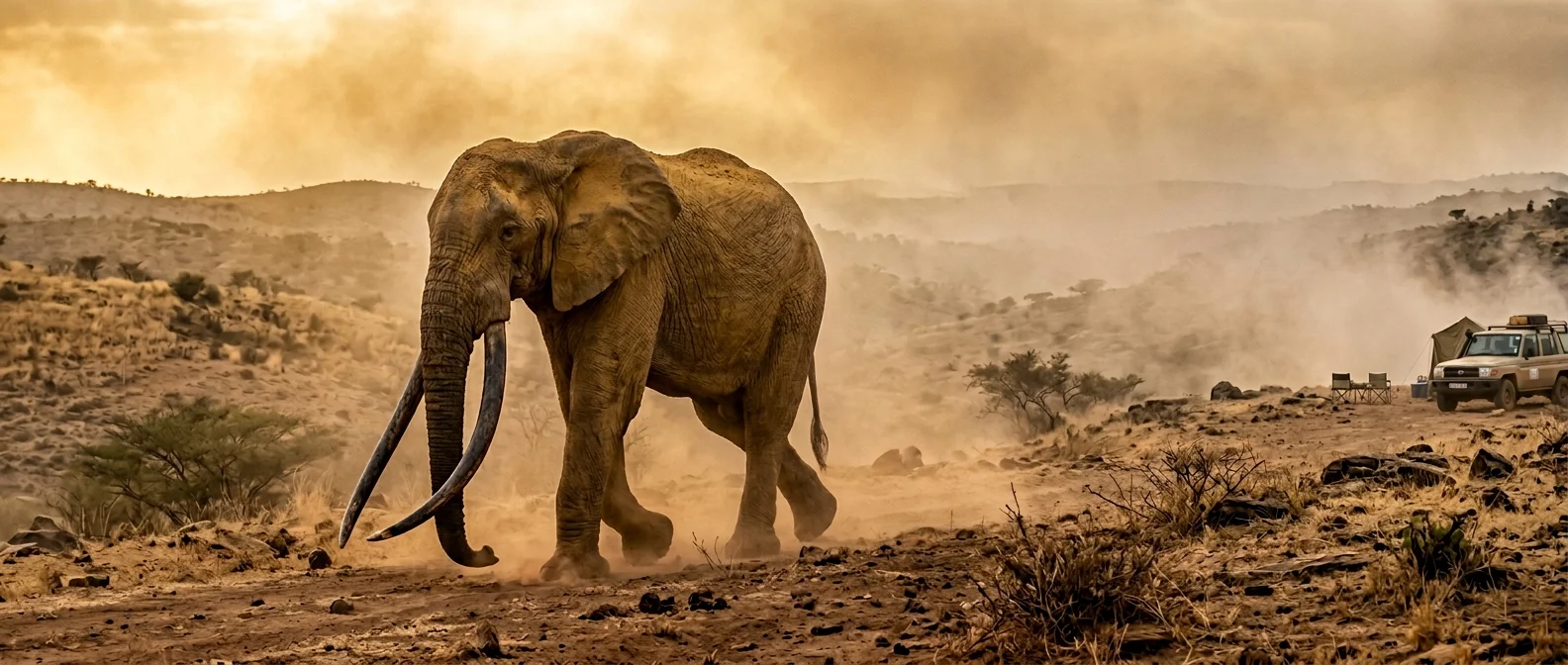
In southeastern Angola, somewhere in the savanna that borders the Cuando River, a trail camera captured something biologists didn't expect: an African elephant. Doesn't sound shocking — unless you know that in Angola, after 27 years of civil war, elephants were thought nearly extinct. They were hunted for ivory, bombed, displaced. Yet they hid in the depths of the savanna. Now they're returning — silently, nocturnally, like ghosts. Their story isn't just biological — it's a lesson in resilience, grief, and regeneration. And it shows us that nature can recover, if we give it space.
📖 Read more: 33-Foot Ghost Jellyfish: Deep-Sea Phantom No One Sees
27 Years of Civil War: The War Against Nature
Angola's civil war (1975-2002) was one of Africa's bloodiest. Over 500,000 dead, millions displaced, and a country destroyed. But the war didn't just destroy people — it destroyed ecosystems. Both sides (MPLA and UNITA) hunted elephants for ivory, selling tusks to buy weapons. Before the war, Angola hosted roughly 100,000 African savanna elephants (Loxodonta africana). After it ended, estimates spoke of fewer than 2,000 elephants in the entire country — a 98% decline. Some biologists believed the population had functionally collapsed. Minefields covering millions of acres of savanna made any counting attempt impossible for years after the war. Angola remained Africa's most heavily mined country for years — with over 10 million active mines scattered across agricultural and forest areas. Many elephants died from mines even after hostilities ended.
Trail Cameras: The Return of the Ghosts
The first evidence came from trail cameras placed by the National Geographic Society in partnership with local researchers. Between 2014 and 2018, they recorded elephants in areas where no one expected them — far from old parks, deep in dense forest zones and riparian groves. Some individuals bore scars from old wounds — bullets that had lodged in their skin decades earlier. These elephants were extremely nocturnal, avoiding all human contact. They moved in small groups, without fixed paths — tactics that resemble survival in a war zone more than natural elephant behavior. Their avoidance of humans was so intense that some groups changed direction upon detecting human scent — even from 2 kilometers away. Researchers called them "ghosts": they live among us, but no one sees them.

📖 Read more: Galápagos Tortoises Return Home After 175 Years
Migration Without Maps: GPS Tracking
The Chase et al. (2016) study in PeerJ was the first major aerial elephant census across 18 African countries — the Great Elephant Census. In Angola, results were mixed: fewer elephants than we hoped, but clearly more than we feared. The aerial census covered 462,000 km² across 18 countries — using light aircraft flying at 100 meters altitude — and revealed that African savanna elephants declined 30% in just 7 years (2007-2014). GPS collar technology revealed that some elephants travel up to 100 km in a single night — massive distances showing they still know ancient migration routes, despite decades of isolation. This confirms Wittemyer's (2013) research showing elephants possess "spatial memory" passed from generation to generation through matriarchs.
War Trauma: Can Animals Suffer from PTSD?
Angola elephants show behaviors that mirror post-traumatic stress. Gay Bradshaw, a neuropsychologist, published in Nature (2005) that elephants who experienced massacres or watched family members killed display hyper-aggression, human avoidance, disrupted social structures, and inability to raise young. In Mozambique — a country with similar history — Poole and Granli (2011) documented that female elephants without elderly guides show dysfunctional parenting. Elephants remember — and pass trauma to the next generation. Young male elephants in Angola, without elderly guides, show aggressive behavior toward rhinos and humans — behavior not observed in stable populations. In South Africa, young males killed rhinos and attacked vehicles — until elderly male mentors were introduced who stabilized the social structure. The parallel with human populations emerging from war is striking: in both cases, trauma doesn't end with the war.
📖 Read more: New Giant Anaconda Species Found in Amazon After 200 Years
Ivory: Why the War Never Ended
The civil war ended in 2002 with the death of UNITA leader Jonas Savimbi, but poaching didn't stop — in fact, in some areas it intensified, as demobilized soldiers sought income. Demand for ivory — mainly from China and Southeast Asia — keeps prices high. A kilogram of ivory can reach $1,500 on the black market. For a poor country like Angola, where average annual income doesn't exceed $2,000, the temptation is enormous and resistance difficult. CITES (Convention on International Trade in Endangered Species) banned ivory trade, but enforcement is weak in rural areas. China banned domestic trade in 2018, but the black market continues through Vietnam, Laos, and Myanmar. Every year, 20,000-30,000 elephants are killed in Africa for their tusks. That's one elephant every 15 minutes. In Angola, poaching is often done by former soldiers who have weapons and knowledge of the terrain — the same terrain that hides the "ghost" elephants.

Protection: New Parks and Community Initiatives
Angola is gradually establishing new protected areas. Luengue-Luiana National Park, on the borders with Zambia and Botswana, forms a critical biological corridor — here pass elephants migrating from KAZA (Kavango-Zambezi Transfrontier Conservation Area), the world's largest transborder conservation area, covering 520,000 km² — larger than all of France. Community initiatives train local residents as guards — through community-based natural resource management (CBNRM) programs that give communities economic incentive to protect rather than hunt, while satellite collars monitor movements in real time. The vision is to create a continuous protection network from Angola to Botswana, where elephants can move safely following their ancestral paths.
📖 Read more: 2 Marsupials Thought Extinct for 6,000 Years Found Alive
Genetics: What DNA Reveals
Genetic analysis of dung samples revealed something remarkable: Angola elephants maintain genetic diversity greater than expected. This means the population didn't pass through as narrow a bottleneck as we feared — perhaps thousands of elephants were hiding in inaccessible areas, in miombo forests and wetlands where neither poachers nor the army reached. DNA studies also reveal that Angola elephants belong to a subpopulation genetically distinct from neighboring populations in Botswana and Namibia, indicating long geographical isolation. This genetic uniqueness makes their protection even more urgent: if lost, genetic material that exists nowhere else disappears.
Lesson for All of Africa
The ghost elephant story isn't just about Angola. In 15 African countries — from Sierra Leone to Rwanda — civil war destroyed large mammal populations. In Mozambique, Congo, Somalia — elephants, rhinos, hippos paid the price of human wars. Angola's elephants might point the way for recovery elsewhere — if there's space, time, and political will. In Mozambique, Gorongosa National Park exemplifies successful post-civil war recovery: elephants returned and the population has grown steadily for 20 years. It's proof the model works — provided there's stable funding and local involvement. Each elephant that steps into camera range carries decades of hidden survival. In their return lies proof that some wild spaces remain beyond human reach — even in war.
"In every war, animals are the first victims and the last we remember."
— Michael Chase, Elephants Without Borders, 2016Sources:
- Chase, M. J. et al. — "Continent-wide survey reveals massive decline in African savannah elephants", PeerJ, 2016
- Bradshaw, G. A. et al. — "Elephant breakdown", Nature, 2005