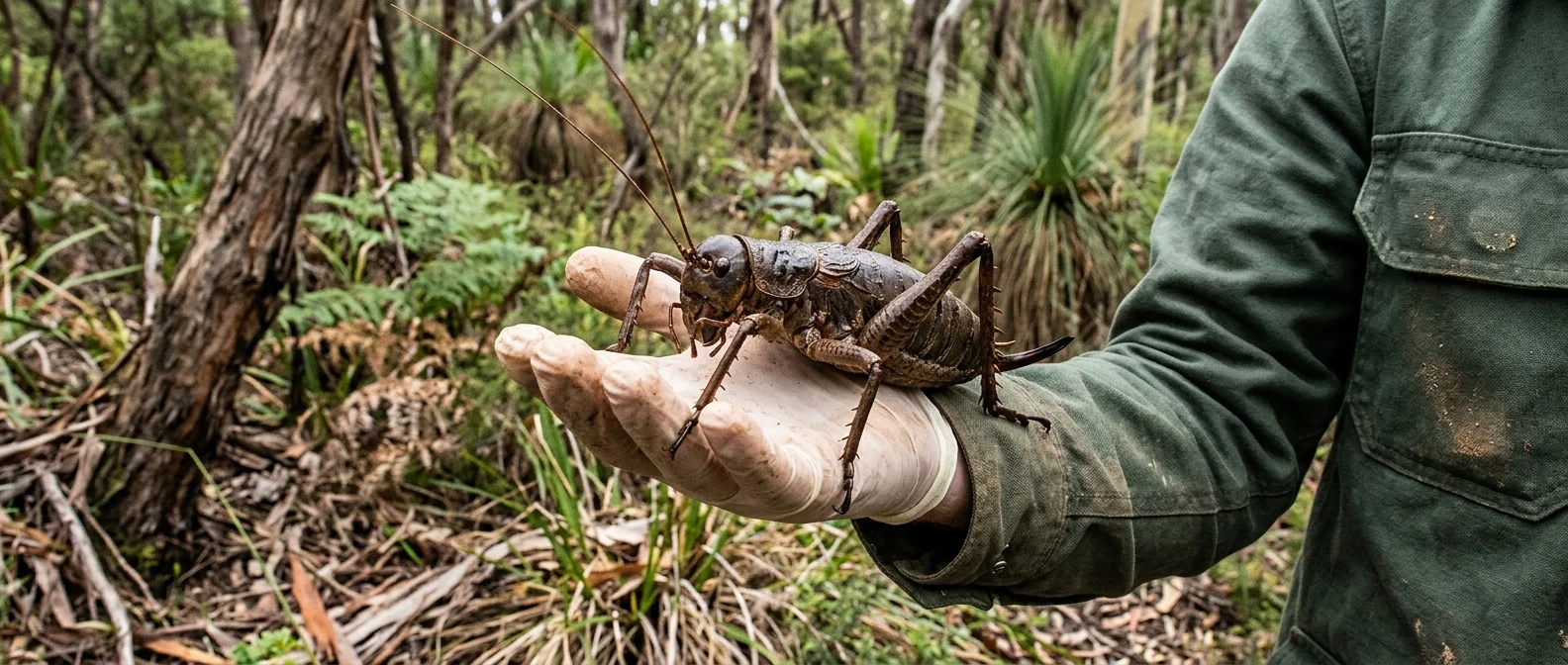
High in the canopy of North Queensland's tropical rainforests, where human feet rarely tread, a creature lived in complete secrecy. A 16-inch stick insect weighing nearly as much as a golf ball, silently inhabiting the treetops. It took a cyclone to bring it down — and a team of scientists to realize what had fallen to the forest floor.
📖 Read more: 2 Marsupials Thought Extinct for 6,000 Years Found Alive
Meet Acrophylla alta
Acrophylla alta is a newly discovered species of giant stick insect — those masters of disguise that look like twigs or tree branches. Found in the Atherton Tablelands region of tropical North Queensland, Australia, at elevations between 500 and 1,200 meters, this behemoth has earned its Latin name “alta,” meaning “high” — a reference to its lofty habitat.
Measuring approximately 40 centimeters (16 inches) in length and weighing 44 grams, it's nearly double the weight of a mature female Ctenomorpha gargantua — which, despite reaching 57 centimeters in length, is much lighter. “There are longer stick insects out there, but they're quite light-bodied,” said Angus Emmott, researcher at James Cook University. “As far as we know to date, this is Australia's heaviest insect.”
A. alta Profile
- Length: 40 centimeters (16 inches)
- Weight: 44 grams — nearly a golf ball's weight
- Elevation: 500-1,200 meters in Atherton Tablelands
- Publication: Zootaxa journal, July 2025
A Hidden Kingdom in the Canopy
Why had no one discovered this giant insect until now? The answer lies in its lifestyle. A. alta lives exclusively in the forest canopy — at the tops of the tallest trees, where it feeds on leaves. This is a habitat nearly impossible to access without specialized climbing equipment.
"It's restricted to a small area of high-altitude tropical rainforest, and it lives high up in the canopy," Emmott explained. "Unless a cyclone or a bird brings one down, very few people have the opportunity to see them." This inherent isolation — literally above our heads — is why a 16-inch insect managed to remain invisible to science until 2025.

📖 Read more: CRISPR 2026: Can We Design Babies?
Why It's So Massive
The size of A. alta isn't random. Researchers believe it follows Bergmann's rule — an evolutionary principle stating that animals in colder climates tend to evolve larger body sizes. The reason is physics: a larger body has a smaller surface area-to-volume ratio, reducing heat loss.
"It's a cool, moist environment where they live," Emmott said. "Their body mass likely helps them survive the cooler conditions, which is why they evolved into this large insect over millions of years." While Bergmann's rule doesn't always apply to insects, A. alta appears to confirm it dramatically.
Eggs Like Fingerprints
Every stick insect species produces eggs that look like microscopic sculptures — and no two are alike. This was the key to recognizing A. alta as a new species. “Each stick insect species has its own distinctive egg style,” Emmott explained. "The eggs have different surfaces, different textures and pitting, they can be different shapes. Even their caps are very unique."
The eggs function like fingerprints in the stick insect world — and A. alta's eggs matched no known species. This uniqueness was the final proof. Combined with morphological characteristics and record-breaking weight, the team concluded they had something entirely new.
📖 Read more: Dinosaurs Had Cancer: The 200-Million-Year-Old Disease
Length vs Weight: Two Records
Australia already hosts some of the planet's largest insects. Ctenomorpha gargantua holds the length record at 57 centimeters — but weighs only half as much as A. alta. A female A. alta specimen full of eggs weighed 44 grams, roughly double what's been recorded for a mature female C. gargantua.
The difference comes down to body structure: A. alta has a more massive, bulky body, while longer stick insects tend to be extremely thin — almost twig-like. This means the title of “largest insect” depends on which measurement you use. In length, C. gargantua wins. In weight, A. alta has no competition.

Acrophylla alta vs Ctenomorpha gargantua
A. alta — Heavier
40cm length, 44g weight — massive, bulky body adapted to high-altitude cold
C. gargantua — Longer
57cm length, ~22g weight — extremely thin body like a tree branch
The Scientific Journey
The discovery was published in July 2025 in the scientific journal Zootaxa. Professor Angus Emmott and his team at James Cook University formally recognized and described the new species. Two specimens were deposited at the Queensland Museum, where they'll be used by other researchers for comparison and species identification.
📖 Read more: Dinosaurs Had Cancer: What Ancient Bones Reveal
"To conserve any ecosystem, we need to first know what's there and what makes it tick, before we think about the best ways to protect it," Emmott emphasized. Cataloging new species in remote ecosystems isn't just academic exercise — it's the foundation of any serious conservation effort.
Masters of Camouflage
Stick insects are masters of camouflage — what biologists call “crypsis.” Their bodies mimic twigs, leaves, or tree bark with stunning accuracy. A. alta is no exception: at the top of a tropical tree, its brown-green body becomes nearly indistinguishable from branches. This ability didn't evolve to fool scientists — it evolved to fool predatory birds and reptiles hunting in the canopy.
Camouflage, combined with their remote habitat, creates an almost perfect cloak of invisibility. Stick insects remain motionless most of the day and move only at night — another habit that keeps them hidden. It's no coincidence that it took a cyclone to reveal this giant's existence.
What It Means for Tropical Forests
The discovery of A. alta sends a clear message: high-altitude tropical rainforests still harbor species we don't know about. If a giant 16-inch insect could remain invisible until now, how many smaller creatures — spiders, beetles, mites — might be living up there unseen?
Queensland's Wet Tropics, a UNESCO World Heritage area, represent one of the world's oldest tropical canopies. Climate change threatens these high, moist forests — and with them, every species that evolved there over millions of years. A nearly half-meter insect that no one knew existed isn't just a biological discovery. It's a reminder that nature still surprises us — if we just look up.