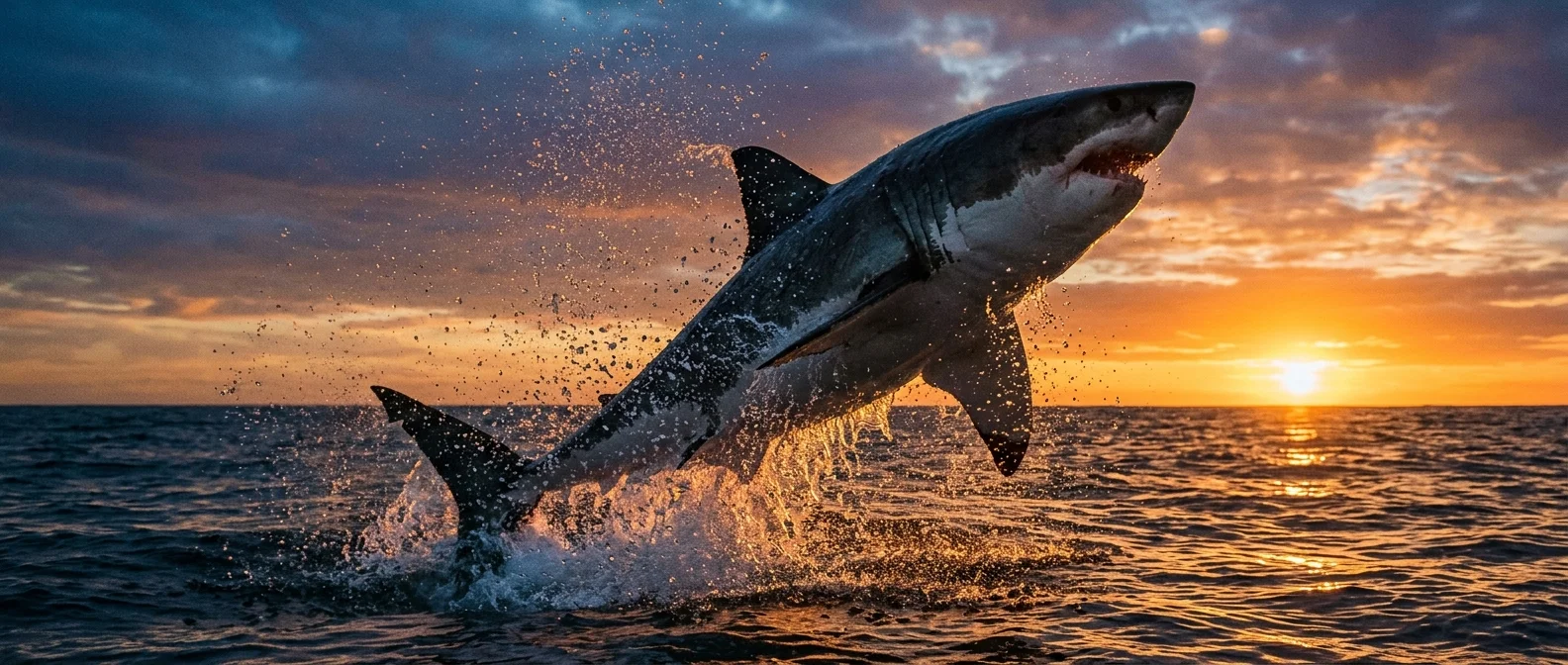
Great White Shark on Trial: Debunking 50 Years of Movie-Made Myths
Since 1975, one movie has defined the reputation of an entire species. Carcharodon carcharias — the great white shark — is considered a ruthless killer. But the evidence tells a very different story. This isn't a documentary. It's a courtroom. And the defendant — weighing 2 tons, measuring 6 meters, with 400 million years of evolution — has alibis you haven't heard.
Peter Benchley wrote “Jaws” inspired partly by real shark attacks in New Jersey. Spielberg's film transferred that fear to millions of viewers. But Benchley himself later declared he regretted it — because the movie led to shark extermination campaigns at resorts worldwide. Let's examine the charges one by one.
⚖️ Charge 1: “Eats Humans”
Verdict: Not guilty. Statistically, only 5 people were killed worldwide by sharks of any species in 2022 — with billions of swimmers in the ocean every year. Great whites tend to deliver one bite only and then retreat — the “bite and spit” technique. The most likely explanation: they mistake humans for seals when viewed from below as silhouettes at the surface. Once they bite and “taste,” they realize the mistake — and leave. They don't hunt humans. They make investigative bites.
A bite from an animal with 1.8 metric tons of force can certainly be catastrophic even if it was “investigative.” On the US West Coast, only 7% of attacks were fatal. In South Africa, over 20%. In Australia, the rate reaches 60%. The difference isn't explained by the shark's behavior — but by distance to hospitals and emergency response times.
In contrast, humans kill approximately 100 million sharks annually — mainly for fin soup, but also as bycatch in nets targeting tuna or swordfish. Who, then, is really the predator?

⚖️ Charge 2: “Cold-Blooded Monster”
Verdict: Not guilty — it's actually warm-blooded. Unlike most sharks, the great white has regional endothermy. A complex countercurrent network (rete mirabile) — arteries and veins wrapped like coils — retains heat generated by powerful swimming muscles near vital organs. This means its body temperature is 14°C higher than surrounding water — allowing it to hunt in cold waters where other predatory sharks cannot. The brain and eyes stay warm, ensuring faster processing of sensory information. It's not a “cold-blooded monster.” It's a warm-blooded athletic machine — a torpedo with 27°C blood in 15°C seas.
Its body is torpedo-shaped — no excess pouches, with a crescent-shaped tail providing maximum thrust. It can reach 6.4 meters in length and weigh over 2,270 kilos. It belongs to the Lamnidae family (mackerel sharks), a close relative of the mako — the world's fastest shark.
⚖️ Charge 3: “Ancient Evolutionary Mistake”
Verdict: Not guilty — evolutionary masterpiece. The great white didn't evolve from the megalodon (Carcharocles megalodon) as previously believed. Recent paleontological analyses show it descended from ancient mako sharks — starting with Carcharodon hastalis, a species with smooth-edged teeth. Evolution worked gradually: first small serrations in C. hubbelli (6-8 million years ago), then fully developed saw-like teeth in modern C. carcharias. The megalodon, conversely, belonged to an entirely different family (Otodontidae) and went extinct 3.6 million years ago without leaving direct descendants.
Today's teeth are a production line: 7 rows, 300 teeth, each one 6 centimeters, serrated, designed to cut flesh and crush bone. Unlike humans who get two sets in their lifetime, the great white produces new teeth for life — a kind of “conveyor belt” that automatically replaces every lost tooth. A single great white can use over 20,000 teeth during its lifetime. This explains why fossilized shark teeth are so common on ocean floors — each individual leaves thousands behind.
⚖️ Charge 4: “Blind Hunter”
Verdict: Not guilty — strategic hunter. The hunting technique is ambush, not blind assault. The great white rockets from the depths toward seals at the surface with such speed — 56 km/h — that the impact launches prey out of the water. If it misses, the shark itself launches into the air — the famous “breaching.” The attack is so violent that prey becomes unable to counterattack. Then the shark retreats and waits for the seal to bleed out.
Recently, scientists discovered melanocytes in great white skin — specialized cells that appear to allow it to darken or lighten its coloration. Countershading — dark back, white belly — is already known: from below it resembles the bright surface, from above it disappears into darkness. If it can actively adjust this contrast, then this is active camouflage — something no one expected from a fish. Additionally, the great white uses so-called ampullae of Lorenzini — electric field sensors in its snout — to detect the heartbeat of hidden prey beneath sand. It sees, smells, feels electric fields, and hears underwater vibrations from kilometers away. There's no hiding place.

⚖️ Charge 5: “Solitary Psychopath”
Verdict: Not guilty — migratory and partially social. The great white isn't the lone killer you imagine. Pairs have been spotted traveling together for extended periods. Some individuals show territoriality around feeding areas — seals, sea lions, dolphins, sea turtles — with dominance hierarchies reminiscent of wolves. Social complexity may not be obvious, but it exists.
White sharks from California have been tracked to Hawaii — and back. From South Africa to southern Australia — migrations of thousands of kilometers across open ocean. They know something about the oceans we don't understand yet. Juveniles grow up in coastal shallow waters — safety nurseries — and as they mature move to deeper waters. Males reach sexual maturity at 10 years (3.5-4 meters), females at 12-18 years (4.5-5 meters). First-year growth rate: 30 centimeters per year.
⚖️ Final Verdict: Vulnerable Species at Risk
The truth no one wants to hear: the great white needs protection, not fear. Females can't even reproduce before 30 years old. Gestation lasts 12 months. They give birth to 2-17 live young, 1-1.8 meters long at birth. Embryos feed by eating unfertilized eggs — and possibly their siblings in the womb (intrauterine cannibalism). Life literally begins with a survival battle.
The population is declining — Vulnerable according to IUCN, critically threatened in the Mediterranean. Illegal fin fishing, entanglement in shrimp and tuna nets, “shark nets” at beaches, deliberate “shark culling” in Australia — all accumulate against a species that develops slowly, reproduces rarely, and produces few offspring. CITES now protects the great white, but enforcement remains difficult in international waters.
The only natural enemy of an adult great white? The orca. In South Africa, two orcas known as “Port” and “Starboard” have been documented to have killed several great whites, removing with surgical precision only the liver — rich in squalene. After the attacks, the entire great white population abandoned the area for months. The irony isn't lost: the animal the world fears most in the sea is prey to an animal called in most languages “killer whale.” The great white isn't the king — it's the prince. And it needs our help.