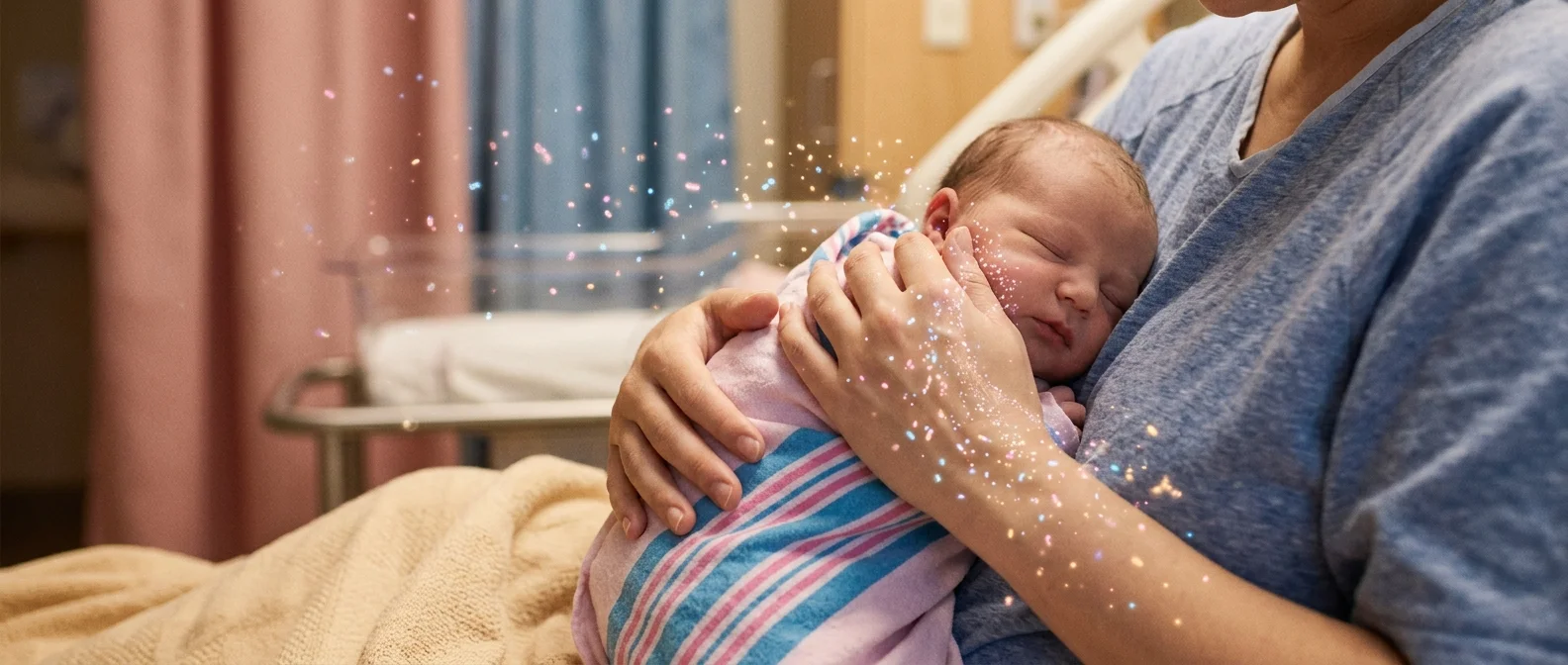
Picture a newborn seconds after delivery. Crying, breathing, opening eyes to a world teeming with microbes. Inside the womb, it lived in an almost sterile environment — amniotic fluid, placenta, and membranes protected it from every microbial invasion (though some researchers question complete sterility — there's evidence of bacterial DNA in placenta and amniotic fluid, but the debate continues). Now, within 72 hours, its body will be colonized by billions of bacteria — a wave of settlers reaching 38 trillion in a few years, outnumbering human cells. This microbial colonization isn't random or innocent — it's one of the most critical events in a human's life, and how you're born determines who you become biologically.
First Contact: The Birth Canal
During vaginal delivery, the baby passes through the birth canal — an environment rich with Lactobacillus, Prevotella, Sneathia. These bacteria literally “bathe” the baby: face, mouth, skin, respiratory tract, digestive system. A Dominguez-Bello study (PNAS, 2010) of 10 mother-infant pairs showed that vaginally delivered babies had microbiomes nearly identical to their mother's vagina — Lactobacillus everywhere. In contrast, C-section babies had skin-like microbiomes — Staphylococcus, Corynebacterium, Propionibacterium. They never passed through the birth canal — first contact was surgical gloves, hospital air, medical staff skin. In 2019, the largest study of its kind (TEDDY cohort, 903 infants) confirmed: C-section babies had significantly lower Bacteroides diversity — a genus critical for immune regulation. The difference isn't just which bacteria arrive first — it's which ones “settle” first, shape the environment, and become permanent residents — this determines which colonizers follow.

First Settlers = First Winners
In ecology, there's the "priority effect" principle — the first species to colonize an environment determine which will follow. This applies to the gut too. Lactobacillus from the vagina creates an acidic environment (lactic acid), preventing pathogens (Clostridium difficile, pathogenic E. coli strains) from establishing. Simultaneously, they “train” the immune system: “these are friendly — don't attack them.” C-section babies, conversely, are first colonized by hospital bacteria — including antibiotic-resistant strains like Enterococcus and Klebsiella. These bacteria don't produce lactic acid, don't protect the mucosa, and don't “train” the immune system properly. The difference remains measurable until at least 12 months of age (Bäckhed et al., Cell Host & Microbe, 2015).
Breastfeeding: The Indigestible HMOs
Breast milk contains over 200 Human Milk Oligosaccharides (HMOs) — complex sugars the baby cannot digest. Why does the mother produce them? They're not food for the baby — they're food for Bifidobacterium infantis in the baby's gut. HMOs function as prebiotics: they selectively feed the “right” bacteria while simultaneously binding pathogens — acting as “decoys,” mimicking intestinal mucosa receptors and preventing dangerous microbes from attaching. Meanwhile, milk transfers live bacteria (~600 species per mL), IgA antibodies (coating the intestinal mucosa like a shield), and lysozyme (an enzyme that kills pathogens). Exclusively breastfed babies for the first 6 months have microbiomes dominated by Bifidobacterium (up to 90% of total) — formula-fed babies have more “adult-like” microbiomes, with more Clostridium and Enterobacteriaceae. The gut pH difference is measurable: 5.0-5.5 in breastfed (acidic, protective) vs 6.0-7.0 in formula-fed (neutral, allows pathogens). Additionally, colostrum — the first milk produced in the first 48-72 hours — contains triple the IgA and lactoferrin: it's literally a “vaccine” in liquid form.
Antibiotics: The Carpet Bombing
Antibiotics in the first weeks of life act like “carpet bombs” on the immature microbiome. A 10-day amoxicillin course can reduce bacterial diversity by 50% in 3 days — wiping out entire genera that had just begun establishing. Recovery takes weeks or months — and isn't always complete, leaving permanent “gaps” in the microbial landscape. A study of 12,000 Danish children (Stokholm et al., Nature Communications, 2020) showed antibiotics before 12 months increase allergic asthma risk at 5 years by 24%, atopic dermatitis by 18%. Antibiotics kill pathogens but simultaneously eliminate “educational” bacteria — those that teach the immune system tolerance. Without this education, the immune system overreacts: allergies, autoimmune conditions, atopic dermatitis, food allergies. Research already links early antibiotic use to increased obesity risk at 5-10 years — possibly because disrupted microbial composition alters nutrient metabolism.

The Hygiene Hypothesis (And Why It's Right)
David Strachan (1989) observed that children with many siblings had fewer allergies. He proposed the "hygiene hypothesis": excessive cleanliness deprives the organism of microbial exposure. Today, the updated version ("old friends hypothesis") says: we don't need infections — we need co-evolutionary microbes (Lactobacillus, Mycobacterium vaccae, helminths) that “regulate” the immune system. The explanation is evolutionary: for 200,000 years Homo sapiens lived in close contact with soil, animals, raw water — the immune system was designed for this reality. Children raised on farms have 50% less asthma than urban ones — exposure to animal bacteria, soil, raw milk trains regulatory T-cells (Tregs) that prevent allergic reactions. The PARSIFAL study (Sweden, 6,000+ children) confirmed: pets in the home during the first year reduce allergic rhinitis risk by 13% — animals bring microbial diversity that sterile apartments don't provide.
The Gut-Brain Axis
Gut bacteria produce neurotransmitters: serotonin (95% of the body's serotonin is produced in the gut — not the brain, as many believe), GABA, dopamine, butyric acid (inflammation regulator). Through the vagus nerve, these signals reach the brain. Experiments on germ-free mice (without any bacteria, born and raised in sterile environments) show increased anxious behavior, reduced sociability, increased cortisol under stress — all reversed with Lactobacillus rhamnosus JB-1 administration. In infants, early microbiome composition appears to correlate with neurodevelopmental outcomes — cognitive development, behavior, even mild autistic tendencies. Follow-up studies (Carlson et al., Biological Psychiatry, 2018) show correlation between low infant microbiome diversity and behavioral problems at 2 years.
Vaginal Seeding: Solution or Risk?
A controversial practice: doctors “swabbing” C-section babies with maternal vaginal fluids immediately after birth — vaginal seeding. Dominguez-Bello (2016) showed it partially restores the microbiome to a vaginal profile. However, the American College of Obstetricians (ACOG) doesn't recommend it yet — risk of transmitting GBS (Group B Streptococcus), HSV (herpes), HPV (papilloma). The practice is being studied in large clinical trials — results expected by 2026. Alternatively, research focuses on probiotics: administering B. infantis EVC001 to C-section babies increases Bifidobacteria by 1000x in 2 weeks (Frese et al., mSphere, 2017). Other approaches include: immediate skin-to-skin contact (kangaroo care) right after C-section and early breastfeeding within 1 hour.
The First 1,000 Days: Window of Opportunity
The first 1,000 days (conception to 3 years) are considered the “window of opportunity” — the period when the microbiome stabilizes into an adult pattern. After age 3, composition remains relatively stable except for drastic interventions — broad-spectrum antibiotics, intestinal infection, radical dietary change. The model is simple and elegant: vaginal delivery + exclusive breastfeeding + avoiding unnecessary antibiotics + contact with nature and animals = optimal “bacterial foundation.” For those born by C-section, breastfeeding can compensate for a significant part of the difference — HMOs and live bacteria in milk constitute a powerful second chance for proper colonization. Perfection isn't required — nature designed multiple backup pathways. The microbiome is remarkably resilient — even after antibiotics, it recovers (though not always completely). But every decision in the first months leaves an imprint — literally a microbial fingerprint — that can last decades. The 38 trillion bacteria living inside you didn't arrive randomly — they started from your first 72 hours of life.
Sources:
- Dominguez-Bello, M.G. et al. (2010). "Delivery mode shapes the acquisition and structure of the initial microbiota across multiple body habitats in newborns." PNAS, 107(26), 11971-11975.
- Bäckhed, F. et al. (2015). "Dynamics and stabilization of the human gut microbiome during the first year of life." Cell Host & Microbe, 17(5), 690-703.