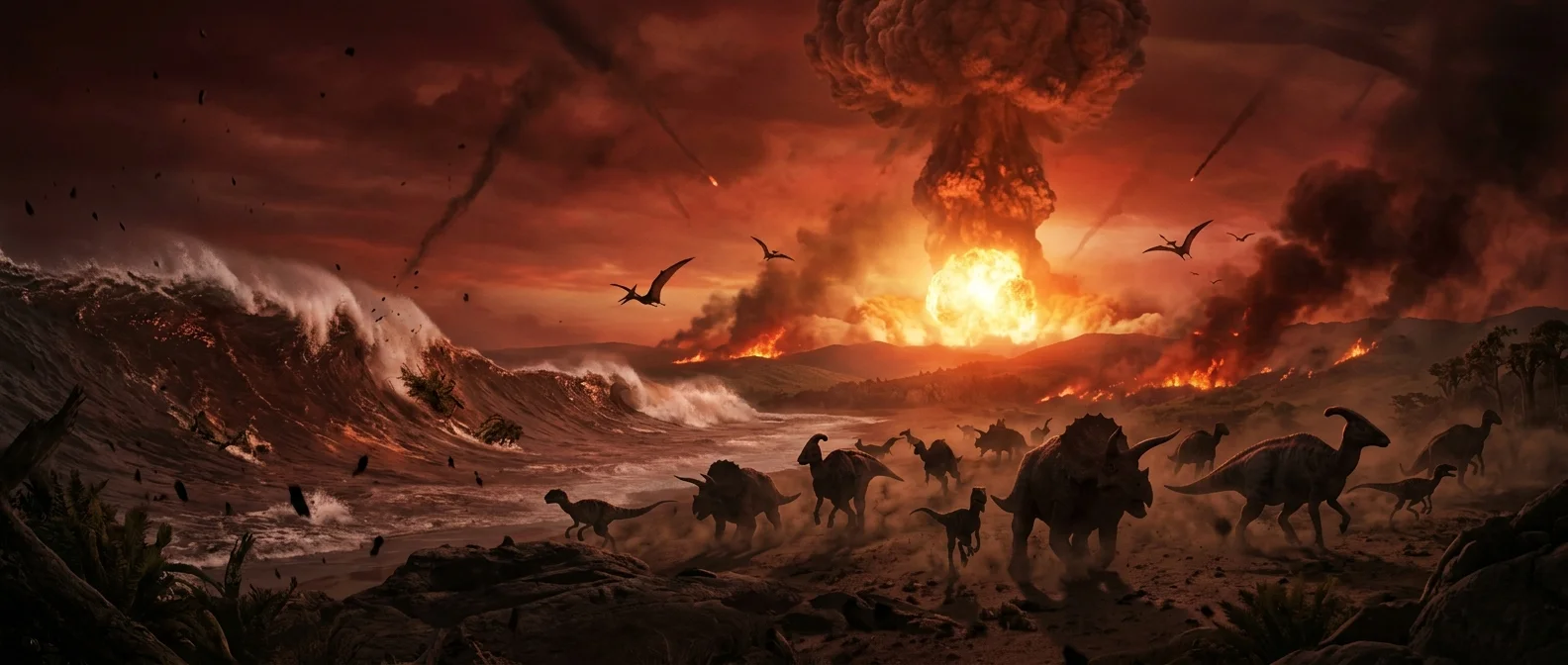
66 million years ago, somewhere in what is now Mexico's Yucatan Peninsula, an asteroid roughly 6-7 miles wide slammed into Earth at 12 miles per second. Within minutes, the atmosphere caught fire. Three-quarters of all life on the planet would never see the sun again. The age of dinosaurs ended that day — but the events that led there are far more complex than that simple story suggests.
☄️ The Alvarez Hypothesis — A Rock from Space
In 1980, physicist Luis Alvarez and his son Walter — a geologist — proposed an idea that sounded crazy at the time: an asteroid killed the dinosaurs. Their key evidence? A metal: iridium. Rare in Earth's crust, but extremely common in meteorites.
The Alvarezes found unusually high concentrations of iridium in the geological layer that separates the Cretaceous from the Paleogene period — the so-called K-Pg boundary. Right at this layer, all known dinosaur fossils stop. Above this line, nothing. No bones, no teeth, no traces.
Their hypothesis gained dramatic strength when scientists located the Chicxulub crater — a massive impact structure 93 miles in diameter, buried beneath the seafloor off the Yucatan Peninsula. Its size and age matched perfectly.
🔥 What Exactly Happened That Day
In 2016, a team of researchers drilled into the seafloor at the center of the Chicxulub crater and pulled up a core sample of rock. This rare glimpse into the crater's interior revealed that the impact had enough force to blast deadly amounts of vaporized rock and gases into the atmosphere — and the effects would last for years.
Wildfires swept across entire forests. Acid rain fell into every ocean. Massive amounts of dust and soot blocked out the sun, dropping temperatures and halting photosynthesis. Marine ecosystems collapsed first — terrestrial ones followed.
🌍 The North Dakota Fossils
In 2019, paleontologists in North Dakota discovered an extraordinary fossil site, almost exactly at the K-Pg boundary. Within it they found tektites — microscopic glass spheres, melted rock that was blasted into the atmosphere by the impact, solidified in the air, and “rained” back to Earth. It's a snapshot of the disaster — like a photograph from a day 66 million years ago.
🌋 The Other Theory: Volcanoes, Not Asteroids
The asteroid isn't the only explanation on the table. A group of scientists insists the real culprit is hiding in India.
The Deccan Traps — a massive volcanic province — began massive eruptions between 60 and 65 million years ago. Today, the volcanic rock covers nearly 77,000 square miles, with thickness reaching 5,900 feet in some places. These eruptions would have choked the atmosphere with carbon dioxide, dramatically altering the climate.
Supporters of this theory point to studies indicating climate changes even before the asteroid. Some research found evidence of mass deaths much earlier than 66 million years ago. And volcanic activity is common on Earth — unlike giant meteorite impacts, which are extremely rare.
🔄 Asteroid vs Volcanoes: The Great Debate
Chicxulub Asteroid
- Iridium layer at K-Pg boundary
- 93-mile crater in Yucatan
- Tektites on global scale
- Sudden, catastrophic impact
Deccan Traps (India)
- 77,000 sq. miles of volcanic rock
- Eruption duration: 5+ million years
- CO₂ & toxic gases in atmosphere
- Climate changes before asteroid
🤝 What If Both Were True?
More and more researchers see room for both theories. A geological "one-two punch": the volcanoes weakened ecosystems gradually, and the asteroid finished them off.
Two independent studies in 2019 examined geochemical evidence from the Deccan Traps and reached slightly different conclusions — one supported that volcanoes caused pre-impact decline, the other that major eruptions came after the asteroid and played a smaller role. The debate remains open.
🦕 Dinosaurs Weren't in Decline
An old narrative claimed dinosaurs were already “declining” before the asteroid. That their extinction was simply the final blow to an already weakened group. A 2025 study published in Science by a Baylor University team overturned this picture.
In New Mexico, within rocks aged 66 to 66.4 million years — literally the final chapter before the asteroid — rich fossil data was found. Dinosaurs weren't in decline. They were thriving.
"Dinosaurs are doing fine, they're flourishing, and the asteroid impact seems to wipe them out. This contradicts the long-held idea that there was a gradual decline in their diversity before the mass extinction."
— Andrew Flynn, New Mexico State University, 2025The study revealed that dinosaurs lived in distinct “bioprovinces” — geographic zones with different ecosystems, shaped primarily by temperature. Southern New Mexico had completely different species from those in Montana and the Dakotas, despite living at the same time.
🐾 What Survived — And Why
Not everything died. Birds — descendants of small theropod dinosaurs — survived. Also: crocodiles, turtles, small mammals, amphibians, and several marine species. What separated them from the 75% that didn't make it?
Small body size. The ability to live underground or in water. Generalized diet — animals that fed on seeds, insects, or decaying matter had an advantage in a world without photosynthesis. Large specialized hunters — dinosaurs, mosasaurs, pterosaurs — no longer had a food chain base.
Within 300,000 years after the impact, according to the 2025 study, mammals began explosive diversification — new diets, new sizes, new ecological roles. The world we know today was built on the ruins of that day.
🔮 Why This Matters Today
The extinction of dinosaurs isn't just a story from 66 million years ago. It's a lesson. It shows how quickly dramatic climate change can destroy even the most dominant creatures on a planet — and how quickly life can restart, if given the chance.
If the asteroid hadn't fallen, perhaps dinosaurs would still dominate. Perhaps mammals would never have had their opportunity. Their extinction was catastrophe, but simultaneously it was the beginning of our world.