You're sitting in your chair right now, alone — or so you think. In reality, trillions of organisms are living on and inside you at this very moment: bacteria, viruses, fungi, mites, and other microscopic creatures. Bacteria on your skin, fungi between your toes, mites in your eyelashes, viruses inside your cells. You're not one organism — you're an entire ecosystem walking around on two legs.
The Numbers That Change Everything
For decades, popular “wisdom” claimed bacteria in your body outnumber your cells 10 to 1. Impressive, but a myth. A revised 2016 study from the Weizmann Institute calculated the real ratio is closer to 1:1 — roughly 38 trillion bacteria versus 30 trillion human cells. The balance actually shifts every time you use the bathroom: a significant percentage of gut bacteria gets expelled regularly. Your microbiome is dynamic, changing hour by hour based on what you eat, when you sleep, and how stressed you are.
But numbers don't tell the whole story — it's the genetic information that truly astounds. Bacteria may equal your cells numerically, but genetically they dominate you completely: the human genome contains about 20,000 genes, while your microbiome harbors over 2 million unique bacterial genes. In terms of genetic information, you're 100 times more microbe than human — and this truth changes how we see ourselves.
Your Skin: A City of 1,000 Species
Your skin isn't a sterile surface — it's a metropolis. On every square centimeter live an average of one million bacteria belonging to hundreds of different species. Your armpit hosts mainly Corynebacterium and Staphylococcus — these bacteria metabolize your sweat and produce the volatile compounds we recognize as body odor. Antibacterial soaps may temporarily eliminate residents, but within hours the colony rebuilds — skin never stays sterile for long.
The oily T-zone of your face, your belly button, the inner fold of your elbow — each area has its own microbial community, almost as different as forest flora from desert flora. Your belly button alone can harbor over 60 different bacterial species. The Human Microbiome Project mapped this impressive diversity and found that each person's microbial signature is as unique as a fingerprint.

The Mites Living in Your Eyelashes
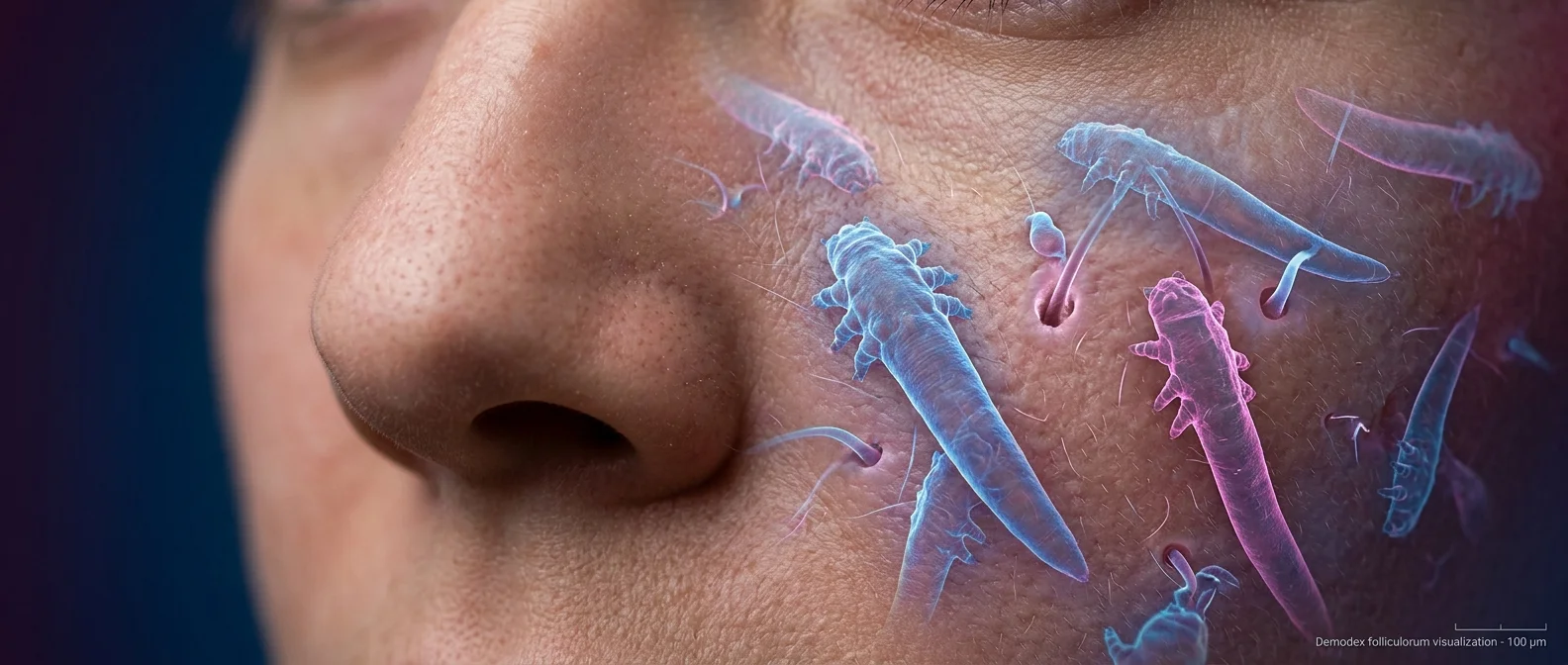
Something is living in your eyelashes right now, and that's not a metaphor. Demodex folliculorum and Demodex brevis are microscopic mites — eight-legged arachnids 0.3 millimeters long that permanently inhabit hair follicles and sebaceous glands on your face, mainly around your nose, cheeks, and forehead. They feed on sebum, your skin's natural oil, and mate at night on your face while you sleep. Their life cycle lasts about two weeks.
Nearly 100% of adults over 60 harbor Demodex — though many younger people have them too without knowing it, since they rarely cause symptoms. A 2022 study revealed something remarkable: Demodex are gradually losing genes they don't need, evolving into obligate symbionts. They can no longer survive outside the human face. They're becoming part of you — biologically.
Your Gut: A World Inside You
The digestive system hosts the majority of your microbiome — mainly in the large intestine, where bacterial density reaches 100 billion per gram. These bacteria aren't just parasitic passengers. They produce vitamins (K, B12), break down plant fibers into butyric acid that feeds intestinal cells, train your immune system, and produce serotonin and other neurotransmitters that affect your mood.
The gut-brain axis is now a recognized and rapidly developing field in neurogastroenterology. Gut bacteria produce serotonin — in fact, about 90% of your body's serotonin is produced in the digestive system, not the brain. Microbiome composition has been linked to depression, autism, obesity, and autoimmune diseases in dozens of studies — though causal relationships remain under investigation. What we know for certain is that the gut isn't just a digestion tube — it's a communication organ with the brain, and its residents hold the keys.

Viruses: The Invisible Residents
It's not just bacteria. Trillions of viruses also live inside you — the so-called human virome, mainly bacteriophages, viruses that infect bacteria. These viruses regulate bacterial populations in your gut, functioning as microbial predators that keep the ecosystem balanced. But there are also viruses embedded in your very DNA: about 8% of the human genome comes from ancient retroviral infections — genetic fossils of viruses that infected our ancestors millions of years ago and remained in the genome forever. Many of these segments are dormant, but not all.
Some of these viral remnants aren't dormant at all — they've been recruited by our organism for critical functions. The protein syncytin, essential for placenta formation during pregnancy, comes from an ancient retrovirus. Syncytin allows cells to fuse, forming the tissue that connects mother to fetus. Without this viral inheritance, human reproduction wouldn't work as we know it — evolution turned an invader into an essential ally.
Allies, Not Enemies
Our relationship with these organisms isn't merely tolerant — it's vital. Babies born through vaginal delivery acquire their first bacteria during passage through the birth canal — mainly Lactobacillus, bacteria that will colonize their gut and train their immune system. C-section babies are initially colonized by skin bacteria from the hospital environment, mainly Staphylococcus and Propionibacterium — a difference being investigated for potential links to allergies, asthma, and autoimmune conditions later in life.
Antibiotics kill symbionts along with pathogens. Microbiome recovery after antibiotic treatment can take months, even years — and some species may never return. That's why fecal transplants, however strange they sound, are now recognized therapy for serious infections like Clostridioides difficile. This understanding is slowly but radically changing the medical community's approach to antibiotic prescribing — every treatment is also an attack on your symbionts.
Your Microbial Fingerprint
Every human carries a unique microbial fingerprint — so distinctive it could theoretically be used for identification, like genetic code or fingerprints. Diet, location, age, pets, even the people you touch daily — all shape your microbiome in real time. Couples living together develop similar skin microbiomes. Dogs and cats “share” bacteria with their owners. Researchers have identified individuals solely from bacteria they left on keyboards or phones — a microbial “signature” that might one day replace traditional forensic tools.
You're Never Alone
Next time you feel alone, remember: trillions of organisms live on you. Mites in your eyebrows, bacteria in your belly button, fungi between your toes, viruses embedded in your DNA. Our relationship with these microorganisms isn't an accident — it's the result of millions of years of co-evolution. Without these invisible residents, we couldn't digest food, wouldn't have proper immunity, couldn't produce essential vitamins. You're never truly alone — you're a universe in motion, a walking planet teeming with life.
Sources:
- Sender, R., Fuchs, S. & Milo, R. “Revised estimates for the number of human and bacteria cells in the body.” Cell, 164(3), 337-340, 2016
- Smith, A.V. et al. “Human Follicular Mites: Ectoparasites Becoming Symbionts.” Molecular Biology and Evolution, 39(6), 2022