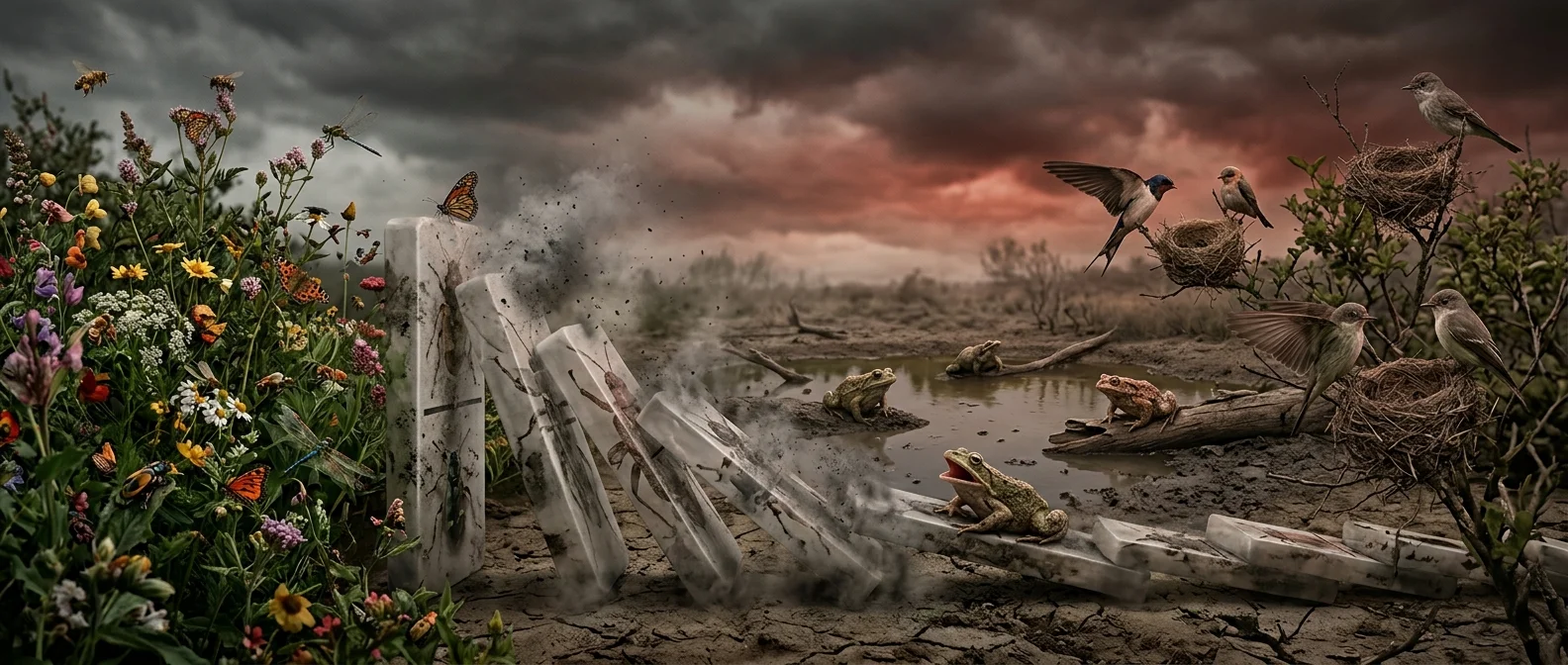
Driving through summer evenings in the 1990s, windshields would be splattered with insects. Today, after hours of highway travel, they remain nearly spotless. This informal observation — known as the “windshield phenomenon” — reflects a dramatic reality: insect populations are collapsing globally, threatening the very foundations of food webs. Science now measures what older generations observed empirically — the nocturnal insects around porch lights, butterflies in meadows, wasps under roof tiles — all becoming increasingly rare.
The Numbers Behind the Collapse
The first shocking study came from Germany. Volunteer entomologists in Krefeld collected flying insects with traps across 63 protected areas over 27 years (1989-2016). The results from Hallmann et al. (PLOS ONE, 2017) were staggering: 75% decline in flying insect biomass. The drop was even steeper in midsummer — 82%. These weren't measurements in industrial zones, but in Natura 2000 areas, theoretically protected. Sánchez-Bayo & Wyckhuys (2019) analyzed 73 studies worldwide and calculated a decline rate of 2.5% annually — meaning potential extinction of 40% of insect species within decades. In Britain, the Rothamsted Insect Survey — the world's longest-running insect trap (since 1964) — recorded 50% decline in aphids and 60% in ground beetles. British butterflies have declined 46% since 1976, while fireflies are vanishing due to light pollution disrupting their bioluminescent mating displays.
Five Drivers of Decline
Wagner et al. (PNAS, 2021) categorized the causes into five main drivers. Land use change is the most significant: converting meadows and forests into monocultures eliminates habitats. Pesticides, particularly neonicotinoids (imidacloprid, clothianidin, thiamethoxam), act neurotoxically at ppb doses — non-lethal but sufficient to cause disorientation, reduced reproduction, and feeding inability. Light pollution traps nocturnal insects (60% of species), climate change shifts distribution ranges, and invasive species (e.g., Vespa velutina, Asian hornet in Europe) create new competition. A frequently overlooked threat is pet insecticides: household mosquito products contain pyrethroids that indiscriminately kill butterflies, hoverflies, and bumblebees within dozens of meters.

Pollination: The Silent Service
75% of cultivated plant species depend on animal pollination — primarily insects. The economic value of pollination services is estimated at $235-577 billion annually (IPBES, 2016). Honeybee populations (Apis mellifera) have declined 40% in Europe and 30% in North America. But wild pollinators — bumblebees (Bombus), solitary bees, hoverflies, moths — are in worse shape: one-third of European bumblebee species are threatened. In Greece, overgrazing on Aegean islands destroys habitats of endemic butterfly and beetle species, while Vespa orientalis is rapidly expanding in Attica, threatening local apiaries. China already uses human pollination in Sichuan apple orchards — workers with brushes transfer pollen flower-to-flower, a process 300 times slower than a bee. The monarch butterfly (Danaus plexippus), symbol of insect migration, has lost 80% of its population since the 1990s, mainly due to destruction of milkweeds (Asclepias) by glyphosate herbicides in the US Corn Belt.
Chain Reactions in Ecosystems
Insects form the base of countless food webs. Insectivorous birds like swallows (Hirundo rustica) have declined 46% in Europe over the past 40 years. In Switzerland, Zellweger-Fischer et al. (2018) documented that house sparrow populations in agricultural areas declined proportionally with insect biomass. In North America, Rosenberg et al. (Science, 2019) revealed a loss of 3 billion birds — 29% decline — since 1970. Bats, critical insect regulators (a colony of 20 million Tadarida brasiliensis in Texas consumes 200 tons of insects per night), face double pressure: reduced food and mortality from wind turbines. In freshwater, dragonfly populations (Odonata) have declined 37% in Europe (IUCN Red List, 2021), while amphibians dependent on insect larvae face dual threats — less food and chemical pollution of wetlands.

Decomposition and Nutrient Cycling
Beyond pollination, insects recycle nutrients. Dung beetles (Scarabaeidae) bury manure, accelerating decomposition and reducing livestock parasites — a service worth $380 million annually in the US alone. Termites decompose 20% of global dead woody biomass, recycling carbon and nitrogen. Ants move 10-50 tons of soil material per hectare annually, aerating soil as much as earthworms in dry climates. Aquatic larvae of mayflies (Ephemeroptera) and caddisflies (Trichoptera) serve as water quality indicators — their disappearance signals freshwater pollution. In Greece, dung beetles in Thessaly and Epirus pastures have declined dramatically from anthelmintic use (ivermectin) in livestock, which poisons manure and kills decomposing insects. Studies in Australia show that without dung beetles (imported in 1968), cattle dung covered millions of hectares of pasture, rendering them useless.
The Methodological Debate
Not everyone agrees this is an “apocalypse.” Van Klink et al. (Science, 2020) analyzed 166 long-term studies with 1,676 sites and found average decline of 0.92% annually in terrestrial but increase of 1.08% in aquatic — possibly due to improved water quality. The picture isn't uniform: tropical forests (El Yunque, Puerto Rico) recorded 98% decline in arthropod biomass (Lister & Garcia, 2018), while some species in Northern Europe are expanding northward. The challenge is "baseline shifting": each generation considers “normal” what they see, without knowing how much has already been lost. Didham et al. (2020) also emphasized "selective publication bias": studies showing dramatic decline publish more easily than those showing stability. Nevertheless, even conservative estimates show overall decline of 1-2% annually in terrestrial — cumulatively catastrophic. What we know for certain: over the past 30 years, flying insect abundance in protected areas has declined at unprecedented rates — the windshield doesn't lie.
Solutions: From Farm to City
The EU banned the three main neonicotinoids in outdoor crops (2018), but exceptions are regularly granted. Agroecology offers alternatives: flower strips at field margins increase natural pest enemies by 24% (Albrecht et al., 2020). In Bavaria, the “Rettet die Bienen” referendum (2019) — with 1.75 million signatures — led to legislation dedicating 30% of agricultural land to organic farming by 2030. In the Netherlands, farmers are subsidized for every meter of flower garden at field margins — €3,000 per hectare annually. Urban gardens function as refuges: studies show cities with green roofs and flower gardens host 50% more pollinator species than surrounding agricultural landscapes. In Greece, the LIFE program for pollinators in Thessaly implements fallow zones with native flora — early results show 35% increase in wild bee density.
Future: Monitoring and Hope
New technologies are changing insect research. Automated traps with artificial intelligence (AmI-Trap) identify species in real-time through computer vision. eDNA (environmental DNA) detects species presence from water or air samples without capture. LIDAR radar satellites can now measure insect swarms at altitude. Biological control — using insects against insects — reduces pesticides: Trichogramma parasitoids are increasing 15% annually in Europe. The “Thousand Meadows” program (Germany) restores barren agricultural land to flowering meadows — after 3 years, butterfly species doubled. Citizen science plays a crucial role: apps like iNaturalist and BeeWalk have collected millions of observations from volunteers worldwide. The “taxonomic impediment” — only 1,500 taxonomic entomologists globally for millions of undescribed species — means we're losing species before even discovering them. The planet's 5.5 million insect species (only 1 million described) have kept ecosystems functional for 400 million years — one-third of human food supply depends directly or indirectly on insects, and their crisis is not just ecological but existential for agriculture and food security of 8 billion people.
Sources:
- Hallmann, C.A. et al. "More than 75 percent decline over 27 years in total flying insect biomass in protected areas." PLOS ONE, 12(10), e0185809, 2017.
- Wagner, D.L. et al. “Insect decline in the Anthropocene: Death by a thousand cuts.” Proceedings of the National Academy of Sciences, 118(2), e2023989118, 2021.