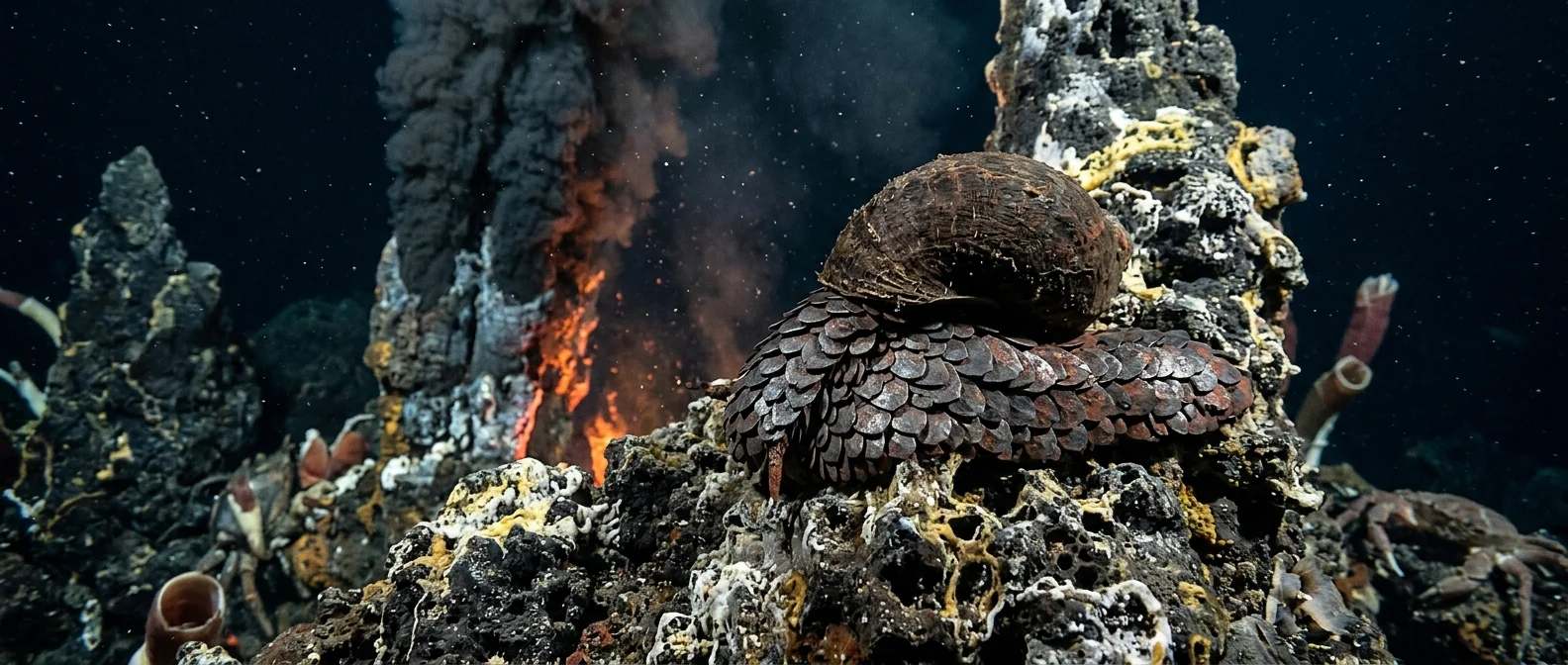
In the depths of the Indian Ocean, at hydrothermal vents where temperatures reach 400°C and hydrogen sulfide kills most life forms, a snail wears armor made of iron. Literally. Its shell is externally coated with iron sulfide — greigite (Fe₃S₄) — the same mineral found in meteorites. Its foot is armored with hundreds of metallic scales. It's the only known animal on the planet that incorporates iron sulfide into its skeleton.
📖 Read more: These Creatures Live 7 Miles Beneath the Ocean Surface
Chrysomallon squamiferum — known as the scaly-foot gastropod, sea pangolin, or volcano snail — looks like nothing you've ever seen. Discovered only in April 2001, it remains one of the most exotic living creatures on Earth. Let's crack open the engineering file of this armored survivor.
🔩 Section 1: The Armor — Three Layers of Defensive Technology
The shell of C. squamiferum is a composite material with three layers, each serving a different defensive purpose. The outer layer, about 30 micrometers thick, consists of iron sulfide, primarily greigite — a ferrimagnetic material. This means this snail's shell responds to magnets. No other living creature uses this material in its skeleton.
The middle layer, 150 micrometers thick, is organic — a thick periostracum made of conchiolin, a complex protein. This layer absorbs mechanical stress: if a crab squeezes the shell, energy spreads through the organic layer instead of causing fractures. It also diffuses heat — a critical feature next to hydrothermal vents. The inner layer, 250 micrometers, is aragonite (calcium carbonate), the classic mollusk shell material. The shell is spherical with three whorls, the apex fragile and eroded in adults. Average width reaches 32 millimeters, with a maximum of 45.5 millimeters — enormous for the Peltospiridae family, where most species stay under 15 millimeters.
This triple armor seriously interests the military. MIT researchers studied the structure for potential applications in civilian and military protective materials — nature, 2,800 meters below the sea, designed a composite armor more effective than many human constructions.

🔩 Section 2: The Scales — 1×5 mm Iron on Each Side of the Foot
If the shell impresses, the foot leaves you speechless. The sides of the foot are covered with hundreds of sclerites — scale-like plates measuring 1×5 millimeters in adults. Each sclerite has a soft epithelial core, a conchiolin sheath, and an outer layer of pyrite and greigite. The scales overlap like roof tiles — a shield of living technology.
The Kairei field population has black scales (due to iron), while the Solitaire population has white scales — without iron mineralization. The difference isn't genetic; it's purely environmental. Remarkably, white scales are mechanically stronger (12.06 MPa) than black ones (6.54 MPa), overturning the intuition that iron only strengthens.
No other gastropod — living or fossilized — possesses dermal sclerites. This isn't a minor detail: it's a unique feature in the entire history of gastropods. Their role is likely protection or detoxification — depositing sulfide waste from the snail's endosymbiotic bacteria.
🔩 Section 3: The Heart — 4% of Body Mass, Proportionally Largest in the Animal Kingdom
This snail's interior is equally radical. Its heart comprises about 4% of body volume — the human heart is only 1.3%. This means, proportionally, the volcano snail has the largest heart of any known animal.
Why? The massive heart pumps blood through an equally massive ctenidium (gill) — occupying 15.5% of the body — and feeds the animal's true "core": the esophageal gland. This gland, two orders of magnitude larger than in other gastropods, houses the endosymbiotic gammaproteobacteria that feed the snail.
Let's be clear: this snail doesn't eat. It doesn't filter water, graze algae, or hunt. Its radula (rasping tongue) has dramatically reduced — only 4 millimeters long. It has no saliva, no jaw. All its nutrition comes from chemosynthesis by bacteria inside the esophageal gland, which oxidize sulfur for energy. The relationship is obligate symbiosis — without the bacteria, it dies. In 2014, this snail's endosymbionts became the first gastropod endosymbionts with a fully sequenced genome. The bacteria can switch between aerobic and anaerobic respiration depending on oxygen availability — explaining how they survive in nearly anoxic environments.
📖 Read more: Vampire Squid: Deep-Sea 'Monster' That Feeds on Marine Snow

🔩 Section 4: The Habitat — 2,780 Meters Below the Indian Ocean
C. squamiferum lives exclusively at hydrothermal vents in the Indian Ocean, at depths of 2,400–2,900 meters. It exists at only three points on the planet: the Kairei field on the Central Indian Ridge (discovered 2001), Solitaire (2009, ~700 km away), and Longqi on the Southwest Indian Ridge (2007, ~2,500 km further).
Combined, its habitable area is less than 0.02 square kilometers — smaller than one-fifth of a soccer field. It lives in transition zones 1–2 meters wide around “black smokers,” where temperature is about 5°C, hydrogen sulfide concentration is high, and oxygen is minimal. This narrow zone is the only space in the world where it can survive. The surrounding community includes 22–35 species depending on location: sea anemones, shrimp (Rimicaris kairei), crabs (Austinograea rodriguezensis), mussels (Bathymodiolus marisindicus), and polychaete worms. The snails form dense aggregations around diffuse flow sites, particularly at Longqi, the largest field (100×150 meters).
The animal can't even retract its foot into the shell — rare for a snail. It has no eyes. It possesses two sensory cephalic tentacles ending in fine tips, but basic sensation comes from statocysts (balance sensors) buried inside the esophageal gland and pallial sensors at the gill tips.
🔩 Section 5: Reproduction and Genetics — Simultaneous Hermaphrodite
C. squamiferum is a simultaneous hermaphrodite — each individual simultaneously possesses ovary and testis. Reproductive organs are located, unusually, in the head-foot section rather than inside the shell. It produces eggs likely of the lecithotrophic type, meaning embryos feed on yolk. There's no copulatory organ, but there's a spermatophore — a specialized sperm packaging center.
Genetic analyses show that the Kairei and Solitaire populations (700 km apart) display relative connectivity — possibly through larval dispersal in plankton. But the Longqi population (2,500 km away) is genetically isolated. This isolation makes it extremely vulnerable.
🔩 Section 6: Extinction Risk — First Animal Threatened by Deep-Sea Mining
In July 2019, C. squamiferum was listed on the IUCN Red List as Endangered — making global history as the first species characterized as such because it's threatened by deep-sea mining. All three habitat sites are located in areas with exploitable metallic sulfide deposits — exactly the same deposits that create the hydrothermal vents.
Germany holds an exploration mining license for the Kairei field (2015–2030). China for Longqi (2011–2026). No protective measures have been established for any of the three sites. Only Solitaire lies within Mauritius's Exclusive Economic Zone (EEZ) — the other two are in international waters under the International Seabed Authority.
The irony is bitter: a snail that built iron armor to withstand Earth's most extreme environments may ultimately be exterminated — by machines mining iron. Chrysomallon squamiferum isn't just a biological marvel. It's an ethics test: can we design technology inspired by it without simultaneously destroying its creator? In the 25 years since its discovery, this snail has inspired materials engineers, astrobiologists, and conservation philosophers. If a creature without eyes, without jaws, and without the ability to eat managed to conquer the volcanoes of the deep, then life's mechanisms are infinitely more resourceful than we imagine.