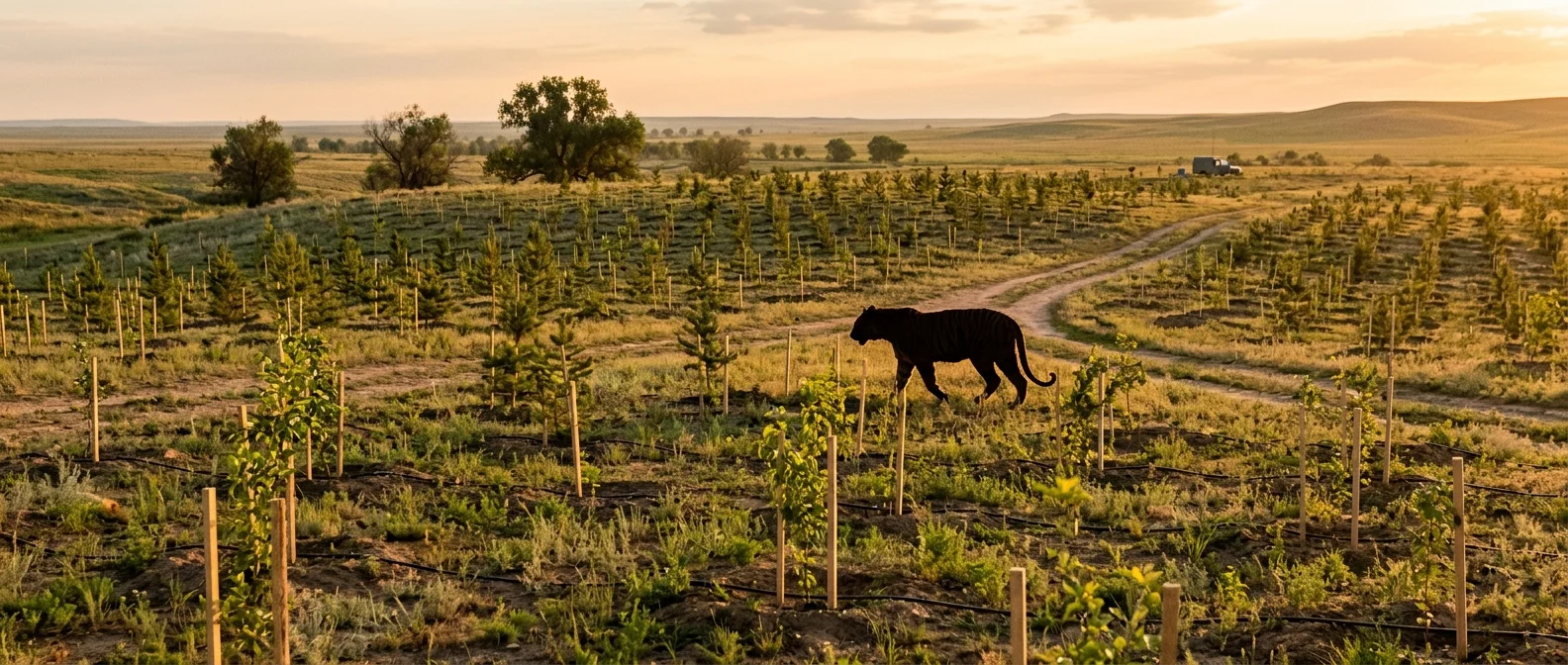
A female tiger named Bodhana walks slowly through a fenced section of forest in southeastern Kazakhstan. Around her, tens of thousands of young trees push their roots into fresh soil near Lake Balkhash. This tiger wasn't born here — she came from a sanctuary in the Netherlands. But her ancestors walked these lands before vanishing over 70 years ago.
📖 Read more: Squirrels Plant Millions of Trees by Accident
🐅 The Caspian Tiger: A Species Lost
Kazakhstan's last tigers disappeared in the late 1940s. They were part of a population known as the Caspian tiger — one of the largest cats Central Asia ever knew. They lived in riparian forests near rivers and lakes, in a landscape that would look unrecognizable to them today. Years of hunting, systematic habitat destruction, and declining prey populations drove them to extinction.
But here's where the story takes a fascinating turn. A 2009 study published in PLOS One revealed that Caspian and Amur tigers (Panthera tigris altaica) were likely part of the same population, separated by human activity in the 19th century. Simply put, they're essentially the same animal. This discovery opened the door to a bold plan: bring Amur tigers to Kazakhstan, and you're essentially restoring the Caspian tiger.
🌳 37,000 Trees in One Year
Before you bring tigers, you must first build their world. In 2025, the tiger reintroduction program — led by Kazakhstan's government with support from WWF and the UN Development Programme — planted 37,000 seedlings and saplings in the South Balkhash region, according to WWF Central Asia. These were added to the 50,000 seedlings planted between 2021 and 2024.
The planting zone extends along 4 kilometers of Lake Balkhash shoreline — Central Asia's largest lake and the world's 15th largest. The new vegetation includes 30,000 Russian olive seedlings, 5,000 willow saplings, and 2,000 Turanga poplar seedlings, creating forest “islands” that regulate water flow.
🦌 First the Prey, Then the Predators
A tiger without prey is a tiger that will starve — or kill livestock. That's why the trees aren't planted randomly. The forests provide shelter, water access, and food for the terrestrial mammals that form the foundation of a tiger's diet: wild boar and Bukhara deer (Cervus elaphus bactrianus).
And the first signs are encouraging. "Already, wild ungulates have been observed feeding in the restored sites, showing that the ecosystem is beginning to function," a WWF Central Asia spokesperson said. "Every planted seedling is a direct contribution to the tiger's future in Kazakhstan."

🏠 Bodhana and Kuma: The First Residents
In 2024, two Amur tigers arrived in Kazakhstan — a female named Bodhana and a male named Kuma, from an animal sanctuary in the Netherlands. They live in a special enclosure within the Ile-Balkhash Nature Reserve. Both tigers were raised in captivity, so they will never be released into the wild. The hope is that their offspring will become part of a new founding population.
There's no guarantee they'll reproduce or that their cubs will be suitable for the wild. That's why the main bulk of the new population will come from wild tigers imported from Russia. According to Kazakhstani officials, the first Russian tigers were expected within the first half of 2026.
🔢 Reforestation by the Numbers
The planting zone near Lake Balkhash is part of a massive national initiative. Kazakhstan has planted approximately 1.4 billion trees since 2021 and aims to reach 2 billion by 2027. In South Balkhash, between 2021-2025, 87,000 seedlings and saplings were planted specifically for creating tiger habitat.
⚠️ The Risks: Tigers Near Humans
Reintroducing large predators isn't a risk-free idea. A 2024 study in the Journal of Wildlife Management examined a Russian program where six orphaned wild tiger cubs were prepared and released. Most hunted on their own and survived. However, one tiger killed over 13 goats in a single incident and didn't show enough fear of humans. That particular tiger was recaptured and moved to a zoo.
📖 Read more: Forest Die-Off Crisis: Why Millions of Trees Are Dying
Kazakhstan appears prepared. A special team will permanently monitor released tigers through satellite collars, detect any potential approach to settlements, and respond immediately to human-wildlife conflict incidents.

🤝 Coexistence: Community at the Center
The measures don't stop at monitoring. The program actively collaborates with local communities to increase awareness about tigers and proper behavior around them. How do you react if you see a tiger? How do you protect your herd? What signs show one is approaching? These aren't theoretical questions — they're practical issues affecting herders and farmers. Sustainable development programs are also promoted — grants for agriculture and ecotourism — so locals benefit from the predator's return instead of seeing it as a threat.
Satellite Monitoring
Every tiger will wear a GPS satellite collar for continuous location and movement tracking.
Herder Compensation
Compensation scheme for residents in case of livestock losses from tigers.
Ecotourism
Grants to local communities for developing sustainable tourism around nature.
Rapid Response Team
Special unit for patrols, problem prevention, and crisis management.
"All of this is part of a long-term strategy for peaceful coexistence between humans and predators," a WWF Central Asia spokesperson said.
🔬 Why This Experiment Is Unique
There are wolf reintroduction programs (Yellowstone), bison (Europe), condors (California). But what Kazakhstan is doing stands apart. It's not simply returning an animal — it's rebuilding an entire ecosystem from scratch. Trees → vegetation → ungulate prey → tigers. The chain is being reconstructed step-by-step, literally from seed. It's like rewriting an entire biological story within a few decades.
Experience from similar efforts shows that success isn't guaranteed. It depends on climate, water resource stability, vegetation development rates — and above all, on an entire society's willingness to accept a top predator next to their homes.
🌍 A Second Chance for the World's Largest Cat
The Amur tiger is the largest living cat on the planet — males can exceed 300 kilograms and reach 3 meters in length without the tail. They once roamed from western China to Turkey. Today fewer than 4,000 tigers live in the wild globally, mainly in India, Russia, and Southeast Asia. The Caspian tiger's extinction was the result of decades of neglect — its return requires decades of planning.
What's happening in Kazakhstan isn't just tree planting. It's the first time a country has attempted to resurrect the entire habitat of an extinct apex predator — and then bring it back. If it succeeds, it will change how we think about species conservation. If it fails, it will show us the limits of what we can restore. Either way, 37,000 trees are now sprouting near Central Asia's largest lake. And two tigers — Bodhana and Kuma — are waiting.