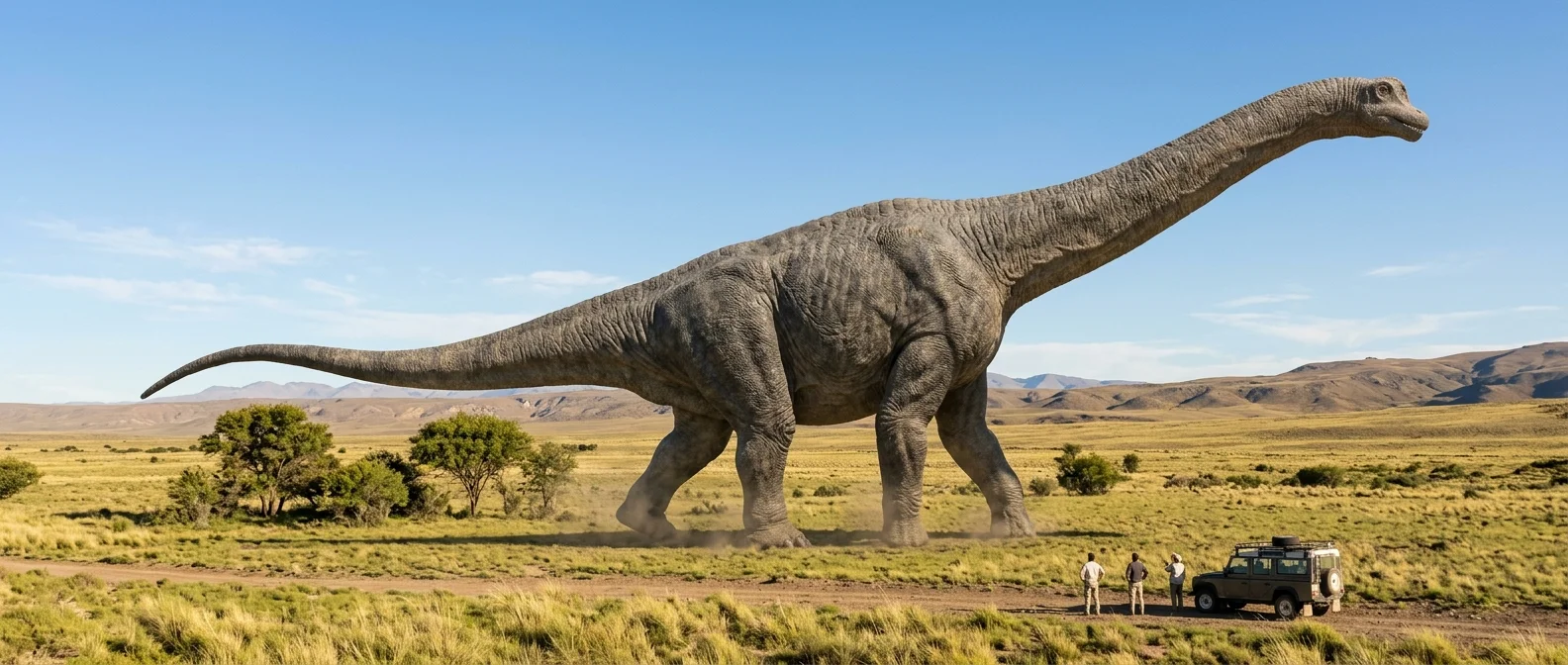
Imagine a creature so massive that every step made the ground tremble. An animal that could reach the tops of the tallest trees without even rearing up on its hind legs. For decades, paleontologists have been searching for the answer to a seemingly simple question: which was the largest dinosaur that ever set foot on our planet?
The truth is, the answer isn't simple at all. Every new excavation overturns the data, every new fossil rewrites the record books. What we know with certainty is that the champions belong to one specific group — the titanosaurs.
Titanosaurs: The Undisputed Giants
Titanosaurs were members of a broader group called sauropods — plant-eating dinosaurs with long necks, long tails, and four colossal legs. Sauropods first appeared in the Late Triassic, but reached their largest sizes during the Cretaceous Period.
Not all titanosaurs were giants — Magyarosaurus, for example, was just 16 feet long. But many within this group broke every size record in terrestrial history. They were the last major group of sauropods to survive until the asteroid impact 66 million years ago.
Patagotitan: The Length Champion
At 123 feet long and an estimated weight of 57 tons, Patagotitan mayorum is currently considered the longest dinosaur ever discovered. It lived approximately 101 million years ago, during the Early Cretaceous, in what is now Argentina's Chubut Province.
The numbers speak for themselves: Patagotitan stood about 26 feet tall. Just one of its leg bones exceeded six feet — taller than most humans. In weight, it was nine times heavier than an African elephant, the largest land animal alive today.
What makes Patagotitan stand out among the giant candidates isn't just its size, but the completeness of its fossils. It's one of the most complete titanosaurs found to date, giving scientists much greater confidence in size estimates compared to other contenders.
Argentinosaurus: The Heavyweight Contender
If Patagotitan wins on length, Argentinosaurus likely wins on weight. With an estimated mass around 70 tons — like twelve elephants combined — this titanosaur may have been the heaviest land animal of all time.
Its fossils were found in Argentina's Neuquén Province, with the first discoveries made in 1987. Argentinosaurus is believed to have lived 90 million years ago, during the Late Cretaceous, and was shorter in length — around 115 feet — but likely more massive.
There's a problem, though: Argentinosaurus is known only from fragmentary remains. A few leg bones, some vertebrae, several ribs, and a piece of sacrum — that's all we have. The incomplete picture makes weight calculations particularly difficult and leaves room for doubt.
⚖️ Patagotitan vs Argentinosaurus
🦕 Patagotitan
- Length: 123 feet
- Weight: ~57 tons
- Era: 101 million years ago
- Fossils: Very complete
- Advantage: Reliable estimates
🦕 Argentinosaurus
- Length: ~115 feet
- Weight: ~70 tons
- Era: 90 million years ago
- Fossils: Fragmentary
- Advantage: Possibly heavier
The Size Race: More Contenders
Patagotitan and Argentinosaurus weren't the only colossi. Dreadnoughtus, which lived 76-70 million years ago, was initially estimated to weigh more than a Boeing 737 — over 59 tons. Later calculations based on body volume models brought this number down to 22 tons, though some estimates fall somewhere in between.
Puertasaurus, known from just four vertebrae, is believed to have had one of the widest rib cages among all sauropods. With an estimated length of 98 feet and weight of 50 tons, it ranks consistently among the largest titanosaurs.
And let's not forget Turiasaurus, the largest dinosaur found in Europe. It lived 155-146 million years ago in Spain, and its fossils show it reached 98-128 feet in length and 51 tons in weight. Remarkably, its skull is estimated at just 28 inches — microscopic relative to its enormous body.
From Egg to Giant
Perhaps the most striking feature of these colossi wasn't their final size, but where they started. A recent 2026 study from University College London revealed how vulnerable baby sauropods were during their first years of life.
Their eggs were just 12 inches in diameter. Think about it: a creature that would become larger than a blue whale started life in an egg you could hold in your hands. The enormous size of adult sauropods likely made caring for eggs impossible without destroying them — like sea turtles today, the newborns were on their own from the first moment.
"Adult sauropods like Diplodocus and Brachiosaurus were larger than blue whales. But their eggs were only 12 inches across. Life was cheap in this ecosystem, and predators like Allosaurus sustained themselves by consuming these baby sauropods."— Dr. Cassius Morrison, UCL Earth Sciences
The study, based on 150-million-year-old fossils from the Morrison Formation in the US, showed that young sauropods formed the base of the food web. Without effective defenses, they were easy targets for predators — and perhaps this constant “feeding” explains why Jurassic predators didn't need to develop extreme hunting abilities, unlike T. rex millions of years later.
The Mystery of Gigantism
How did these animals reach such extreme sizes? The answer lies in a combination of factors. Their long necks — which in some species like Mamenchisaurus sinocanadorum reached 49 feet — allowed them to feed from vast areas of vegetation without moving their bodies.
Their hollow bones reduced weight without sacrificing strength. Bird-type lungs provided extremely efficient breathing. And reproduction through eggs meant they weren't limited by birth size like mammals — mothers could lay dozens of eggs each year.
One thing we can't ignore: almost all the largest dinosaurs come from Argentina. Patagonia was the land of giants, with its plains and rivers supporting the vegetation these colossal creatures required. If an even larger dinosaur is ever found, odds are it will emerge from Argentina's rocks too.
The Contest Continues
The title of “largest dinosaur” changes hands every few years. Each new excavation brings new contenders to the forefront. Today, Patagotitan holds the crown for longest, while Argentinosaurus battles for the title of heaviest. Tomorrow? No one can say for certain.
What we know is that millions of years ago, creatures larger than any modern imagination walked the Earth. And somewhere out there, beneath the rocks of Patagonia, perhaps another giant waits to be discovered.