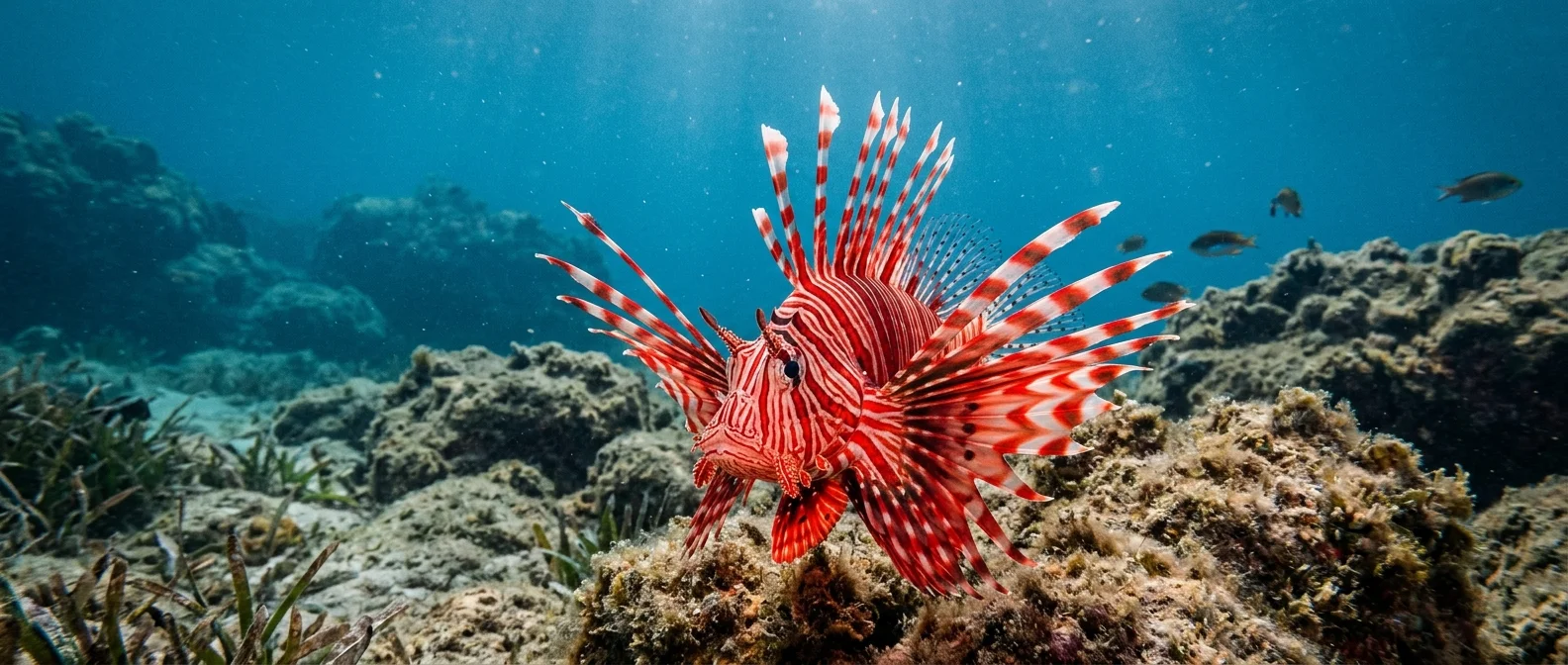
In 2012, a fish with venomous spines and striking striped fins was spotted for the first time in Cypriot waters. Today, just over a decade later, the lionfish (Pterois miles) has spread across the entire eastern Mediterranean — and scientists are calling it "the most destructive invasive fish species known to science."
📖 Read more: World's Largest Coralline Reef Discovered in Mediterranean
🚨 Invasion Timeline: How It Happened
The lionfish's Mediterranean story is a masterclass in how human intervention can reshape entire ecosystems. Pterois miles originates from the Indo-Pacific Ocean — the warm waters of the Indian Ocean and Red Sea. Genetic studies confirmed that Mediterranean lionfish populations stem from the Red Sea and likely entered through the Suez Canal.
This isn't coincidental. The Canal, connecting the Mediterranean to the Indian Ocean via the Red Sea, functions like a "severed artery" according to Professor Jason Hall-Spencer of the University of Plymouth — with invasive species pouring through it. Rising water temperatures due to climate change make the Mediterranean even more hospitable to tropical species. The lionfish isn't alone — hundreds of invasive species, known as “Lessepsian migrants,” followed the same route. But none proved as catastrophic.
🦁 The Perfect Invader
Why is the lionfish so successful? The answer lies in a combination of traits that make it nearly unstoppable in new environments. It's a generalist predator — eating virtually any fish or invertebrate that fits in its mouth. Native Mediterranean fish don't recognize it as a threat. They don't flee. They don't react.
"After years of studying these predators, I'm still impressed by how easily they can adapt to such different environments," explains Davide Bottacini, lead researcher from Wageningen University. "It's always striking to see how such an exotic and conspicuous predator can approach its prey without being detected."

Its 18 venomous spines — 13 dorsal, 3 anal, and 2 pelvic — aren't lethal to humans, but cause intense pain, swelling, and nausea that can last for days. For small Mediterranean fish, they're a deadly weapon. The lionfish's hunting method is equally effective: it spreads its fins like a fan, creating a “wall” that corners prey. Then, with lightning speed — within milliseconds — it opens its mouth creating suction and swallows entire fish. This suction is among the fastest in the fish world.
Another advantage: the lionfish is a cryptic nocturnal hunter. During nighttime, it moves slowly over the seafloor, locating prey that are sleeping or hiding in rock crevices. Native fish, having never evolved to face this threat, react as if there's no danger — some even approach the exotic fins out of curiosity. This absence of defensive behavior makes every hunt almost guaranteed success.
Voracious Predator
Consumes over 70 species of fish and invertebrates. Devours prey up to 2/3 of its body size — something extremely rare in nature.
Defensive Venom
Venomous spines deter virtually every natural predator. In the Mediterranean, no native species has learned to handle it.
Explosive Reproduction
A female spawns 20,000-30,000 eggs every few days. Reproduction continues year-round, peaking in summer.
Climate Advantage
Rising Mediterranean temperatures expand its habitat range — cold waters once unsuitable are now becoming friendly.
📖 Read more: Giant Isopod: 20-Inch Deep-Sea Armored Scavenger Discovered
📊 The Alarming Data
The research team from MER Lab Cyprus, collaborating with the Universities of Cyprus and Plymouth, recorded lionfish ranging from 8 to 37 centimeters in length and 0.5 to 4 years in age — numbers showing the population is successfully reproducing and maturing in Cypriot waters. Females outnumbered males, concerning since one male can mate with multiple females, triggering population explosions.
The comparison with the Western Atlantic is nightmarish. There, the lionfish (Pterois volitans) was first spotted in Florida in 1994. By 2014, estimates suggested up to 1,000 lionfish per acre in certain areas — numbers that destroyed coral reefs, eliminated native herbivorous fish, and allowed algae to smother corals. The Mediterranean invasion shows similar patterns — with fish forming large aggregations, developing faster, and reaching larger sizes than in the Indian Ocean.
Atlantic Invasion
Florida 1994 → 1,000/acre by 2014. Destroyed Caribbean coral reefs. Control measures failed for 30 years running.
Mediterranean Invasion
Cyprus 2012 → rapid spread across Southern Europe. Larger sizes and faster development. Year-round reproduction — summer peak.

🔬 Research and Response Strategy
The 2024 study from Wageningen University, published in NeoBiota journal, represents the most comprehensive review of the invasion to date. Researchers analyzed all available scientific data and identified knowledge gaps — particularly regarding lionfish interactions with Mediterranean ecosystems. The Mediterranean, as the world's largest enclosed sea, hosts over 11,000 animal species — many unique globally.
Meanwhile, the European RELIONMED program (€1.6 million funding, 4 years) focuses on Cyprus as the invasion epicenter. Goals include: mapping the expansion history, assessing impacts on native species, and developing containment strategies. Savva Ioannis, lead researcher at MER Lab, explained: "Among the numerous threats to our marine ecosystems, biological pollution is less apparent to human perception. But in reality, it's powerful enough to disrupt ecological balance."
The study emphasized the critical role of citizen science — citizen divers, fishermen, and observers record lionfish sightings and provide data supporting research. This community involvement is essential for understanding expansion dynamics and designing effective control measures. In Cyprus, diver training programs for lionfish recognition and reporting are already operational — a network of thousands of “eyes” beneath the surface.
Why it can't be eradicated
The scale of expansion suggests lionfish can no longer be eradicated from the Mediterranean. Scientists propose creating a dedicated lionfish fishing industry — it's edible, tasty, and commercial fishing could reduce populations.
🌍 What It Means for the Mediterranean
The Mediterranean already faces enormous pressures — overfishing, pollution, climate change, plastics. Adding an invasive super-predator could prove the final straw. Lionfish don't just eat common fish — they prey on endemic species of high conservation value, many existing only in the Mediterranean. Greece, Turkey, Lebanon, and Egypt report increasing sightings, while it now appears in colder waters previously considered unsuitable for the species.
Biosecurity policy for the Suez Canal remains inadequate. Professor Hall-Spencer emphasizes that "the recent rapid spread of lionfish is a serious concern for marine life balance, as this is the most harmful invasive fish species known to science." Without drastic action, the Atlantic's story risks repeating — this time in a sea already suffering. Unlike the Atlantic, the Mediterranean is an enclosed basin — native species can't simply migrate elsewhere.
"The Suez Canal is like a severed artery, with invasive marine species pouring through it. The recent lionfish spread is a serious concern — this is the most destructive invasive fish known to science."
— Prof. Jason Hall-Spencer, University of Plymouth (2020)