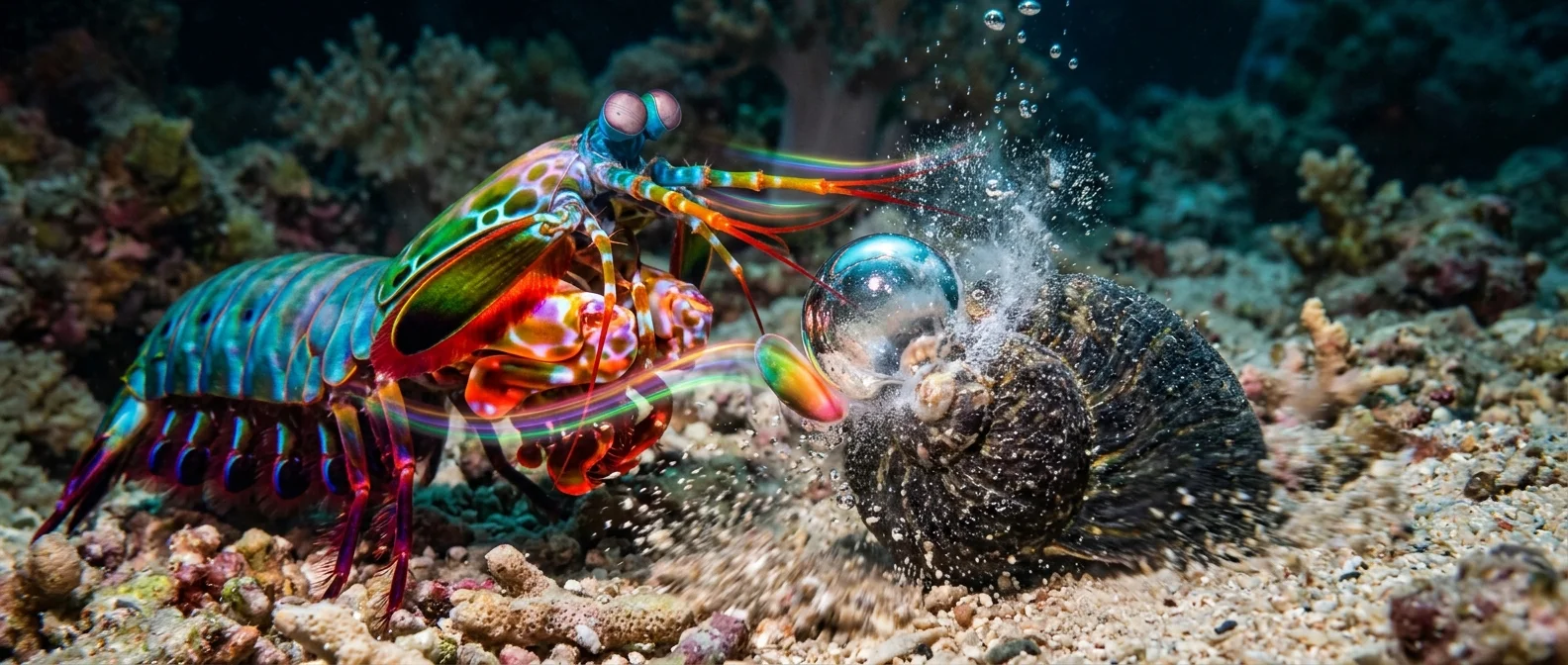
Imagine a 6-inch crustacean that punches with the force of a bullet. A creature that sees colors invisible to human eyes, shatters aquarium glass with a single blow, and whose fist creates bubbles so powerful they emit light and heat reaching thousands of degrees. This isn't science fiction — it's the daily reality of the mantis shrimp, the deadliest puncher in the animal kingdom. And scientists just discovered it wears hidden ballistic armor.
📖 Read more: Killer Whales Turn Cannibal: Orcas Hunt Their Own Kind
Nature's Most Powerful Punch
Mantis shrimp (order Stomatopoda) comprise a group of approximately 450 species of marine crustaceans living in tropical and subtropical shallow waters. Despite their small size — typically 4 to 15 inches — they hold the absolute speed record for striking in the animal kingdom. Their specialized front appendages, known as dactyl clubs, shoot out at speeds reaching 50 miles per hour — as fast as a .22 caliber bullet.
But speed is just the beginning. As the club slices through water, it creates a low-pressure zone behind it — a phenomenon known as cavitation. Bubbles form that, when they collapse within milliseconds, emit megahertz pressure waves, heat reaching 8,500°F (close to the sun's surface temperature), and even a faint flash of light — a phenomenon called sonoluminescence. The victim receives a double hit: first the physical impact of the club, then immediately the pressure wave from collapsing bubbles.
Bioceramics: The Secret Spring
How does such a small creature generate such devastating force? The answer lies in an impressive bioengineering structure. Researchers from Nanyang Technological University in Singapore, led by Ali Miserez, revealed in 2018 in the journal iScience that inside the mantis shrimp's appendages exists a saddle-shaped structure that functions as a biological spring.
Dual Layer
The saddle-shaped structure consists of two layers: an upper bioceramic layer, similar to bone or tooth enamel, and a lower biopolymeric layer, fibrous like rope.
Compression & Tension
During loading, the ceramic layer compresses while the polymeric layer stretches — each material receives exactly the force it handles best.
Energy Storage
Muscles slowly load the spring while tendon-latches hold it. When released, it fires all the energy in milliseconds.
Explosive Release
Design equivalent to a ceramic spring — something no engineer would think of. Stores more energy than metal or polymer.
"If you asked a mechanical engineer to make a spring that stores a lot of elastic energy, they wouldn't think to use ceramic," explains Miserez. "But if you compress them, ceramics are quite strong. And they're stiffer than metal or polymer, so you can store more energy." His team has begun 3D printing mantis shrimp-inspired springs with potential applications in micro-robotics.

Phononic Shield: How It Survives Its Own Strikes
One question remained: how does the mantis shrimp not self-destruct from its own deadly blows? In February 2025, a team from Northwestern University led by Professor Horacio D. Espinosa published in the top journal Science an answer that surprised the scientific world: the dactyl clubs carry an integrated phononic filter — a structure that selectively filters pressure waves.
Two-Level Phononic Shield
The impact region consists of mineralized fibers in a herringbone pattern that resists cracking. Below it, the periodic region consists of twisted fiber bundles in a corkscrew shape (Bouligand structure) — each layer rotates relative to the previous one. This structure functions as a phononic shield, selectively blocking high-frequency shear waves that would destroy internal tissues.
"The mantis shrimp is known for its incredibly powerful punch that can break mollusk shells and even crack aquarium glass," explains Espinosa. "However, to repeatedly perform these high-impact strikes, the club must have a robust protection mechanism against self-damage." The team used two advanced techniques — transient grating spectroscopy and picosecond laser ultrasonics — to examine how pressure waves travel through the armor.
The findings have immediate practical applications: the Bouligand structure could inspire new protective materials for military vehicles, sports equipment, and ballistic vests. The research was funded by the Air Force Office of Scientific Research, Office of Naval Research, and National Science Foundation — underscoring the military significance of the discovery.
Superiority Inside and Out: The Vision Truth
Beyond their fighting ability, mantis shrimp possess the most complex visual system in the animal kingdom. While the human eye has 3 types of color photoreceptors (red, green, blue), mantis shrimp have 12 to 16 — seeing colors from ultraviolet to infrared. They can also detect light polarization, including circular polarization, something extremely rare in the animal kingdom.

Tripartite Band
Each eye divides into three zones with a central “midband” of 6 rows of ommatidia, specialized for color and polarization detection.
Independent Movement
The two eyes move independently of each other, scanning the environment in 360 degrees — they literally see everything simultaneously.
Smashers vs Spearers: Two Philosophies of Death
Mantis shrimp divide into two main categories based on attack method. Smashers use club-like appendages to crush hard shells — crabs, snails, mollusks. Spearers have sharp, barbed appendages that shoot into soft-bodied prey — fish and worms. Both types use the same spring-latch mechanism but with completely different morphology of the final weapon.
A common trait is their territorial aggression. They live solitary in burrows they dig in sand or rock crevices, which they defend fiercely. In aquariums, they're notorious for their habit of breaking glass — a fact that has made them infamous among aquarists who call them “thumb splitters.”
Unexpected Intelligence
Researchers discovered a brain region in mantis shrimp called the reniform body — a neural structure that processes complex visual information. Some mantis shrimp recognize individual opponents, remember the outcome of previous fights, and avoid rivals that have defeated them in the past.
From Ocean to Industry
The mantis shrimp has become a muse for biomimetic engineering. The discovery of bio-ceramic springs leads to new micro-robotic actuator designs. The Bouligand structure inspires next-generation ballistic materials. Their compound eyes drive pioneering polarization sensor designs for satellite remote sensing and medical imaging. Even their colorful armor — which changes fluorescence under UV light — is studied for applications in next-generation optical filters.
Ultimately, this small tropical arthropod represents hundreds of millions of years of evolutionary perfection. Every aspect of its body — from lightning springs and phononic shields to hyperspectral eyes — constitutes an engineering lesson that human technology is just beginning to decode. Nature, it seems, built the perfect fighter long before we invented gunpowder.