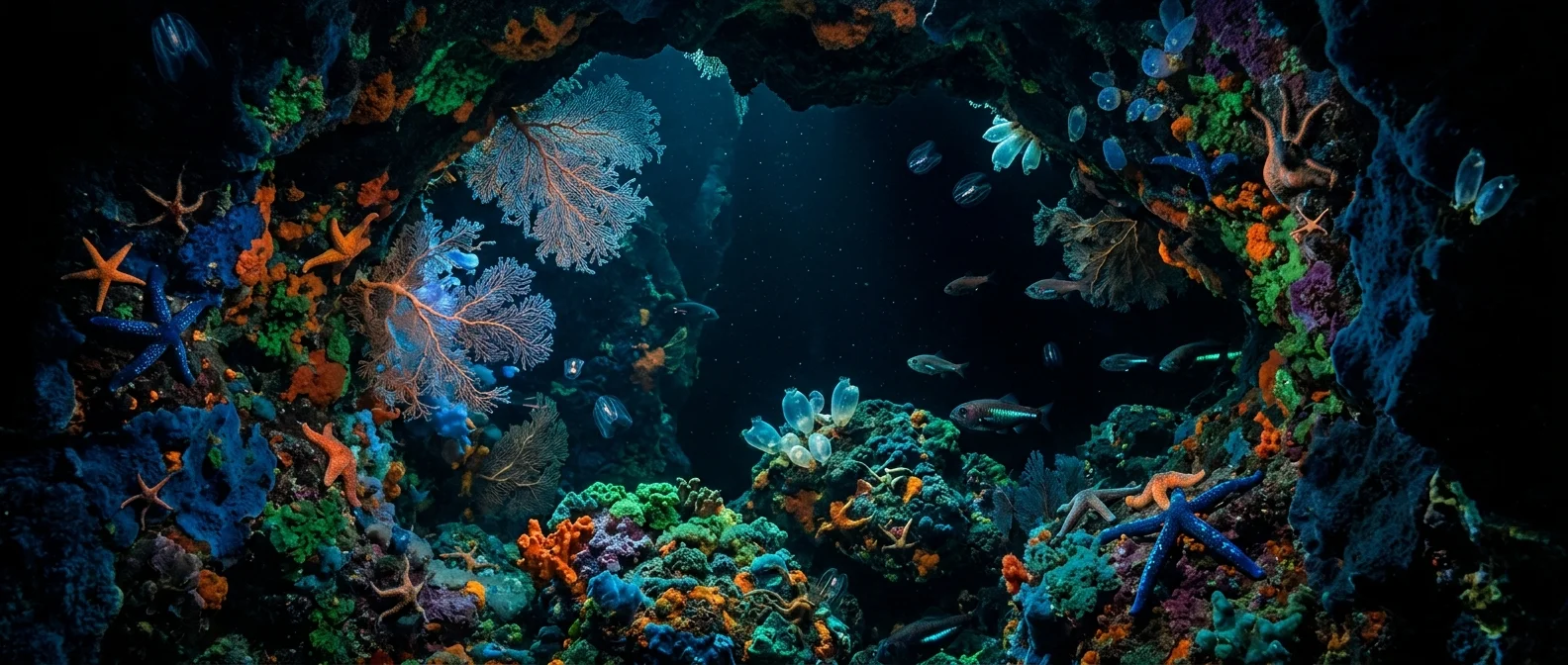
You descend through a cenote in Mexico's Yucatan Peninsula. Sunlight fades within meters. Around you, silence is absolute — no waves, no currents, no signs of life. Yet as your eyes adjust to the darkness, you begin to spot tiny shrimp moving slowly through the water. They feed on invisible methane. They live in an ecosystem that needs not a single ray of sunlight. Welcome to the world of underwater caves — the planet's most mysterious ecosystems.
📖 Read more: Frogs That Give Birth to Live Babies Without Tadpoles
🌑 Biodiversity Reservoirs in the Dark
Marine caves are considered “biodiversity reservoirs” — but the vast majority remain unexplored. According to a major international initiative led by Dr. Vasilis Gerovasileiou from the Hellenic Centre for Marine Research, there are more than 20,000 recorded species of cave-dwelling organisms — and the data is so scattered it severely hampers any attempt to assess their conservation status.
The WoRCS (World Register of marine Cave Species) initiative, published in Research Ideas and Outcomes, works within the framework of the World Register of Marine Species (WoRMS) to compile ecological and geographical data. The goal? Create a unified database with standardized terminology linking habitat type, salinity regimes, and cave zone for every recorded species.
🦐 Methane: The Invisible Fuel of Life
In the Ox Bel Ha cave network in northeastern Yucatan, scientists discovered an ecosystem operating by rules entirely different from the surface world. Here, methane replaces sunlight as the primary energy source.
The team led by David Brankovits from Texas A&M University at Galveston, in collaboration with the U.S. Geological Survey (USGS), conducted the most detailed ecological study ever performed on a coastal cave ecosystem permanently underwater. The results were published in Nature Communications.

Methane forms naturally beneath the jungle floor and — contrary to what usually happens in soils — migrates downward, deeper into the water and cave passages. There, bacteria and other microorganisms feed on both methane and other dissolved organic matter, creating the foundation of an entirely different food web.
"The discovery that methane and other forms of mostly invisible dissolved organic matter form the base of the food web in these cave environments explains why cave-adapted animals can thrive in the water column in a habitat with no visible signs of food" — David Brankovits, lead researcher, Texas A&M University at Galveston
🔬 Underground Estuary: Two Worlds in One Cave
The Ox Bel Ha cave network is described as an “underground estuary” because the flooded corridors contain two distinct water layers: fresh water fed by rainfall and saltwater from the coastal ocean. This underground estuary complex covers an area roughly equal to Galveston Bay — the seventh-largest bay in the United States.
The cenotes — natural sinkholes used to access cave systems — serve as important freshwater sources for communities throughout the Yucatan. The Maya considered them gateways to the Underworld. Today, scientists are discovering that mythology wasn't far from the truth.
🤿 The Art of Cave Diving
To study these ecosystems, scientists used techniques previously employed only by deep-sea submersibles. Every member of the research team was a trained cave diver, following strict safety protocols.
Tom Iliffe, Professor of Marine Biology at Texas A&M, has studied the biodiversity, evolution, and conservation of marine cave animals for nearly 40 years. "Providing a model for the basic functioning of this globally distributed ecosystem is an important contribution to coastal groundwater ecology," he noted, "and establishes a baseline for assessing how sea-level rise, coastal tourism development, and other stresses will affect the sustainability of these lightless and foodless systems."
Submersible techniques
Researchers used methods first applied in deep-sea missions
Cave diver-scientists
Every scientist was a certified cave diver with strict safety protocols
40 years of research
Professor Tom Iliffe has studied cave marine animals for four decades

⚠️ Threats to an Invisible World
The greatest tragedy of these ecosystems is that they're being destroyed before we even discover them. Uncontrolled coastal urbanization poses a direct threat to cave systems worldwide. Biodiversity data remains so fragmented that conservation status assessments are severely hampered.
The WoRCS initiative plans to engage both scientific communities and citizen scientists, developing maps, guides, and courses, involving volunteers in data coding, and creating tools for Marine Protected Area managers. The WoRCS team proposes that every future funded program for cave ecosystems should include a work package dedicated to data collection and coding.
Uncontrolled destruction: Coastal urbanization, sea-level rise, and tourism development threaten ecosystems we haven't even mapped. According to researchers, conservation assessment of these species is “severely hampered” by fragmentation of existing data.
🌍 Why Caves Are Changing Biology
One of the most surprising findings from the Ox Bel Ha study was that food doesn't come from the surface. Previous studies assumed that the majority of organic matter in cave ecosystems came from vegetation and tropical forest debris washed into caves through cenotes. Reality proved entirely different.
Deep within caves — far from cenotes — there are virtually no surface remains. Microbes depend exclusively on methane and dissolved organics seeping through the ceiling. These processes are analogous to those occurring in the global ocean, particularly in “oxygen minimum zones” — areas where deoxygenation is an increasing concern.
Methane downward
Instead of rising to the atmosphere, methane migrates deeper into cave passages
Ceiling as source
Dissolved organics seep from the ceiling — not from surface cenotes
Global model
Processes mimic ocean “oxygen minimum zones”
Underwater cave systems aren't just geological curiosities. They're living laboratories showing us how life can exist without the sun — information with enormous implications for both terrestrial ecology and the search for extraterrestrial life in dark underground oceans, from Enceladus to Jupiter's Europa.