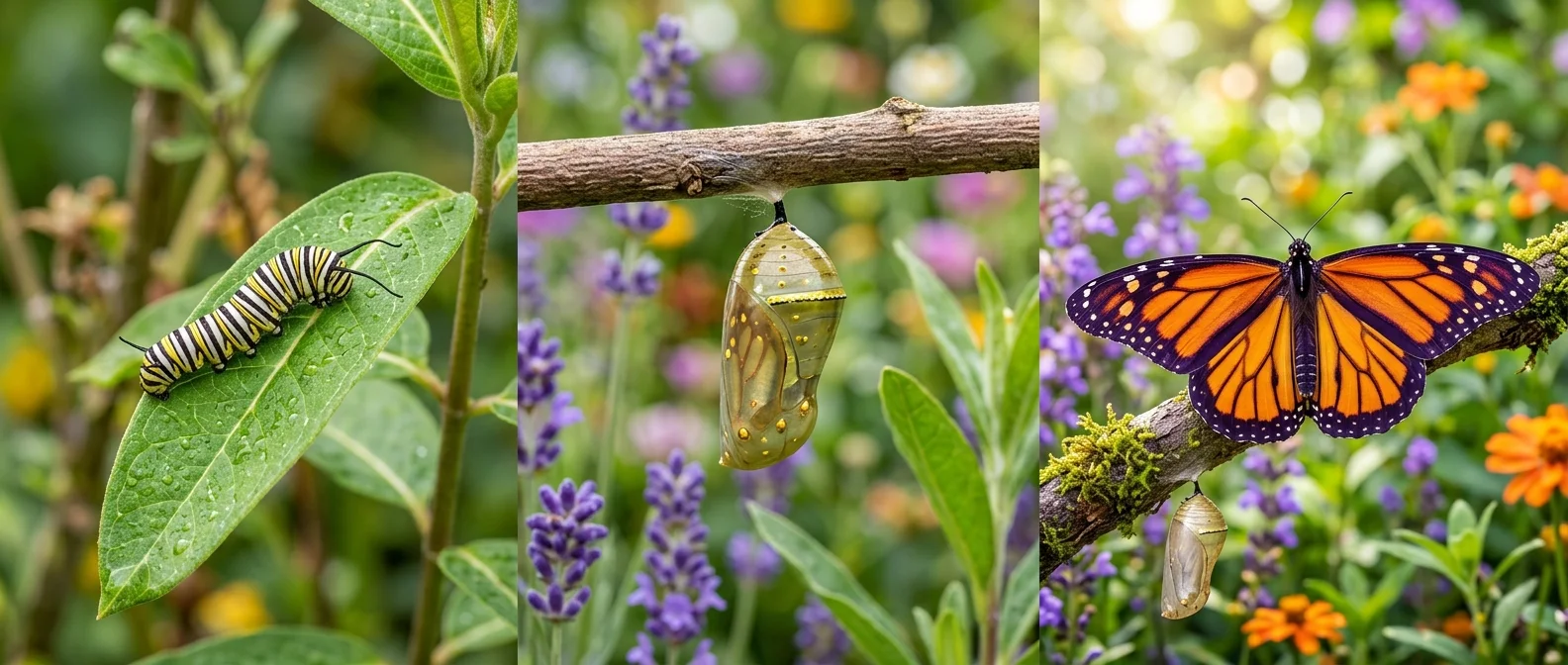
Imagine entering a cocoon, literally dissolving into cellular soup, and waking up two weeks later with a completely different body — wings, compound eyes, and a mouth that sips nectar instead of chewing leaves. This is exactly what millions of insects do every day. Complete metamorphosis is perhaps the most radical biological phenomenon in nature — and the mechanisms behind it remain partly mysterious.
Two Types of Metamorphosis: Incomplete vs Complete
Not all insects metamorphose the same way. Hemimetabolous insects — grasshoppers, cockroaches, dragonflies — undergo incomplete metamorphosis: juveniles resemble miniature adults (nymphs), grow gradually through molts, and acquire wings in the final stage. Holometabolous insects — butterflies, beetles, flies, bees, ants — do something far more dramatic: the larva (caterpillar, grub) enters a pupal stage (chrysalis or cocoon), where the body is almost completely deconstructed and rebuilt from scratch.
The numbers are staggering: holometabolous insects represent over 85% of all insect species — roughly 800,000 known species. Complete metamorphosis emerged 280 million years ago, in the Permian, and proved so evolutionarily successful that it came to dominate the biosphere. The reason? It allows larvae and adults to exploit completely different ecological niches — the caterpillar eats leaves, the butterfly drinks nectar — drastically reducing competition between generations of the same species.
What Happens Inside the Chrysalis: The “Soup”
When a caterpillar forms a chrysalis, enzymes called caspases activate — the same proteolytic enzymes that cause apoptosis (programmed cell death) in the human body. Muscles, intestines, eyes, legs — nearly every tissue dissolves. What remains is literally a “soup” of cells, rich in amino acids and nutrients. But within this soup, microscopic structures survive: the imaginal discs.
Imaginal discs are clusters of undifferentiated cells — “architectural blueprints” of the future adult — that exist inside the caterpillar from the moment of hatching, dormant and invisible while the caterpillar feeds and grows. The Manduca sexta (tobacco hornworm) caterpillar carries separate discs for wings, legs, antennae, eyes, and reproductive organs. During metamorphosis, these discs “awaken,” multiply rapidly, and use the nutrients from the dissolved caterpillar as fuel to build the new body. Each disc “knows” what it must become — a wing disc will always become a wing, never a leg — thanks to position genes (Hox genes) that determine the identity of each body segment.

Two Hormones That Control Everything
Metamorphosis is orchestrated by two hormones: ecdysone and juvenile hormone (JH). Ecdysone — produced by the prothoracic glands — sends the signal “change form.” JH — produced by the corpora allata — says “stay larval.” As long as JH levels are high, each molt simply produces a larger caterpillar. In the final larval stage (instar), JH drops dramatically. Now, ecdysone acts alone — and triggers metamorphosis.
The system is incredibly precise: ecdysone activates gene cascades through nuclear receptors (EcR), opening and closing thousands of genes in predetermined sequence. Early response genes like E74, E75, and Broad-Complex activate first and regulate the target genes that execute actual tissue remodeling. A single error in the timing sequence can create lethal developmental abnormalities — the precision of this genetic timetable is a marvel of molecular biology.
Silk, Hooks, and Safety Belts
Before the caterpillar begins metamorphosis, it must first secure a safe anchor point. According to a study by Xia, Dong et al. in ACS Biomaterials Science & Engineering (2024), butterfly caterpillars use extremely sophisticated silk constructions. The cremaster — a hook-like structure at the rear of the chrysalis — grips a silk “pad” like a velcro system. The study examined Danaus chrysippus and Papilio polytes species and discovered that, while butterfly silk is thinner and weaker than silkworm silk (fewer beta sheet structures), caterpillars weave ~20 strands together, creating improvised safety belts 8 times stronger than a single thread.
Memory Survives: What Does the Butterfly Remember?
One of the most astonishing findings in metamorphosis biology: memory can survive. According to the study by Blackiston, Casey, Weiss in PLoS ONE (2008) at Georgetown University, tobacco hornworm caterpillars (Manduca sexta) were trained to avoid specific odors (associated with mild electric shock). When adult moths emerged from pupae, they continued to avoid the same odors. "The idea that a caterpillar's experiences can survive into the adult butterfly challenges the widespread notion — that the larva essentially turns into soup," said Martha Weiss.
However, memory didn't always survive: only mature caterpillars in the final larval stage (fifth instar) retained their memories as adult moths. Younger caterpillars learned but forgot during metamorphosis. This suggests that certain neural networks mature enough to withstand remodeling — likely the mushroom body, a learning center in the insect brain, preserves critical synapses. This may have ecological significance: a female butterfly that remembers the host plant she fed on as a caterpillar can deposit her eggs on the same plant.

280 Million Years of Evolution
Complete metamorphosis emerged in the Permian (~280 million years ago) and the first holometabolous fossils belong to beetles and proto-hymenopterans. How did this radical system evolve? The prevailing theory (Berlese-Truman) suggests that the larva corresponds to a “prematurely hatched” embryo — evolution “moved” hatching earlier, creating a feeding stage (caterpillar) before the adult reproductive stage. The pupal stage emerged as an intermediate “bridge” for this transition. An alternative hypothesis (James Truman, 2019) proposes that the pupa corresponds evolutionarily to the final nymphal stage of hemimetabolous insects, which became “internalized” in a closed casing.
Metamorphosis isn't just for butterflies. Frogs undergo their own version — from tadpole to tetrapod amphibian, with thyroxine (thyroid hormone) instead of ecdysone, reorganizing the entire digestive system (from herbivory to carnivory) and gradually absorbing the tail. Flatfish (like sole) metamorphose dramatically: one eye literally migrates to the other side of the head within weeks, while the body changes color asymmetrically. Even sea urchins turn their internal structures outward during the transition from larva to adult — a metamorphosis so extreme it resembles embryonic development from scratch.
Engineering Marvels: Wing Unfolding
When the butterfly emerges from the chrysalis (a process called eclosion), its wings are crumpled and soft. Within ~30 minutes it pumps hemolymph (insect “blood,” which is yellow-green and doesn't carry oxygen) through wing veins, fully expanding them. Once they dry and harden (through sclerotization — linking chitin proteins), they become structurally extremely strong, with microscopic scales covering the surface and providing color through structural coloration (iridescence, not pigments). Monarchs (Danaus plexippus) fly 3,000 miles from Canada to Mexico with wings constructed inside a chrysalis — an engineering masterpiece weighing just 0.5 grams.
Why We Study Metamorphosis Today
Understanding metamorphosis has direct practical applications: ecdysone inhibitors are used as insecticides (e.g., tebufenozide, which causes premature and lethal metamorphosis), while JH analogs (like methoprene added to water) prevent mosquito larvae from maturing into biting insects — a crucial tool against malaria and dengue fever. In biomedicine, imaginal discs are studied as models of tissue regeneration: how does a cluster of undifferentiated cells “know” to build an entire wing? The answer may lead to new regenerative therapies in humans. Metamorphosis isn't just a marvel of nature — it's a roadmap for the biotechnology of the future.
Sources:
- Blackiston, D.J., Casey, E.S., Weiss, M.R. "Retention of Memory through Metamorphosis: Can a Moth Remember What It Learned As a Caterpillar?" PLoS ONE, 3(3): e1736, 2008. Georgetown University.
- Xia, Q., Dong, Z. et al. “How do butterflies stick to branches during metamorphosis?” ACS Biomaterials Science & Engineering, 2024. American Chemical Society.