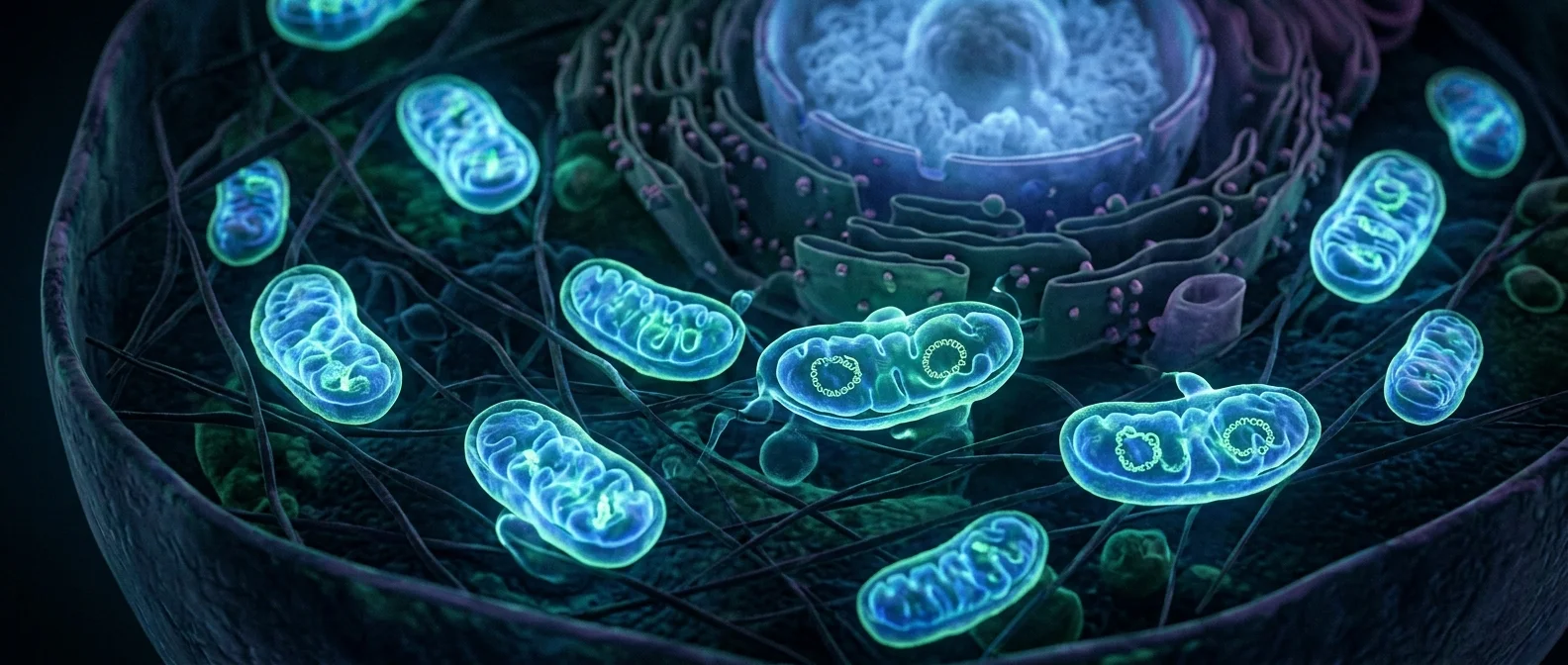
Inside every cell in your body — except red blood cells — live hundreds of microscopic organisms with their own DNA. They're not viruses. They're not parasites. They're mitochondria, and two billion years ago they were free-swimming bacteria in ancient oceans. At some point, a primitive archaeal cell swallowed them. Instead of digesting them, it kept them alive inside. And this bizarre biological partnership became the foundation for every complex organism on the planet.
📖 Read more: Nautilus: 500-Million-Year Living Fossil Unchanged by Time
The Discovery Nobody Believed
In 1967, a biologist at Boston University published a proposal the scientific community considered outrageous. Lynn Margulis argued that mitochondria weren't created inside cells — but were once independent bacteria incorporated through a process she called endosymbiosis. Her work was rejected by 15 journals before finally being published. As an idea, it was so radical that many biologists ignored it for years.
Margulis didn't give up. She continued gathering evidence — morphological, biochemical, genetic. She looked at mitochondria under electron microscopes and saw structures that resembled bacteria more than cellular components. Gradually, the rest of the scientific community began recognizing the evidence. Today, endosymbiotic theory is considered one of the foundational ideas in modern biology.
DNA That Doesn't Belong to You
Every mitochondrion carries its own genetic material — a small, circular DNA molecule completely separate from the 23 chromosome pairs in the nucleus. This mitochondrial DNA (mtDNA) consists of 16,569 base pairs and encodes 37 genes: 13 for proteins, 22 for transfer RNA, and 2 for ribosomal RNA. The number seems small compared to the 20,000+ genes in the nucleus, but these 37 genes are critical — without them, the electron transport chain stops and energy production collapses.
And here things get even stranger. If you compare mtDNA structure with that of modern bacteria — especially alphaproteobacteria — the similarity is striking. Circular molecule without histones, distinctive ribosomes, antibiotics that affect both. Mitochondria still retain their “bacterial identity,” two billion years later.

The Body's Energy Factories
The most famous role of mitochondria is ATP production — the molecular “currency” of energy in every living cell. Through oxidative phosphorylation, mitochondria convert glucose and oxygen into usable energy with remarkable efficiency. Consider the numbers: a single glucose molecule through anaerobic fermentation yields 2 ATP molecules. The same molecule, through mitochondria? Up to 36 ATP molecules. The human body produces roughly its own weight in ATP every day — almost entirely through mitochondria.
This massive efficiency difference explains why endosymbiosis was so evolutionarily revolutionary. Before mitochondria, cells were limited to anaerobic metabolisms with minimal energy yield. After incorporation, the energy available to them multiplied. The result? Larger cells, more complex internal structures, and eventually multicellular organisms. Biochemist Nick Lane has argued that without mitochondria, neither plants would exist, nor animals, nor fungi — nothing beyond simple bacteria in ancient oceans.
Maternal Inheritance: Only From Mother
Unlike nuclear DNA inherited from two parents, mitochondrial DNA comes exclusively from your mother. The reason is purely mechanical: during fertilization, the sperm contributes almost exclusively nuclear DNA. The father's few mitochondria — located in the sperm's tail and providing energy for swimming — are tagged with ubiquitin and actively destroyed after entering the egg. Maternal mitochondria, conversely, wait inside the egg — approximately 100,000 to 200,000 in each egg.
This creates a clean genealogical line. You can trace your maternal ancestry thousands of generations back. Geneticists have used this property to map human species migrations. The so-called “Mitochondrial Eve” — the most recent common maternal ancestor of all modern humans — is estimated to have lived in Africa about 200,000 years ago.
She wasn't the only woman of her time. She was simply the one whose mitochondrial line was never broken through daughters.
📖 Read more: Parasaurolophus: The Singing Dinosaur That Played Music
Evidence of Bacterial Origin
Beyond DNA, mitochondria betray their ancient origin in many ways. They have a double membrane — the inner one resembles a bacterial membrane and forms folds known as cristae that increase reaction surface area. They divide autonomously through binary fission, exactly like bacteria, on a schedule independent of host cell division. Their ribosomes (70S) resemble bacterial ones, not the larger eukaryotic (80S) ribosomes.
A striking detail: certain antibiotics, like chloramphenicol, inhibit protein synthesis in bacteria and mitochondria — while not affecting cytoplasmic ribosomes. The reason? Mitochondria still retain their bacterial protein translation machinery. This seemingly small detail was one of the first biochemical findings supporting endosymbiotic theory, decades before genetic sequencing analyses became feasible and accessible.

Cellular Death: Mitochondria Decide
Energy production isn't their only role. Mitochondria control programmed cell death, known as apoptosis. When a cell suffers serious damage — infection, radiation, mutations — mitochondria release cytochrome c into the cytoplasm, activating a chain of enzymes (caspases) that methodically disassemble the cell.
Without this mechanism, damaged cells would continue multiplying uncontrollably. And indeed, many cancer types show mitochondrial dysfunction — cells fail to die when they should. The mitochondria-cancer relationship is one of the most active fields in oncological research today.
Mitochondria and Aging
Every time mitochondria produce energy, they release oxygen free radicals — unstable molecules that can damage proteins, lipids, and DNA. Over years, these micro-damages accumulate. Mitochondrial DNA is particularly vulnerable because it lacks the same repair mechanisms as nuclear DNA. This gradual molecular wear is considered one of the basic mechanisms of aging.
Researchers at the Karolinska Institute created mice with defective mitochondrial DNA replication enzyme. The animals aged prematurely: losing hair, reducing muscle mass, showing cardiac problems. Conversely, experiments improving mitochondrial function through exercise or intermittent fasting show delayed aging at the cellular level. Mitochondria, it seems, don't just determine how much energy you have — but how fast you age.
Mitochondrial Diseases and Modern Medicine
Mutations in mitochondrial DNA cause a group of rare but devastating diseases. Leber hereditary optic neuropathy, MELAS syndrome, Kearns-Sayre syndrome — all related to dysfunctional mitochondria unable to produce enough energy for cells that need it most. The organs affected first are those with the highest energy demands: the brain with its billions of neurons, skeletal muscles, the heart, and the eye's retina.
In 2016, Britain approved a pioneering technique known as “three-parent babies.” Some mothers carry mitochondrial mutations that cannot be avoided with classic prenatal genetics. The solution? Transfer nuclear DNA to a donor egg with healthy mitochondria from a third woman. The result: a child with nuclear DNA from both parents and mitochondrial DNA from a donor. The technique raises ethical questions around genetic modification, but for families facing catastrophic mitochondrial diseases, it represents real hope.
The ancient bacteria that entered our cells two billion years ago aren't just energy factories. They control the life and death of every cell, regulate aging, keep the maternal genealogical line intact, and remain biologically foreign inside us — with their own genetic code, their own reproduction, their own evolutionary history. Perhaps the oldest tenant that will never leave.
Sources:
- Margulis, “Origin of Eukaryotic Cells,” Yale University Press, 1970
- Gray, Burger & Lang, “Mitochondrial Evolution,” Science, 1999