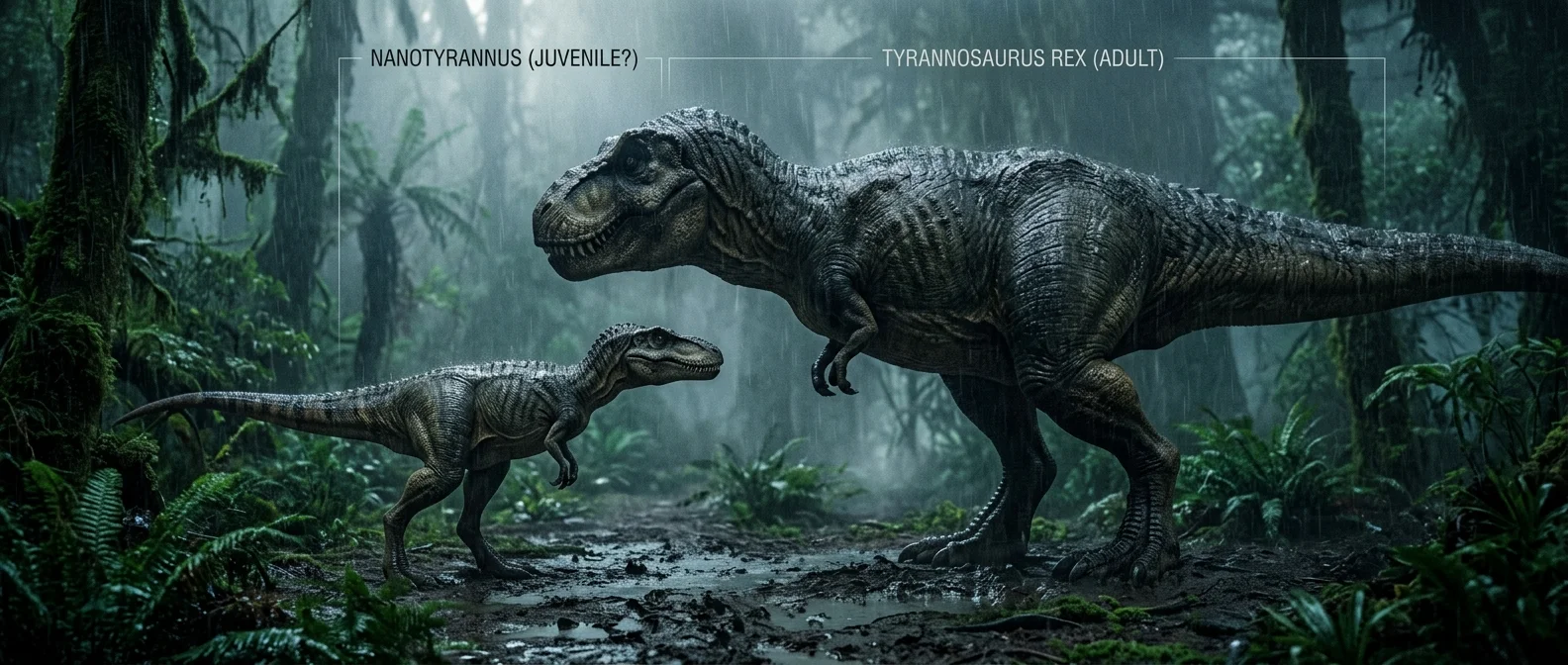
In paleontology, few debates burn as fiercely — or last as long — as the one surrounding Nanotyrannus. For over 80 years, scientists have been locked in an almost literal battle over a single question: Was Nanotyrannus a distinct species of dwarf tyrannosaur, or simply a young Tyrannosaurus rex that never reached adulthood?
📖 Read more: Pachycephalosaurus: Head-Butting Terror That Scared T-Rex
A Skull That Started Everything
The story begins in 1942, when American paleontologist David H. Dunkle discovered a small but nearly complete skull in Montana's Lance Formation. Charles Gilmore classified it as Gorgosaurus lancensis — a juvenile specimen of a known tyrannosaur. Nothing unusual there, initially. The skull ended up at the Cleveland Museum of Natural History, where it remained relatively ignored for decades.
Until Robert T. Bakker arrived. In 1988, the legendary — and often provocative — paleontologist re-examined the skull and announced something that ignited a firestorm: this was an entirely new genus of tyrannosaur. He named it Nanotyrannus lancensis — the “dwarf tyrant” — arguing that the skull bones were fused, indicating an adult. If he was right, it meant a microscopic predator roamed alongside the gigantic T. rex in the same habitats.
The “Separate Species” Case
Supporters of Nanotyrannus as an autonomous species present a series of compelling arguments. First, the teeth: Nanotyrannus had 14-15 teeth in the upper jaws, while adult T. rex had only 11-12. The teeth were thin and blade-like, designed for slicing, unlike the thick, bone-crushing teeth of T. rex. Second, the forelimbs were proportionally longer relative to body size. Third, the skull displayed a unique feature — a small cavity in the jugal bone — that appears in no T. rex specimen.
The Longrich et al. (2024) study in Fossil Studies strengthened this position, arguing that anatomical differences between Nanotyrannus and T. rex exceed what one would expect from simple ontogenetic development.
Even more intriguing is the CT scan analysis of the skull. The examination revealed that Nanotyrannus had exceptionally developed olfactory bulbs — proportionally larger even than those of adult T. rex. The optic lobes were also massive, indicating exceptional stereoscopic vision. If it was a separate species, this would mean Nanotyrannus was built for hunting in low-light conditions — a nocturnal predator stalking through Cretaceous forests. Some researchers believe this would explain how a small predator could coexist with T. rex without direct competition: they hunted at different times of day.
The “Juvenile T. Rex” Case
The majority of the paleontological world, however, leans toward a simpler explanation: Nanotyrannus is simply a young Tyrannosaurus rex. The primary argument is that the skull bones weren't actually fused — the exact opposite of what Bakker originally claimed. This means the animal hadn't completed its development at death.
Nanotyrannus (evidence)
- ~16 ft body length
- 14-15 teeth per jaw
- Thin, blade-like teeth
- Unfused skull bones
Adult T. Rex (evidence)
- ~40 ft body length
- 11-12 thick teeth
- Massive, crushing teeth
- Fully fused skull
A crucial argument involves the known morphological changes in T. rex's life cycle. According to Thomas Carr, a tyrannosaur specialist, young T. rex were “gracile, cute animals, like Dobermans” — light, fast, with many thin teeth (up to 74 in juveniles). After age 13-14, they transformed rapidly: skulls became deep, teeth thickened, entire bodies “bulked up” — a change he compares to transitioning “from Doberman to Pitbull in just a few years.”
📖 Read more: Velociraptor: Hollywood Myths vs Scientific Reality
"Jane" and the Bones That Speak
The 2001 discovery of a more complete specimen changed everything. “Jane” (BMR P2002.4.1), a young tyrannosaur about 21 feet long found in Montana by the Burpee Museum team, displayed characteristics of both Nanotyrannus and juvenile T. rex. Histological analysis of the bones — studying growth rings within the bones themselves — revealed that Jane was about 11 years old at death and far from full maturity.
Holly Woodward and her team at Oklahoma State University published a definitive 2020 bone histology study, examining growth rings in two disputed tyrannosaur specimens. The conclusion: the animals weren't fully developed at death — significantly strengthening the position that these are juvenile T. rex.
The transformation was dramatic in numbers. A young T. rex at 10-12 years weighed only 1,100-2,200 pounds. Within a decade, weight skyrocketed to 11-18 tons — adding over 4 pounds daily for years. Growth was so explosive it literally altered every bone in the body. Teeth decreased in number (from 74 in juveniles to just 54 in adults) but increased dramatically in thickness — some reaching banana size. This radical change makes comparing juvenile specimens to adults nearly impossible, since they resemble completely different animals.
The Little Tyrant in Its World
Whether a separate species or juvenile T. rex, Nanotyrannus — or the animal behind that name — lived in western North America during the late Cretaceous (68-66 million years ago). The region was vastly different from today: a shallow inland sea split the continent, while the young Rocky Mountains rose to the west. Climate was humid and warm year-round, with forests of oak, birch, conifers, and magnolias.
In this ecosystem roamed Triceratops, hadrosaurs, ankylosaurs — and of course the colossal T. rex. A small, agile 16-foot predator with stereoscopic vision and sharp teeth would have its own role in this arena. If it was a juvenile T. rex, it hunted prey appropriate to its size — small mammals, reptiles, young dinosaurs — before beginning the dramatic transformation toward gigantic adulthood.
Speed would be its greatest advantage. With longer legs relative to body size, lighter build, and a more gracile skull, a young tyrannosaur (or autonomous Nanotyrannus) would run much faster than an adult — estimates suggest 25-30 mph, compared to 12-18 mph for a mature T. rex. This made it a deadly hunter in an ecosystem full of fast ornithopods and small ceratopsians.
"Young T. rex were very gracile, cute animals — like Dobermans. After 13-14 years, the skull became deep, teeth thickened. They transformed into Pitbulls within just a few years."— Thomas Carr, tyrannosaur specialist, Carthage College (LiveScience, 2024)
An Endless Debate?
Despite recent findings, the debate continues. Study of the “Dueling Dinosaurs” specimen — a Nanotyrannus trapped in mortal combat with a ceratopsian — could provide definitive answers. If histology shows this animal was nearly adult at 16 feet, then Nanotyrannus wins as a separate species. If it proves immaturity, then it's simply a young T. rex.
What makes this debate so captivating isn't just the answer, but what it reveals about paleontology's nature. With only two skeletons — both juveniles — scientists must decide whether they're seeing a child or an adult. The absence of ironclad evidence means judgment relies on interpretation — and in paleontology, two experts can examine identical bones and see completely different animals.