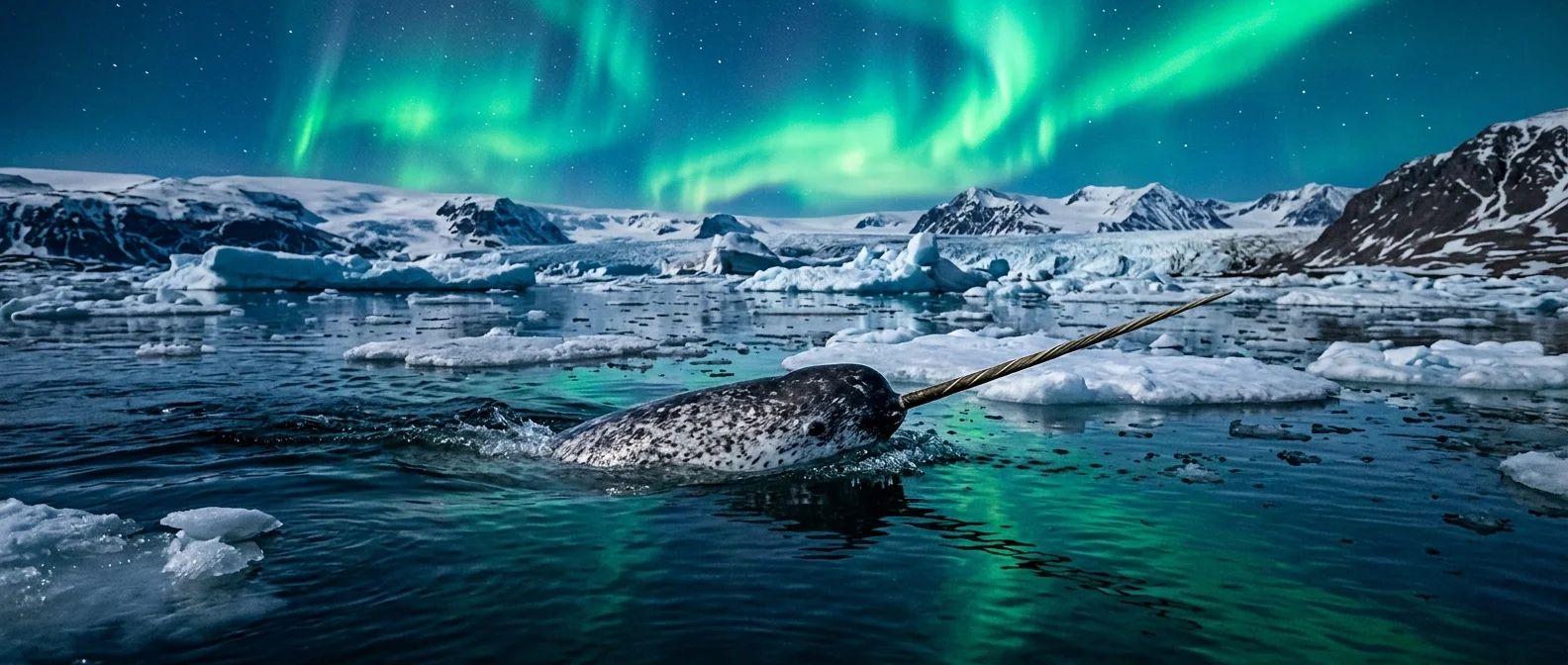
In the dark, frozen waters of the Canadian Arctic, a shadow moves slowly beneath the ice. From its head protrudes a spiral horn nearly ten feet long — like a unicorn that decided to live in the sea. This isn't mythology. This is the narwhal, and what we knew about it until yesterday was almost nothing.
📖 Read more: Mediterranean Corals Turn White: What's Happening in 2026
🦄 Monodon monoceros — One Tooth, Countless Uses
The narwhal (Monodon monoceros) belongs to the Monodontidae family alongside the beluga whale. It lives exclusively in Arctic waters — primarily around Greenland, Canada, and the Svalbard archipelago. Its iconic spiral tusk isn't a horn — it's an elongated canine tooth that grows mainly in males and can reach 10 feet in length.
The tusk is actually the left upper canine tooth that breaks through the lip and develops in a counterclockwise spiral. Unlike normal teeth (hard enamel outside, soft pulp inside), the narwhal's tusk is built backwards: soft tissue on the outside and hard material inside. This means millions of nerve endings are exposed to seawater, transforming the tusk into a massive sensory organ — capable of detecting changes in temperature, salinity, and pressure. About one in 500 males develops two tusks, while tusks rarely appear in females (roughly 15% of the population).
For decades, scientists assumed the tusk primarily served in mating competition — a tool for displaying sexual fitness. The “tusking” behavior, where two or more narwhals simultaneously raise their tusks nearly vertical and cross them, was thought to be ritualistic rival assessment. But the truth proved far more complex.
🎥 Drones Revealed 17 Different Behaviors
In February 2025, researchers from the FAU Harbor Branch Oceanographic Institute in Florida, collaborating with Fisheries and Oceans Canada and Inuit communities in Nunavut, published results from groundbreaking drone research. For the first time, they captured narwhals using their tusks in their natural environment.
Hunting Arctic Char
Narwhals use their tusks to investigate, manipulate, and stun Arctic char (Salvelinus alpinus) — applying enough force to kill the fish.
Play (First Recording)
First evidence of play in narwhals — exploratory play with objects, behavior not directly connected to survival or reproduction.
Kleptoparasitism
First recording of narwhal-fish-bird interaction: glaucous gulls (Larus hyperboreus) “steal” food that narwhals bring to the surface.
Remarkable Precision
Notable dexterity, accuracy, and speed of tusk movement — with continuous adjustments to follow moving targets.
Social Learning
Certain behaviors suggest social learning between individuals — possible teaching and individual personality differences.
Food Competition
One narwhal blocks another's access to the same fish — competitive but non-aggressive interactions between individuals.
Greg O'Corry-Crowe, lead author and National Geographic Explorer, explained: "We knew that narwhals do tusking — raising and crossing their tusks. But now we know that tusks have other uses, some quite unexpected: foraging, exploration, and play." The study recorded that narwhals use specifically the tip of the tusk for brief contacts with targets, causing a reaction from the fish each time. None of the observed incidents were aggressive between individuals — even food competition was subtle, almost “communicative.”

Field Methodology
The research was published in Frontiers in Marine Science (2025) by Greg O'Corry-Crowe (FAU, National Geographic Explorer) and Cortney Watt (Fisheries and Oceans Canada). Drones provide real-time viewing without disturbing the animals — a crucial tool for studying these elusive creatures.
📖 Read more: Whales Change Their Songs: Culture Beneath the Waves
📜 The Tusk as Climate Archive
The narwhal's tusk isn't just a tool — it's a data archive. Just like tree rings, each year adds a new growth layer. Because the tusk connects to the body through blood supply, each layer records the animal's physiology that year.
An international team from Aarhus University (Denmark) and McGill University (Canada) analyzed tusks from ten narwhals from northwest Greenland. In each layer they measured mercury, stable carbon isotopes (δ13C) and nitrogen (δ15N) — data revealing what the animal ate, where it lived, and how ice conditions changed.
Before 1990
Diet based on ice-associated prey — halibut and Arctic cod. Extensive ice cover, stable ecosystem.
After 1990
Shift to open-water prey — capelin and polar cod. Ice steadily decreasing each year. From 2000, mercury increases dramatically.

Scientific Finding
The analysis was published in Current Biology (2021) by Professor Rune Dietz (Aarhus University) and Jean-Pierre Desforges (McGill University). Unique discovery: a single animal provides 50 years of continuous data — something extremely rare in ecological research.
❄️ Narwhals Face a Changing World
Narwhals spend more than half their time submerged in foraging dives, reaching depths up to 5,000 feet. They feed primarily on Arctic cod, halibut, squid, and shrimp. They can fast for several days at a time — an adaptation to unpredictable food availability under ice. Their echolocation is considered among the most directional in the animal kingdom.
The narwhal is the Arctic mammal most affected by climate change. Ice isn't just habitat — it's a shield. It protects narwhals from killer whales (orcas), their greatest threat. As ice retreats, orcas invade areas that were once safe.
Simultaneously, narwhals cannot eliminate mercury from their bodies. Unlike polar bears (which eliminate it through fur) or seabirds (through feathers), whales lack this mechanism. Their enzymatic system is also less effective at breaking down organic pollutants. Every meal means more mercury — forever.
"The narwhal is the Arctic mammal most affected by climate change. At the same time, whales cannot eliminate environmental pollutants — they don't shed mercury through fur or feathers, and their enzymatic system is less effective at breaking down organic pollutants."
— Prof. Rune Dietz, Aarhus University (2021)The positive side? Research revealed that narwhals have greater dietary flexibility than we believed. The shift from ice-associated to open-water prey shows adaptability — a card in the survival game. But flexibility has limits, especially when the environment itself becomes toxic.
Significant finding: museums worldwide house hundreds of narwhal tusks from earlier eras. By analyzing them, researchers can open a window into the Arctic's climatic past — long before modern measurements began. Similar archives hide in teeth of other species, in whale baleen, in whale earwax plugs, even in tree rings.
Beyond mercury and ice, a third threat emerges: noise. Research shows narwhals are seriously affected by ship and seismic airgun sounds even at distances of 12-18 miles. Noise interferes with echolocation, communication, and foraging — silent catastrophe in a world that depends on sound.
With help from drones, satellites, and collaboration with Inuit communities, scientists are intensifying study of these elusive creatures. Each expedition reveals something new — and each discovery reminds us how little we knew before turning drones downward, over their frozen waters. The unicorn of the sea isn't myth — it's alive, threatened, and still full of mysteries.