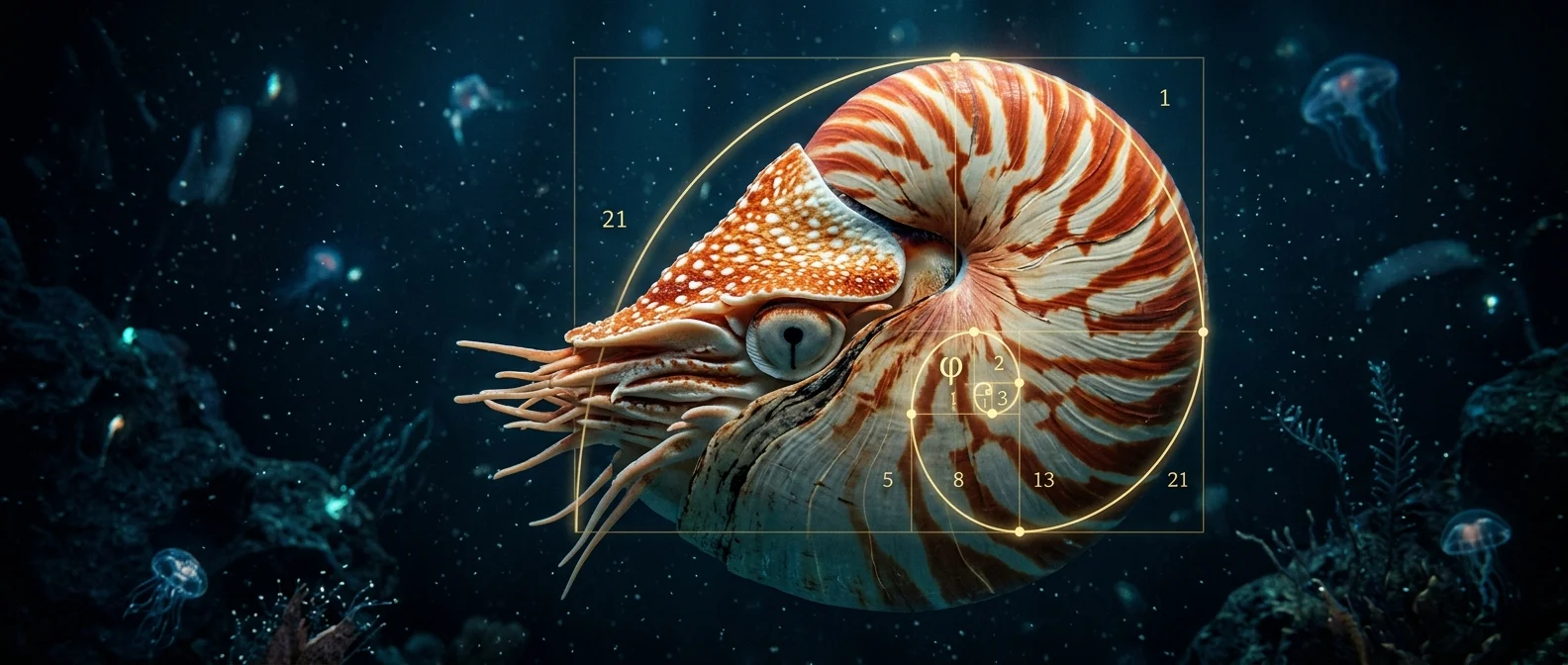
Imagine a creature that existed before the first land plants appeared. Before dinosaurs ruled. Before fish developed jaws. Its shell lies embedded in 500-million-year-old rock — and the exact same shell floats today in western Pacific waters. This isn't just another animal. It's a time capsule — living proof that evolution sometimes finds a solution so perfect, it doesn't need changing for half a billion years.
The Nautilus pompilius — the chambered nautilus — is a cephalopod mollusk, related to octopuses, squid, and cuttlefish. But unlike them, it retains an external shell. It belongs to the order Nautiloidea — a group that once numbered thousands of species. Today, only five living species of the genus Nautilus survive. The nautilus itself serves as a paleontological dating tool — its presence in a rock layer determines geological age. Let's open this time capsule, chamber by chamber.
🐚 Chamber 1: The Mechanism — 36 Rooms of Buoyancy
The nautilus shell is spiral, smooth, roughly 10 inches in diameter. Internally, it divides into approximately 36 separate chambers, each sealed with a wall of nacre (mother-of-pearl). The animal inhabits only the outermost — the largest — chamber. The rest? They function as a buoyancy system.
A thin tube (siphuncle) runs through every chamber, from first to last. Through this, the nautilus regulates gases and liquids inside the chambers — adding or removing water — thus controlling its buoyancy. Want to rise? Remove water, gases expand, it becomes lighter. Want to sink? Reverse process. This mechanism — regardless of depth — allows it to maintain neutral buoyancy without energy waste. It's essentially a biological submarine.
As the nautilus grows, it constructs new chambers: the body moves forward and seals a new nacre wall behind it. This process repeats dozens of times throughout its life. The shell can be white, orange, or even violet, with characteristic red-brown stripes on the outer side. The inner layer — material identical to what makes pearls — reflects iridescent light, giving the shell an ethereal glow.

🐚 Chamber 2: The Anatomy — 94 Tentacles Without Suckers
The nautilus's most striking feature might not be its shell, but what emerges from it: up to 94 thin, contractile tentacles — far more than an octopus's 8 arms or a squid's 10. These tentacles lack suckers — unlike every modern cephalopod. Instead of suckers, they function with hair-like grooves that capture prey through adhesion and attachment.
The nautilus feeds on shrimp, crabs, lobsters, and small fish. It hunts mainly at night: at sunset it rises from depths of 2,000 feet to 300 feet, scanning the seafloor. At sunrise, it returns to the depths. This daily vertical migration — from darkness to relative light and back — may constitute the greatest distance daily movement of any mollusk. Specialized chemoreceptors in the tentacles detect food in darkness — smell completely replaces vision in lightless depths.
The nautilus's eyes represent another archaism: they function like a camera obscura — a small hole allows light to enter, without a lens. It's the only modern cephalopod without eye lenses — a characteristic considered primitive, dating from that era 400 million years ago when eyes hadn't yet invented focusing. It compensates with overdeveloped olfactory ability: each of the 94 tentacles carries chemical receptors capable of detecting food traces in the dark, cold deep water.
🐚 Chamber 3: The Movement — Jet Propulsion Without Aerodynamics
The nautilus moves by jet propulsion: it inhales water into the mantle cavity and expels it through a flexible funnel. But compared to squid, the nautilus funnel consists of two separate flaps instead of a single tube — making it less aerodynamic and a slower swimmer. This isn't a disadvantage — it's archetypal design. The structure resembles the first cephalopods, which appeared long before squid perfected jet propulsion.
The nautilus's mantle cavity is proportionally smaller than that of modern cephalopods. But combined with the shell's buoyancy, it doesn't need speed. It hovers and moves calmly, without wasting energy — an advantage in deep waters where food is sparse and energy economy means survival. In a sense, the nautilus is the opposite pole of a squid: instead of speed, efficiency. Instead of power, balance.

🐚 Chamber 4: The Time — 500 Million Years Without Change
The order Nautiloidea appeared in the late Cambrian — about 500 million years ago. The first nautiloids had straight shells (orthoconic), but over time evolved into spirals. The group exploded in diversity during the Ordovician, with thousands of species inhabiting ancient oceans. They were the apex predators of their time — long before jawed fish appeared, long before sharks became “kings.”
What exterminated the rest? Five mass extinctions — each one decimated the nautiloids. Ammonites, their relatives with more complex shells, vanished in the Cretaceous-Paleogene mass extinction (66 million years ago). The nautilus, with its simpler but more resilient design, survived. The ability to regulate buoyancy at various depths, flexible diet, and low energy requirements likely protected it where its specialized relatives perished.
Today, five nautilus species survive — all in the western Pacific and coastal Indian Ocean. N. pompilius is the most common and studied. It lives at depths of 165 to 2,000 feet, but its shell can't withstand pressure below 2,600 feet — at that point, the chambers shatter. This means the nautilus lives in a narrow depth zone: deep enough to avoid most predators, shallow enough that the shell doesn't implode. A living submarine with maximum dive depth.
🐚 Chamber 5: The Threat — Beauty That Kills
After 500 million years, the nautilus faces a new mass extinction — this time human-caused. Its pearlescent shells sell as decoratives, jewelry, and collectibles. Demand, especially in Asia and the West, fuels overexploitation of populations in the Philippines, Indonesia, Fiji, and New Caledonia.
The nautilus doesn't face only fishing pressure. Climate change warms the deep waters it inhabits. Ocean acidification slowly corrodes its shell — made entirely of aragonite, a form of calcium carbonate particularly sensitive to low pH. In 2016, Nautilus pompilius was proposed for inclusion in CITES Appendix II, restricting international trade. But the nautilus reproduces slowly, lays few eggs, and takes years to mature — classic profile of a vulnerable species. The animal that survived five mass extinctions may not withstand the sixth — the one humans create with plastics, nets, and heat.
Nautilus reproduction doesn't help: unlike octopuses that lay tens of thousands of eggs, the nautilus lays only a few eggs each time. Hatching takes remarkably long — up to 12 months, one of the longest incubation periods in cephalopods. The young are microscopic versions of adults, but extremely vulnerable. The slow replacement rate means every adult loss hits the population disproportionately hard. Half a billion years of evolution didn't prepare the nautilus for the speed at which humans are changing the planet.