Ocean's Darth Vader: The Armored Giant That Survives Years Without Food
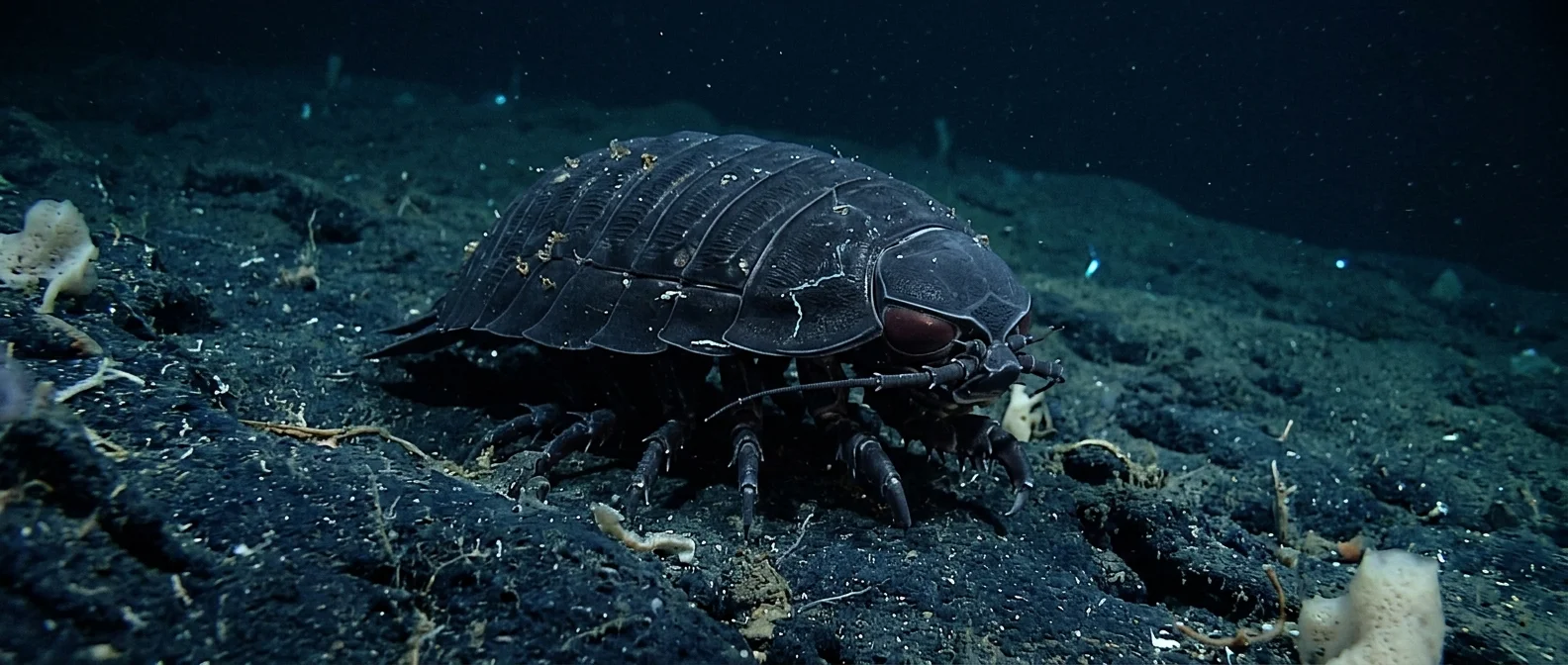
If Darth Vader were a crustacean, this would be it. An armored creature with compound eyes containing 3,500 lenses, seven pairs of legs, a calcium carbonate exoskeleton, and the ability to survive years without food. The giant isopod Bathynomus giganteus looks alien, but it lives here — on the ocean floor, in darkness, under pressures that would crush a submarine.
📖 Read more: 10 Creatures That Glow in the Ocean's Darkness
And it's a cousin of the common pill bug (Armadillidium vulgare) — the “roly-poly” you find in your garden. That's right: the tiny creature that rolls into a ball when you touch it has a relative in the ocean that weighs over two pounds. Same ball-rolling defense strategy. Same segmented armor plating. Just on a completely different scale.
🛡️ The Giant of the Abyss
Isopods are an order of crustaceans (Isopoda) that includes over 10,000 species. Most are small — 0.3 to 1.4 inches. But in the ocean depths, nature decided to do something different. Bathynomus giganteus reaches 14 inches long — 500 times larger than its terrestrial cousins. In 2020, an even larger species was discovered, Bathynomus raksasa, reaching 14.4 inches. This isn't your garden-variety pill bug. This is the king of pill bugs — and it weighs more than two pounds.
The cause of this enormous size is called deep-sea gigantism — the tendency for deep-sea organisms to grow much larger than their shallow-water relatives. Theories abound: cold temperatures slow metabolism, allowing longer lifespans and continued growth. High pressure possibly favors larger cells. Food scarcity might favor larger body size — bigger organisms can survive longer periods of starvation due to energy reserves. Nobody knows for sure. But Bathynomus is living proof: in the darkness, bigger means more resilient.
It's not alone in its genus. Scientists recognize about 9 species in the genus Bathynomus. Most live in tropical and subtropical depths, from the Caribbean to Indonesia, from 560 to 8,200 feet deep. In 2020, B. raksasa ("raksasa" means “giant” in Indonesian) was found in Javanese waters and became an international sensation — even larger than B. giganteus.

🛡️ Premium-Grade Armor
The giant isopod's body is a mechanical masterpiece. The thorax consists of 7 segments, the abdomen of 6. Each segment is covered by broad exoskeleton plates — armor made of calcium carbonate — like overlapping medieval plate armor. The shape is elongated, slightly curved, designed to withstand enormous pressures. When threatened, it rolls into a ball — exactly like the garden pill bug, except this ball weighs two pounds, is hard as stone, and lives 6,500 feet underwater.
Underneath are 7 pairs of grasping legs (pereiopods). The first two function like hands — pushing food toward the mouth parts. The jaws are so powerful they can tear through dead whale skin. The pleopods (abdominal appendages) serve both for breathing (gills) and swimming — though it rarely swims. The antennae on the head function as chemical sensors — they can detect the scent of decomposition in water from hundreds of yards away.
🛡️ 5 Years Without Food
Perhaps the giant isopod's most terrifying ability: it can live for years without eating. At Japan's Toba Aquarium, one giant isopod — dubbed No. 1 — refused all food for 5 years and 43 days before finally dying on February 14, 2014. It doesn't fast by choice. It fasts because it can. Its metabolism is so slow in the cold deep waters that a single meal — from a whale carcass or dead fish — can sustain it for months or years. This also explains why aquariums struggle to feed them — these creatures don't eat “on demand.” They eat only when they decide to.
The reason behind this super-endurance: in the depths, food arrives randomly. How often does a dead whale sink down? How often does a tuna die 1,600 feet above? The answer: rarely. And Bathynomus must always be ready — armored, alive, on standby — even if the last meal was two years ago.
In nature, it lives at depths between 560 and 8,200 feet, mainly in the Gulf of Mexico, Caribbean, western Atlantic, and also the Indian Ocean (where B. raksasa was found). When it finds food, it eats like a machine — without restraint. It feeds on dead whales, fish, squid, even sponges. It eats until it can't move — its stomach can swell so much the animal becomes unable to walk. Then it slowly walks back to its spot on the seafloor and waits. Months. Years. However long it takes. The temperature in the depths is a constant 39°F — cold enough to keep metabolism essentially paused.

🛡️ Eyes in the Dark
The giant isopod's compound eyes are among the largest of any isopod — about 3,500 individual lenses (ommatidia). Think of an eye like a mosaic — each lens sees a small image and the brain combines them into a panorama. Behind each lens is a reflective layer — similar to what makes cats' eyes glow in the dark (tapetum lucidum). This means every photon entering the eye gets used twice: once going in, once reflected back. At depths of 3,000+ feet, this makes an enormous difference. Bathynomus doesn't see colors — it sees shadows, movements, contrasts. Enough to spot carcasses on the seafloor or recognize the shadow of a predator.
🛡️ The Dark Side of the Force
Why “Darth Vader”? Look at the frontal view. The triangular head, the large round compound eyes on the sides, the armored mask — the resemblance to Darth Vader's helmet is uncanny. In 2022, it went viral online when researchers published a frontal photograph of a B. raksasa — and users immediately saw the Sith Lord. Add that this creature lives in absolute darkness, feeds exclusively on the dead, can survive without food for half a decade, and its main defensive response is to become an impenetrable calcium sphere — then the nickname isn't hyperbole. It's patient. Relentless. Resilient.
Reproduction is equally slow and careful. Females carry eggs in a pouch under the body (marsupium) — a kind of sac formed by special plates on the belly. The eggs are large — the largest of all marine isopods. The young hatch without a larval stage — they look like miniature adults (manca) with 6 instead of 7 pairs of legs. This direct development is an advantage in the deep sea — no planktonic stage needed, no dependence on currents, no exposure to dangers. Born already armored, ready to wait in the darkness.
Bathynomus isn't an alien — it's something worse. It's proof that our planet hosts extraordinary life at depths we never visit. It's not threatened — the ocean floor doesn't face the same dangers as shallow waters. It's not hiding. It's simply waiting — in darkness, armored, eternally patient — for the next meal. And if that never comes? No problem. Bathynomus has time. Much more than you could imagine. In the late 19th century, French zoologist Alphonse Milne-Edwards described B. giganteus — and the world couldn't believe a “pill bug” could grow so large. Nearly 150 years later, Bathynomus continues to amaze us.