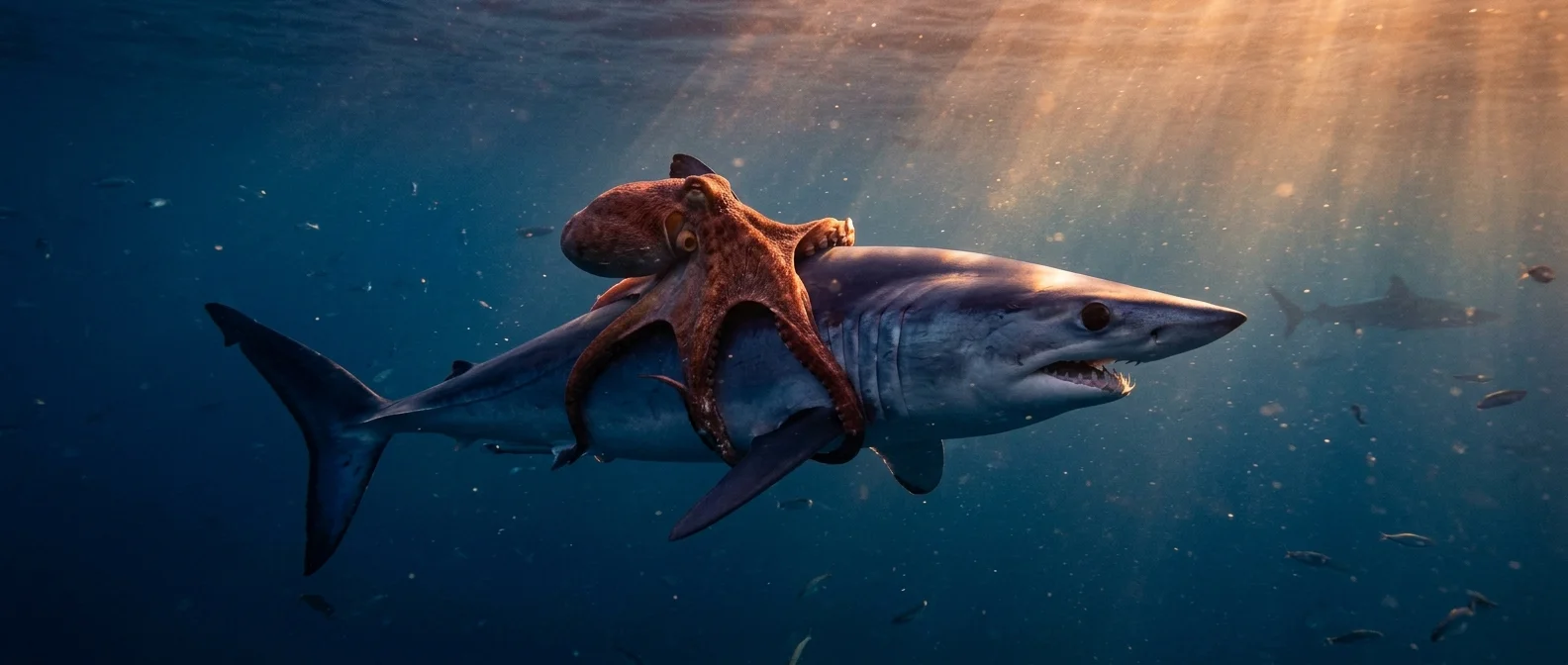
December 2023, Hauraki Gulf, off New Zealand's North Island. A research drone hovers above the water, its camera capturing a metallic gray dorsal fin — a large mako shark. But something orange sits on its head. A buoy? An injury? Researcher Rochelle Constantine from the University of Auckland lowers a GoPro into the water. What she sees next defies explanation: an octopus, tightly gripping the head of the planet's fastest shark.
🔍 Evidence 1: What the Camera Actually Captured
The University of Auckland team was there for routine work — studying shark populations in the Hauraki Gulf. They weren't looking for anything exotic. Just a drone and an underwater camera. The footage shows a roughly 10-foot shortfin mako swimming slowly near the surface. On its head, an octopus — likely a common Pacific octopus — clings with all its tentacles gathered at one point.
Constantine described the moment: "We deployed the drone, put the GoPro in the water, and saw something unforgettable: an octopus sitting on the shark's head, clinging on with its tentacles." The team watched this “sharktopus” — as they dubbed it — for a full 10 minutes before letting the two strange travelers continue. The shark didn't seem bothered. It swam slowly, steadily, as if nothing unusual sat atop its head.
The big question: how did they end up together? Octopuses live on the seafloor — in rock crevices, coral reefs, sandy bottoms. The shortfin mako lives in pelagic waters, near the surface or in the open ocean. Two worlds that rarely intersect.
🦈 Evidence 2: The World's Fastest Shark
The shortfin mako (Isurus oxyrinchus) isn't just fast. It's the fastest shark that exists. It reaches 46 miles per hour at full sprint — a speed that ranks it among the fastest fish on the planet, alongside swordfish and tuna. It can leap 20 feet above the ocean surface — something few sharks can do.
Its body is designed for speed. Hydrodynamic shape, pointed snout, crescent-shaped tail fin. Its diet consists mainly of fast fish — swordfish, tuna — as well as squid. Sometimes it even eats other sharks. The mako hunts near the surface but has been spotted at depths up to 1,640 feet.
There's something speed can't solve, however. The shortfin mako is listed as endangered on the IUCN Red List. The reason? Its fins. They're considered extremely valuable in the shark fin trade. Beyond that, they're frequently caught as bycatch on longlines targeting tuna and swordfish. Their reproduction is slow — they can't compensate for the losses.

🐙 Evidence 3: A Brain Scattered Across 8 Arms
If the mako represents violent speed, the octopus represents something entirely different: intelligence without a skeleton. Octopuses possess some of the most remarkable biological features in the animal kingdom. Three hearts. Blue blood, thanks to a copper-based protein (hemocyanin) instead of iron. And a nervous system so decentralized that each arm essentially thinks for itself.
Only 10% of neurons are located in the central brain. 60% are found in the arms, according to Oceana Canada. Each arm can taste, touch, and move without commands from the central brain — though the brain can take control if needed. Octopuses change color — a process that burns more calories than a human spends in 25 minutes of running. They solve puzzles, recognize faces, use tools. An octopus in a New Zealand aquarium in 2016 escaped on its own — lifted the lid, crawled across the floor, found a pipe leading to the sea, and vanished.
🧬 Three Hearts, Blue Blood
Octopuses have one systemic heart in the center of their body that pumps blood throughout the organism, and two branchial hearts — one for each gill. Hemocyanin (copper protein) transports oxygen more efficiently than hemoglobin in cold water and low-oxygen conditions. This is why octopuses survive at depths and temperatures that would kill most fish.
🧩 Evidence 4: Why Did It Sit There?
Nobody knows for certain. Constantine admitted to Live Science: "We really don't know how this octopus, which lives on the seafloor, found this 10-foot mako that lives in pelagic — open waters. It's really a mystery — but the ocean is full of unexpected things."
Let's examine the possible explanations. First: transportation. Octopuses sometimes “ride” larger creatures or even debris to travel long distances without expending energy. In marine biology, this is called phoresy — one organism uses another as transport.
Second: protection. An octopus in open water is completely exposed. There are no rocks, crevices, or shells to hide in. But what creature would dare attack something sitting on the head of a mako? Exploiting an apex predator as a “shield” isn't unthinkable in nature.
Third: accidental encounter. Perhaps the octopus was near the surface — something rare but documented — and accidentally landed on the shark. Once attached, it had no reason to let go. A free ride isn't worth the trouble of leaving.
🎭 Two Worlds, One Frame
Mako Shark
Fastest shark on the planet — 46 mph. Open-water predator. Designed for speed, not flexibility. Eats swordfish and tuna. Internal skeleton, jaws, power.
Octopus
No skeleton, 3 hearts, blue blood. 60% of neurons in tentacles. Changes color, solves puzzles, escapes from closed containers. Its brain is everywhere.

🤝 Evidence 5: Octopuses and Fish — A Complex Relationship
The Hauraki Gulf scene isn't the first time octopuses have cooperated — or interacted — with fish. Studies show that certain octopus species hunt together with fish. Octopuses and groups of wrasses form hunting parties: the fish scare prey out of their hiding spots, the octopus catches them inside crevices. It works for both.
It doesn't always go smoothly, however. A 2024 study in Nature revealed that octopuses punch their fish collaborators during joint hunts. Large blue octopuses used their arms to hit blackfin wrasses in the head — fish that, according to researchers, weren't the best hunting partners. Nobody's sure if this is punitive behavior or accidental movement, but the idea that an octopus “evaluates” its partners is tremendously appealing.
Additionally, octopuses throw shells and sand at each other — something that looks very much like aggressive behavior. In Australia, “gloomy” octopuses darken their skin to show hostility and climb onto shipwrecks to appear taller. Social complexity in an animal that theoretically lives alone.
⏳ Evidence 6: A Life Too Short
Perhaps the harshest truth about octopuses: they live almost nothing. Most species live only one year. Even giant Pacific octopuses — which reach 600 pounds and 30 feet — live at most five years, according to the Monterey Bay Aquarium. After reproduction, males and females enter a rapid aging process: they stop eating, lose coordination, develop wounds.
Females care for their eggs until they hatch — in some deep-sea species, this can last years. They don't eat during this entire period. They die shortly after. Males might be eaten by the female after mating, but even if they escape, they die within a few months.
You wonder: what could an octopus achieve if it lived 50 years instead of one? If it could pass knowledge to the next generation. If there was cultural memory, like in whales. But there isn't. Every octopus starts from zero. And yet, it solves puzzles, escapes from laboratories, and climbs onto sharks.
🌊 Final Evidence: What This Photo Means
The photo from Hauraki Gulf doesn't prove any new biological mechanism. It doesn't change textbooks. It doesn't overturn theories. But it does something perhaps more important: it reminds us how little we know about the ocean. Constantine said it best: "One of the most beautiful things about being a marine scientist is that you never know what you're going to see in the sea."
The shortfin mako, an endangered species, was swimming slowly that afternoon. If it had been swimming fast, Constantine believes the octopus would have been dislodged. Perhaps that was the only reason the footage exists: a moment of calm in the life of a creature that rarely stops. Ten minutes of shared journey between two animals that should never have been in the same frame.
If we support marine conservation initiatives, Constantine says, we can ensure such moments continue to happen. The 300+ known octopus species — and likely many more unknown ones — share the ocean with thousands of shark species. We don't need technology to find extraordinary scenes. We just need a drone, a GoPro, and the ocean itself.