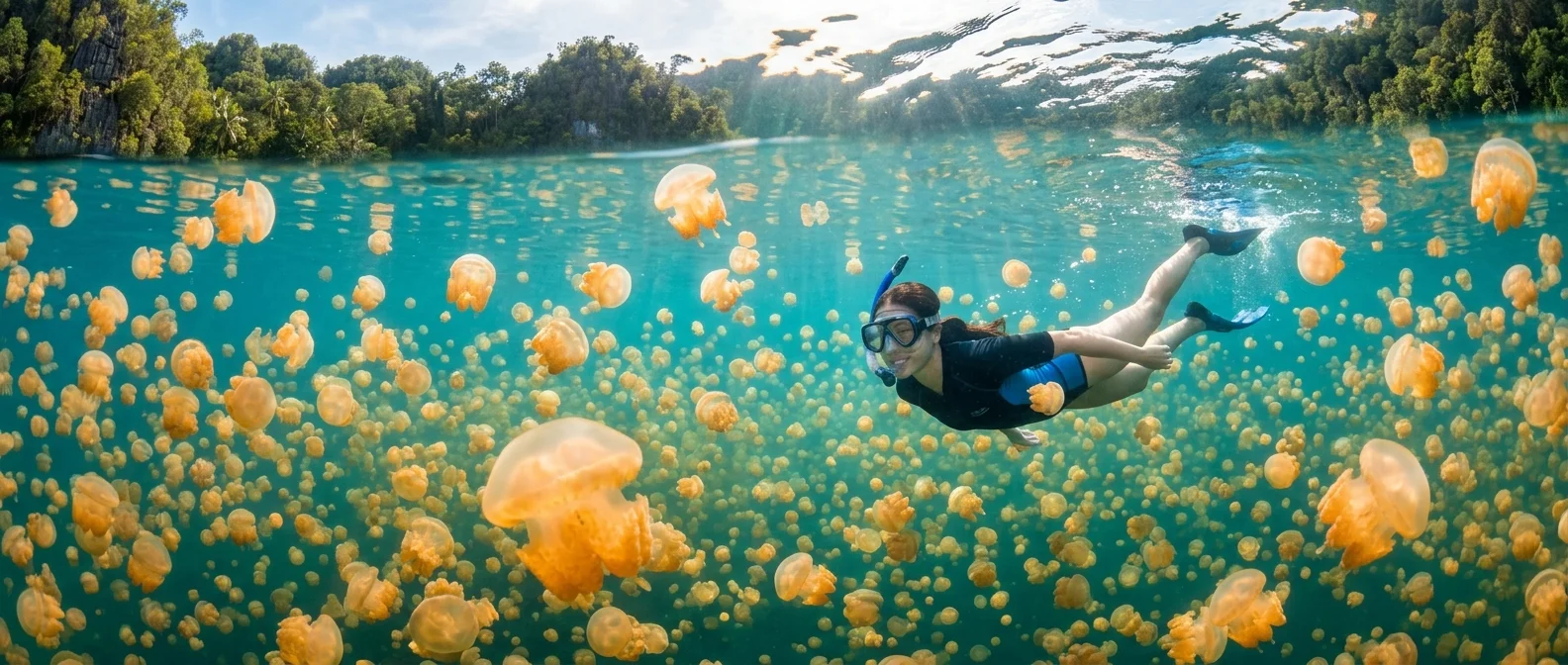
On a tiny island in the western Pacific, hidden among limestone cliffs, lies a lake that resembles a scene from another planet. Every morning, millions of golden jellyfish begin a silent migration following the sun — a ritual repeated uninterrupted for 12,000 years. This is Palau's Jellyfish Lake, one of Earth's most extraordinary ecosystems.
📖 Read more: Fox Snatches Wolf Pup: First Time Caught on Camera
🏝️ A World Sealed in Limestone
Lake Ongeim'l Tketau — meaning “Fifth Lake” in the local language — sits on Eil Malk island, part of Palau's Rock Islands archipelago. It formed roughly 12,000 years ago when sea levels rose after the last ice age, flooding a limestone basin. Today, the lake connects to the ocean only through microscopic cracks and fissures in the rock — enough for seawater to enter, but too narrow for predators to pass through.
This isolation created a unique evolutionary experiment. The jellyfish trapped inside evolved separately from their marine relatives for millennia, creating a distinct subspecies: Mastigias papua etpisoni. Without large predators threatening them, these jellyfish followed a remarkable evolutionary path — they lost almost all their sting.
🌞 Daily Migration: Dancing with the Sun
Every day, approximately 5 million golden jellyfish perform a horizontal migration that follows the sun's path with clockwork precision. In the early morning hours, the entire population moves toward the eastern side of the lake, following the light. By afternoon, the golden army reverses course and moves west.
Photosynthetic Symbiosis
The jellyfish host zooxanthellae (microscopic photosynthetic algae) in their tissues. Migration ensures maximum light exposure for their symbiotic algae partners.
Dual Feeding Strategy
Jellyfish feed both on nutrients produced by zooxanthellae through photosynthesis and by filtering zooplankton at night when they descend to greater depths.
Body Rotation
During migration, jellyfish rotate counterclockwise, ensuring uniform photosynthesis across their entire body surface.
This symbiotic relationship explains their characteristic golden color. Zooxanthellae — the same microscopic algae that live in corals — give the jellyfish their warm hue. According to a University of Southampton study that created the first global jellyfish database (JeDI), jellyfish distribution in oceans is primarily determined by temperature and dissolved oxygen — factors that operate completely differently in Palau's lake.

☠️ The Deadly Zone at the Bottom
Below 15 meters depth, Jellyfish Lake hides a lethal secret. A dense layer of hydrogen sulfide (H₂S) — an extremely toxic gas — covers the bottom. This chemical stratification means the lake divides into two worlds: the bright, life-filled upper world and the dark, anoxic lower world at the deepest point.
Scuba Diving Prohibited
Scuba diving is strictly forbidden in the lake. Beyond the risk of hydrogen sulfide poisoning at depths greater than 15 meters, air bubbles from regulators could become trapped under the jellyfish canopy and cause them harm. Only swimming and snorkeling in the upper layers is permitted.
This stratification creates a natural laboratory for microbiologists. Right at the transition zone, where oxygen disappears and hydrogen sulfide begins, unique bacterial communities develop that exploit this chemical gradient to produce energy through chemosynthesis.
🌡️ Climate Threat: The 1998 and 2016 Crises
Jellyfish Lake is not invincible. Twice in recent history, the population collapsed almost completely. In 1998, an intense El Niño phenomenon dramatically increased water temperature, killing the zooxanthellae in jellyfish tissues. Without their photosynthetic energy source, the population shrank to just a few hundred. The same mechanism — bleaching — threatens coral reef systems worldwide.
In 2016, another severe El Niño caused serious drought in Palau, lowering water levels and increasing temperature and salinity. The population crashed again. Palau's government closed the lake to tourists until 2019, when jellyfish recovered sufficiently. This resilience reflects broader findings about Palau's ecosystems: research by Woods Hole Oceanographic Institution showed that the Rock Islands — the same uplifted limestone formations that host marine lakes — contain corals with genetically determined heat resistance.

🏛️ Rock Islands: UNESCO Monument
The Rock Islands Southern Lagoon was recognized as a UNESCO World Heritage Site in 2012 — for both its natural and cultural value. It's a complex of 445 limestone islands creating a labyrinth of lagoons, marine lakes, and hidden bays.
57 Marine Lakes
Palau has 57 marine lakes — the world's largest concentration. Five of these host jellyfish populations.
Conservation Pioneer
Palau established the first national marine sanctuary in the Pacific and dedicated 80% of its marine waters to protected zones.
Evolutionary Laboratories
Each marine lake is a separate evolutionary laboratory — species living in different lakes evolved independently, creating unique subspecies.
Woods Hole Oceanographic Institution research revealed that the Rock Islands create microenvironments with higher temperatures than the open ocean, functioning as “greenhouses” that accelerate natural selection. Corals developing here have four genetically distinct lineages, with “LB” and “RD” lineages showing exceptional heat tolerance — a resilience they share with their “neighbors,” the golden jellyfish.
🔬 Why We Study Jellyfish Lake
Jellyfish Lake isn't just a tourist attraction — it's a living laboratory of evolutionary biology. Its isolation allows scientists to study how species adapt to closed environments, how symbiosis between animals and photosynthetic algae evolves without external pressures, and how entire ecosystems respond to climate disruptions.
Research Significance
The first global jellyfish database JeDI (Jellyfish Database Initiative) contains over 476,000 records of gelatinous organisms. Palau's lake serves as a critical reference point in this database, representing a completely closed system — ideal for controlling variables that are impossible to isolate in the open ocean.
Meanwhile, the lake's history serves as a warning. If the 1998 and 2016 El Niño events could nearly eliminate a population of 5 million organisms, what might continued ocean warming mean for marine ecosystems globally? The answer lies hidden in the limestone of a tiny island nation in the western Pacific — if you just look beneath the surface.