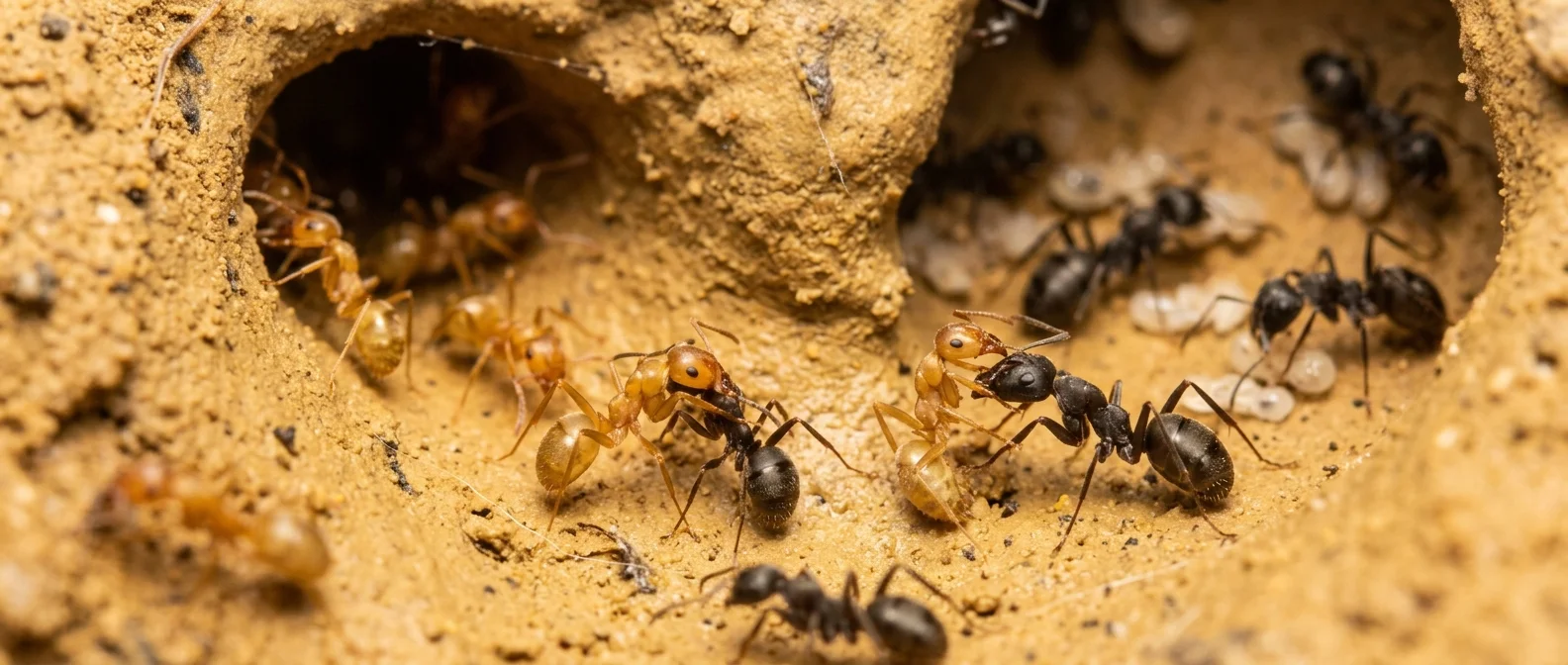
What would you do if you could clone yourself, invade someone else's home, and force them to raise your children? It sounds like science fiction, but in the ant world, that's exactly what one rare Japanese species does. Temnothorax kinomurai is the first known ant species in the world composed entirely of queens — no workers, no males, no rules.
📖 Read more: Mitochondria: Ancient Aliens Living Inside Every Cell
A Kingdom of Queens Only
In ant colonies, the hierarchy is clear: one queen reproduces, thousands of workers labor, and a few males exist solely for reproduction. Keiko Hamaguchi, a biologist at the Kansai Research Center in Kyoto, and Jürgen Heinze from the University of Regensburg in Germany, revealed that Temnothorax kinomurai completely overturns this system.
From six colonies they studied in the lab, 43 offspring emerged. None were male. None were workers. All were queens — genetically identical copies of their mother. “This is the first known species with only queens,” Heinze told LiveScience. Parthenogenesis — reproduction without fertilization — completely replaces sexual reproduction here.
T. kinomurai Profile
- Found in only 9 locations in Japan
- 100% queens — no males, no workers
- Reproduction via parthenogenesis (cloning)
- Published: Current Biology, February 23, 2026
The Invasion Strategy
But how does a species survive without workers? The answer is brutal: by stealing workers from others. Young T. kinomurai queens invade the nests of a related species, Temnothorax makora. They sting the host queen and the most aggressive workers, neutralizing all resistance. If the coup succeeds, the surviving workers begin feeding and caring for the invader's eggs — without suspecting anything.
"T. kinomurai needs the host workers for feeding and brood care — it cannot reproduce without them," Heinze explained. This is social parasitism in its most extreme form: an entire species that depends completely on another species' labor to exist.

📖 Read more: Spiders Keep Fireflies as Living Bait to Lure 10x More Prey
The Laboratory Experiment
Hamaguchi's team tested the strategy in the lab. Of the 43 clone offspring born, seven were placed in new T. makora colonies to attempt coups. Seven succeeded — a success rate that reflects the risk of this strategy. The seven new queens produced a total of 57 offspring, which were — again — exclusively queens.
No males, no workers, in any generation. The findings were published February 23, 2026, in the journal Current Biology. This represents a biological dead end that breaks all the rules: an ant that needs neither a mate nor its own workforce.
Parthenogenesis vs Sexual Reproduction
Daniel Kronauer, a biologist at Rockefeller University in New York, explained why this strategy works. Normally, sexual reproduction produces genetically diverse workers — an advantage for colonies that need defense against pathogens and division of labor. But since T. kinomurai produces no workers at all, these advantages disappear.
"This could shift the balance in favor of asexual reproduction and ultimately lead to the disappearance of males," Kronauer said. Parthenogenesis allows the queen to maximize her genetic legacy: each offspring carries exactly 100% of her DNA, without “dilution” from paternal genes. In evolutionary terms, it's the ultimate genetic self-promotion.
📖 Read more: Why 503 Snake Species Turn Cannibal: Evolution's Dark Secret
Why It's Unique
Some ants already know parthenogenesis. Some use social parasitism. But no other species had been found to combine both strategies simultaneously. Jonathan Romiguier, an evolutionary biologist at the University of Montpellier in France, commented: "Despite the intuitive evolutionary logic behind such a combination, no species had been shown to implement it — until now."
In a kingdom of over 15,000 known ant species, this is “quite unusual,” Kronauer added. T. kinomurai represents an evolutionary strategy no one expected: an organism that completely abandoned sexual reproduction, workers, and males, relying exclusively on cloning and parasitism.

The Iberian Cloning Spider
The discovery of T. kinomurai wasn't the only bombshell in the myrmecology world recently. In September 2025, researchers revealed that the Iberian ant queen Messor ibericus clones males of a completely different species, Messor structor — without transmitting any of her own nuclear DNA. This was called “xenogamy” — giving birth to a different species.
Denis Fournier, an evolutionary biologist at the Free University of Brussels, described the discovery as “almost science fiction.” "Most of us learn that species boundaries are strict — and here's a system where ants regularly cross them as part of their normal life," he said. Together, the two discoveries show that cloning in ants isn't an exception — it's an emerging field of study.
Comparing Two Cloning Strategies
T. kinomurai (Japan)
Clones itself — produces only queens via parthenogenesis, invades T. makora nests
📖 Read more: Why We Get Goosebumps: The Science Behind Chills and Thrills
M. ibericus (Europe)
Clones males of another species — produces M. structor males without transmitting her own DNA
Questions That Arise
The study raises fundamental questions about evolution. How long can a species survive without genetic diversity? Cloning means every T. kinomurai queen is nearly genetically identical to every other. If a pathogen attacks one, it could kill them all. The lack of genetic diversity is a biological risk — a bomb that could explode if environmental conditions change.
On the other hand, the strategy has worked for centuries — at least. The species was found in nine locations in Japan, showing it's not a random mutation but a stable evolutionary solution. Nature, once again, proves that rules exist to be broken — at least in the ant world.
What It Teaches Us
The discovery of T. kinomurai isn't just about ants. It shows that reproduction — the most fundamental function of any organism — can take forms that defy logic. An entire species without males, without workers, surviving exclusively through cloning and parasitism, represents an extreme evolutionary experiment.
Kronauer commented: “In over 15,000 ant species, this is quite unusual.” Nature doesn't always follow biology textbooks. Somewhere in the forests of Japan, microscopic queens clone themselves, invade foreign nests, and feed off unsuspecting workers. And they've been doing this for centuries, completely silently.