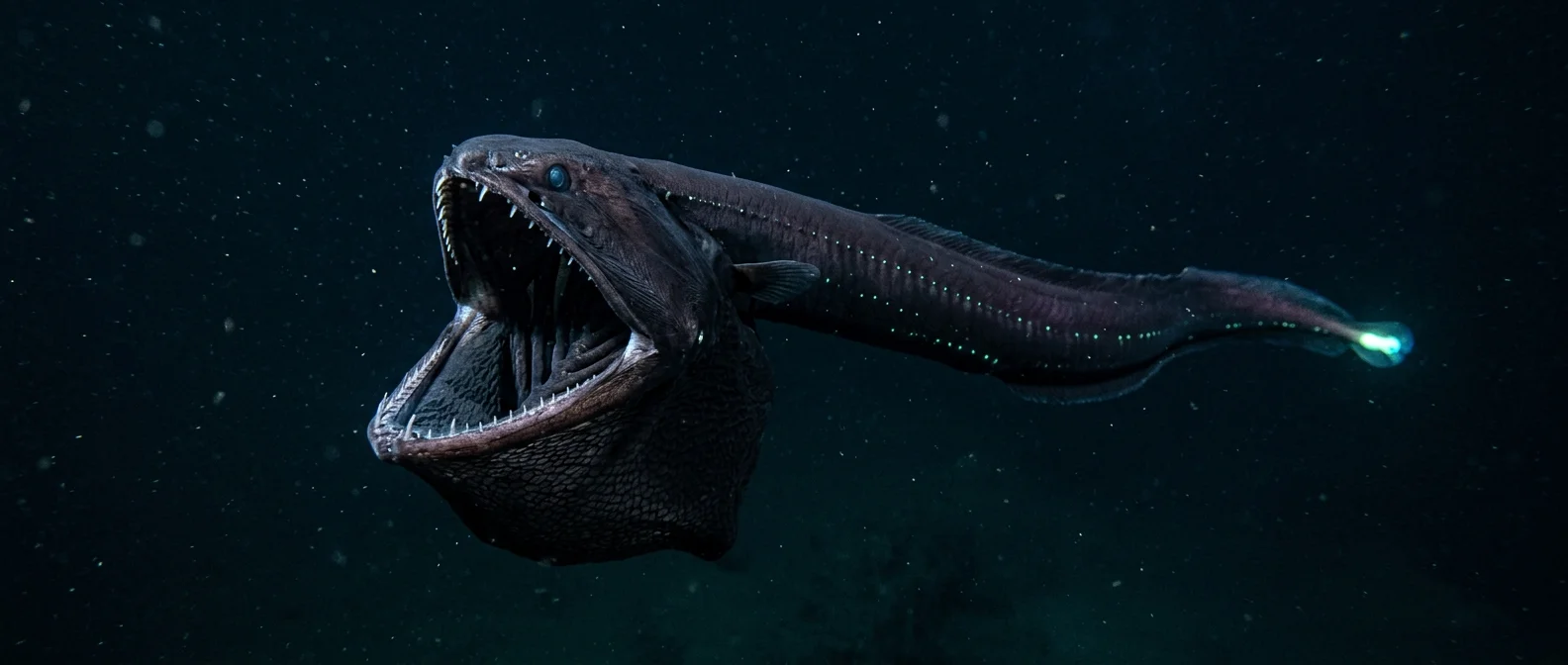
September 2018, North Pacific Ocean. The research vessel E/V Nautilus deploys an ROV 1,400 meters below the surface, near Papahānaumokuākea. The camera captures what looks like a black, snake-like creature — until it suddenly unfolds a massive umbrella-shaped mouth. No jaw in the animal kingdom performs this transformation. This is Eurypharynx pelecanoides, the pelican eel — a fish built almost entirely from mouth.
📖 Read more: 10 Animals That Glow in the Dark: Bioluminescent Wonders
🔦 Mission 1: Discovering the Ghost — Species Identity
The first Eurypharynx pelecanoides specimen was described by French ichthyologist Léon Vaillant in 1882. It came from a deep-water fishing trap — a body thin as rope, with a disproportionately large head. No one knew what it was then. Today we know it represents the sole member of the family Eurypharyngidae, in the order Saccopharyngiformes — a group of bathypelagic fish that resembles no known relatives.
The name says everything: eurys (wide) + pharynx (throat). Ocean-throat, essentially. It occurs in tropical and temperate waters worldwide — from northern California to Peru, from Iceland to South Africa. Bathypelagic, found between 500 and 7,625 meters depth, according to FishBase data. The typical depth: 1,200 – 1,400 meters. Where sunlight never reaches.
🪪 Biological Identity
Scientific name: Eurypharynx pelecanoides (Vaillant, 1882)
Order: Saccopharyngiformes
Family: Eurypharyngidae (sole member)
Maximum length: 100 cm (males/unsexed)
Common length: 55 cm
Depth: 500 – 7,625 m (typically 1,200 – 1,400 m)
Temperature: 2.3 – 5.5°C
IUCN Status: Least Concern (2012 assessment)
🦷 Mission 2: The Umbrella Mouth — Anatomy Without Precedent
The reason no one forgets the pelican eel is singular: its jaws. They occupy more than half the length before the anal region. The oral cavity is extraordinarily distensible — it can open to nearly 180 degrees, transforming the entire front section into a living trap. Imagine a fish that hunts without hunting. It simply opens.
The muscular structure of the body relies on V-shaped fibers, extremely elastic, allowing instantaneous expansion and contraction. There are no caudal fin rays — the tail evaporates into a long, whip-like filament. No scales exist. No lateral line pores — instead, raised tubules detect currents.
The eyes? Microscopic. Estimates report a diameter around 2.6 millimeters. In a 100-centimeter creature, this resembles a pinprick. The evolutionary pressure here was clear: in absolute darkness, vision isn't needed. Vibration sensing suffices.
📖 Read more: How 31 Wolves Changed Yellowstone's Rivers Forever
💡 Mission 3: The Pink Lantern — Bioluminescence at the Tail's End
Somewhere at the end of this long, thin body, something unexpected exists. A light organ. The pelican eel's tail terminates in a swollen caudal organ that emits pink luminescence — and periodically, red flashes.
Bioluminescence in bathypelagic fish isn't rare. Here though, the function isn't fully understood. One hypothesis: it works as a lure, attracting small crustaceans toward the wrong end of the body — away from the mouth, but within detection range. Another version: it serves in recognition between individuals, especially during reproductive periods. No one has provided a definitive answer yet.

Beyond bioluminescence, the pelican eel's skin possesses another property: it's exceptionally dark. Studies on bathypelagic fish show certain species reflect less than 0.5% of received light — a “super-black” camouflage strategy. No reflection, no shadow, no detection. In a world where the only light comes from other animals, invisibility is a matter of life.
🦐 Mission 4: Hunting in Darkness — What It Eats and How
Adult E. pelecanoides feed primarily on crustaceans — mainly euphausiids (krill) and ostracods. According to FishBase data, their diet also includes small fish, cephalopods, and other invertebrates. The trophic level of 4.1 places them high in the food chain — apex predators of the mesopelagic layer, despite their ridiculous size.
The feeding technique remains debated. The dominant interpretation: lunge feeding. The fish opens its jaws abruptly, creating a low-pressure cavity that “sucks in” prey along with massive volumes of water. Subsequently, the oral cavity contracts slowly, expelling water while retaining prey. It functions, essentially, as a living net trap.
📖 Read more: Tent-Making Bats: Nature's Master Architects
⚔️ Two Strategies of Bathypelagic Hunting
Pelican Eel
Lunge feeding: opens entire body like a net. Passive waiting. Eats whatever enters the mouth — mainly small crustaceans. Low energy expenditure.
Lancetfish (Alepisaurus)
Active hunting: locates prey, pursues, grabs with sharp teeth. High energy expenditure, but larger prey.
🧬 Mission 5: One Life, One Death — Reproduction and Life Cycle

Perhaps the most tragic characteristic of this species is semelparity: it reproduces once in its lifetime and dies. According to FishBase data, degenerative changes in males and females indicate that after spawning, physiological collapse is irreversible. The oocytes are found at the same developmental stage (monocyclic ovaries), reinforcing the hypothesis of a single reproductive cycle.
The eggs are pelagic — they float in the water column. The larvae, leptocephali, resemble transparent ribbons. This is a typical characteristic of Anguilliformes and related orders, though molecular mtDNA analyses show that Saccopharyngiformes constitute a separate clade — they're not “true eels” in the strict sense.
Population resilience is characterized as “very low” according to IUCN assessment: the minimum population doubling time exceeds 14 years. With semelparity and slow reproduction, the species relies almost entirely on the fact that nothing can reach it.
🔬 Semelparity: Reproduction-Self-Destruction
Semelparity means one reproductive cycle, then death. The most famous semelparous organism? Salmon. But while salmon travel thousands of miles to spawn, the pelican eel reproduces in the same abyssal darkness where it lives. Monocyclic ovaries, degenerative changes, one spawning — and then, the end. How many years does it live until that moment? We don't know.
📖 Read more: World's Largest Organism Is a Fungus Covering 965 Hectares
📡 Mission 6: First Contact — Live Recordings from the Deep
For over 130 years after the first description, almost the only E. pelecanoides specimens came from bathypelagic nets — meaning dead or damaged. The first noteworthy live observation came in September 2018, when E/V Nautilus recorded an individual at Papahānaumokuākea Marine National Monument, in the deep Pacific.
The video went viral immediately. The reason wasn't just the animal's appearance — it was the behavior. In the footage, the pelican eel inflates its oral cavity in real time, forming a balloon-jaw before returning to snake shape within seconds. In October 2018, new images came from the Azores — this time at shallower depth, around 1,000 meters.
We still don't know exactly how it moves when not hunting. If it sleeps (or if the concept of sleep applies at this depth). If it interacts with other E. pelecanoides outside reproduction. If territorial behavior exists. ROVs can see them — but can't follow them for hours. Our knowledge is snapshots. Flashes in a dark room.
E/V Nautilus, 2018
First notable recording of a living individual at Papahānaumokuākea — depth approximately 1,400 meters. Captured jaw inflation on video in real time.
Azores, Oct. 2018
Second known live observation, around 1,000 m depth. Reinforces data that the species is truly cosmopolitan (circumglobal).
What We Don't Know
Sleep cycle. Territorial behavior. Interaction between individuals. Exact adult age. Population size. Precise spawning depth.
"Every time we lower a camera into the abyss, we see something we didn't expect. But that doesn't mean we understand them — it only means we photograph them."
The pelican eel isn't threatened — the IUCN category is Least Concern. No one fishes for it deliberately, no net regularly reaches 1,400 meters. Its very inaccessibility is its best shield. The 2012 assessment is noted as “needs updating,” but the reality remains: we don't know how many exist, we don't know if they're increasing or decreasing, we know almost nothing beyond morphology and some chemical analyses.
And perhaps this is the most honest thing a science blog can say: knowledge about bathypelagic species is measured in dozens of specimens and a few seconds of video. The pelican eel isn't just a weird fish. It's a reminder that our planet contains entire worlds we haven't yet touched.