On July 5, 1996, a lamb was born in a Scottish laboratory without having a mother in the conventional sense. Its cell came from the mammary gland of an adult sheep, and its nucleus was transferred into an egg that had been emptied of its own genetic material. Dolly, the most famous sheep in history, proved that an adult somatic cell could “turn back time” and create an entire organism — but this was only the beginning of a story filled with failures, ethical dilemmas, and stunning discoveries.
📖 Read more: Is 80% of Your DNA Really Junk? The Non-Coding Truth
How Cloning Works: The SCNT Method
Somatic Cell Nuclear Transfer (SCNT) is the basic technique behind every cloned animal. Scientists remove the nucleus from an egg using an extremely fine micropipette, leaving behind only the cytoplasm with its mitochondria and ribosomes. In its place, they insert the nucleus of a somatic cell — a skin, muscle, or connective tissue cell — containing the donor's complete DNA, roughly 3 billion base pairs.
The reconstructed egg undergoes electrical stimulation that “awakens” it and triggers cell division. If all goes well, an embryo forms and is transferred to a surrogate mother. The newborn organism carries identical nuclear DNA to the donor — the first biological “photocopy” in history. However, the mitochondrial DNA comes from the egg, creating a genetic “mosaic” that many overlook.

Dolly's Legacy: 277 Attempts for One Lamb
Ian Wilmut and Keith Campbell at Scotland's Roslin Institute needed 277 attempts to create Dolly. Of the 277 reconstructed eggs, only 29 developed embryos capable of implantation, and only one was born alive. Dolly got her name from Dolly Parton — a joke by the researchers, since the donor cell came from a mammary gland.
Dolly lived just 6.5 years, roughly half the normal lifespan of a Finn Dorset sheep. She developed arthritis at age 5 and lung disease that led to her euthanasia in 2003. While it wasn't proven that these were directly related to cloning, her premature aging raised serious questions about the procedure's safety. Her telomeres — the protective “caps” at chromosome ends — were shorter than expected for her age.
Why 90% Fails: The Cattle Study
Less than 10% of cloned embryos survive to birth. In a 12-year study, abnormalities were found in over 5,000 genes in the extraembryonic cells of cloned cattle.
According to research by Harris Lewin from the University of California at Davis, published in the Proceedings of the National Academy of Sciences in 2016, the main cause of failure is massive gene dysfunction. Lewin's team, collaborating with French researchers from INRA, analyzed tissues from cloned cattle embryos at 18 and 34 days of development using RNA sequencing.
The results were striking: at day 18, over 5,000 genes in extraembryonic tissue showed abnormal expression. Of these, 123 genes were associated with abnormal extraembryonic tissue morphology, 121 with embryonic mortality, and 14 with implantation failure in the uterus. Hormonal communication between embryo and mother — particularly interferon tau, the pregnancy recognition signal — was dramatically reduced.
However, at day 34, surviving cloned embryos showed much more normal gene expression — a sign that those surviving implantation had properly “reprogrammed” their genes. As Lewin commented: "It's amazing that the process works at all, demonstrating the tremendous plasticity that developing animals have."
First Cloned Primates: Zhong Zhong and Hua Hua
On January 24, 2018, Qiang Sun's team at the Institute of Neuroscience of the Chinese Academy of Sciences in Shanghai announced a historic achievement in Cell journal: the birth of two genetically identical long-tailed macaques (Macaca fascicularis) via SCNT. They named them Zhong Zhong and Hua Hua, from the Chinese surname “Zhonghua” meaning “Chinese people.”
Zhen Liu, the lead researcher, spent three full years optimizing the SCNT procedure. The key was using epigenetic regulators — molecules that “open” genes normally silenced in differentiated cells to prevent embryonic development. Additionally, the cloned cells came from embryonic fibroblasts, connective tissue cells. When they tried adult donor cells, the clones died hours after birth.
Pet Cloning: A $50,000 Living Market
Commercial pet cloning is already reality. ViaGen in Texas offers dog cloning for $50,000 and cat cloning for $35,000. Sooam Biotech in South Korea, founded by Hwang Woo-suk, has cloned over 1,500 dogs since 2006. The first cloned cat, Cc (CopyCat), was born in 2001 at Texas A&M University.
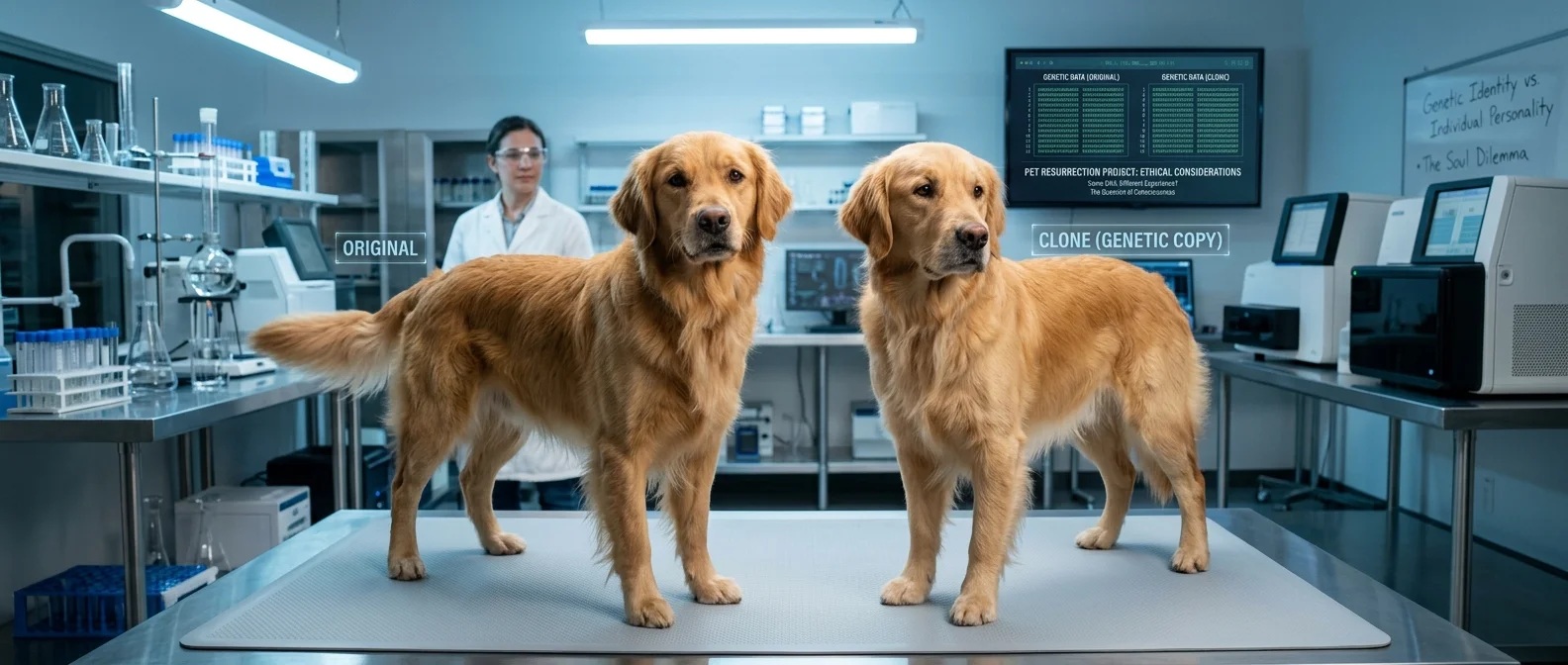
But a cloned pet isn't a “copy” in the everyday sense. Cc had a tricolor calico donor, but she was born tabby with white — because coat color in cats depends on random X-chromosome inactivation, a phenomenon not controlled by DNA. Behavior, personality, and memories obviously aren't inherited — the clone shares a genome, not a soul.

From Dolly to Today: 25+ Species Cloned
After Dolly, over 25 mammalian species have been successfully cloned via SCNT. The sequence was: mouse (1998, Cumulina), cattle (1998), goat (1999), wild mouflon sheep (2001), cat (2001), rabbit (2002), mule (2003), horse (Prometea, 2003), dog (Snuppy, 2005), black-footed ferret (2020), and rhesus macaque (2023).
Each species presented different challenges. Mice clone relatively easily — Teruhiko Wakayama's team in Japan cloned mice via SCNT for 25 successive generations, proving the technique can work repeatedly without cumulative genetic damage. Primates, conversely, resist stubbornly: their nuclei are more “tightly locked” at the epigenetic level, with stronger gene silencing mechanisms. Cattle fall somewhere in between, with 5-10% success rates depending on technique and donor cell type.
De-extinction: Cloning as Revival Tool
Cloning's greatest ambition is reviving extinct species. In 2003, a cloned Pyrenean ibex (Capra pyrenaica pyrenaica) was born in Spain — the first extinct species to “return” — but died 7 minutes after birth from a lung defect. Colossal Biosciences now works on mammoth revival, using CRISPR gene editing on Asian elephant (Elephas maximus) cells to introduce genes for cold resistance, dense fur, and fat storage.
Revive & Restore focuses on the passenger pigeon (Ectopistes migratorius), extinct since 1914 — though here the technique isn't classical cloning but “genetic rescue” through genome editing of related species. The Tasmanian thylacine (Thylacinus cynocephalus), extinct since 1936, is also a target for Australian researchers.
Ethical Dilemmas: When Do We Stop?
Researchers Qiang Sun and Muming Poo, after the birth of Zhong Zhong and Hua Hua, publicly called on the scientific community to discuss limits. "We recognize that future research using non-human primates anywhere in the world depends on scientists following very strict ethical standards," Poo stated. Lewin was even clearer: "Our findings reinforce the need for a strict ban on human cloning for any purpose."
Pet cloning raises its own issues. For every cloned dog born, multiple surrogate mothers and egg donors are needed, along with surgical procedures and dozens of failed embryos. Critics argue that $50,000 could save hundreds of shelter animals, while millions of strays face euthanasia annually due to lack of adoption. Supporters counter that commercial cloning funds research benefiting endangered species conservation, like the black-footed ferret and rhinoceros.
The first cloned dog, Snuppy (an Afghan hound), was born in 2005 in South Korea. It took 1,095 reconstructed embryos and 123 surrogate mothers to produce just 2 puppies — Snuppy and a second that died at 22 days.
Sources:
- Liu, Z. et al. “Cloning of macaque monkeys by somatic cell nuclear transfer.” Cell, 2018 — ScienceDaily, Cell Press
- Biase, F.H. et al. "Massive dysregulation of genes involved in cell signaling and placental development in cloned cattle conceptus and maternal endometrium." PNAS, 2016 — ScienceDaily, University of California, Davis