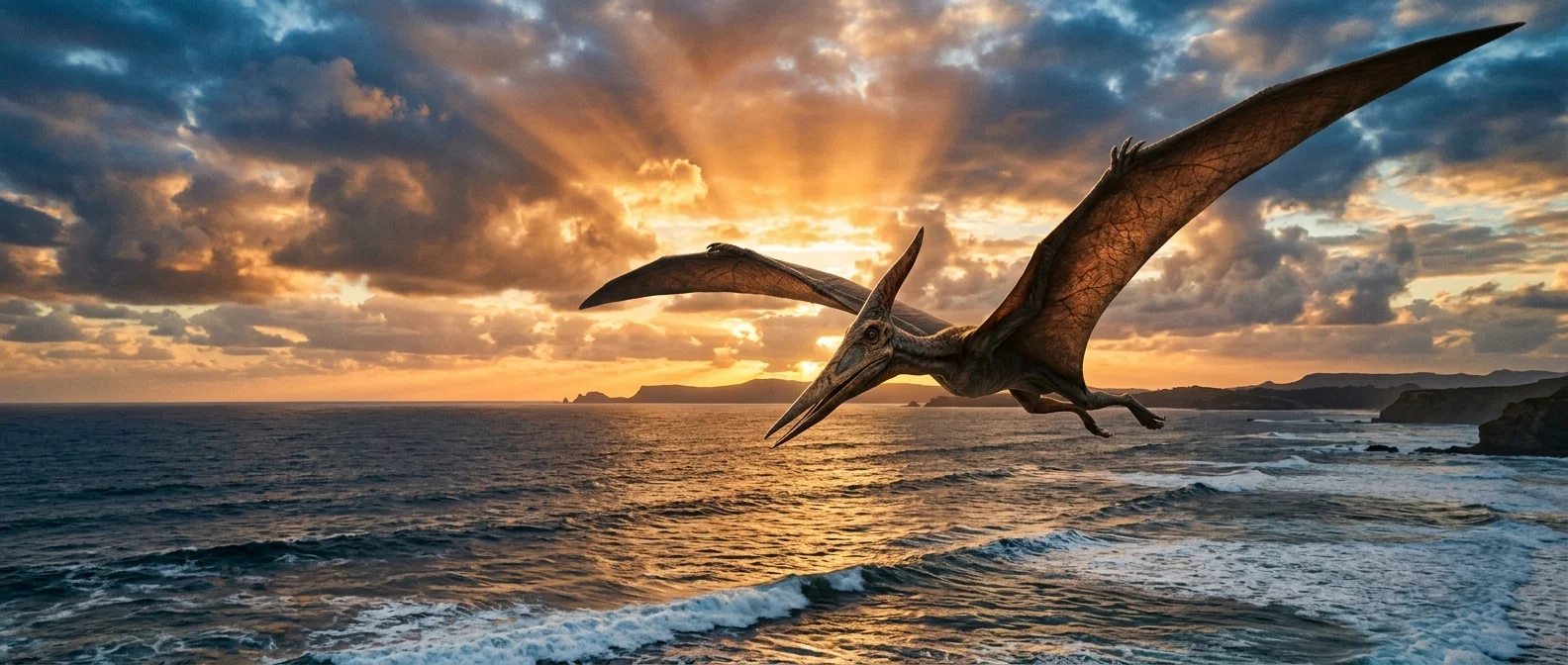
Millions of years ago, long before any bird spread its wings, the skies belonged to creatures that were neither birds nor dinosaurs. Pterosaurs — these flying reptiles that the world mistakenly calls “pterodactyls” — ruled Earth's atmosphere for over 150 million years. And contrary to what you might think, their story is far more complex and impressive than any movie portrayal.
📖 Read more: 70-Ton Dinosaur: The Patagotitan Giant That Ruled Earth
Neither Pterodactyls Nor Dinosaurs
Let's clear something up from the start: “pterodactyl” doesn't exist as a scientific term. It's simply the popular name for a vast order of flying reptiles — pterosaurs. These weren't dinosaurs. They were close relatives, but represented a separate evolutionary lineage. And modern birds? They don't descend from pterosaurs but from small, feathered, terrestrial dinosaurs.
The first recognized pterosaur was Pterodactylus, discovered in 1784 by Italian scientist Cosimo Collini — who initially thought he'd found a marine creature that used its wings as paddles! Only in 1801 did French naturalist Georges Cuvier suggest it could fly, and in 1809 he coined the term “Ptero-dactyle” — from the Greek pteron + daktylos, meaning “winged finger.”
From Tiny to Colossal
The diversity of pterosaurs was staggering. There were over 130 recognized genera, from microscopic creatures to true giants of the air.
The smallest pterosaur, Nemicolopterus crypticus, had a wingspan of just 10 inches — like a small bird. It was discovered in western China. At the other end of the spectrum, Quetzalcoatlus northropi had a wingspan of 36 feet — like a small airplane. In between, Pteranodon with 9-20 feet flew over open oceans hunting fish, while Coloborhynchus capito reached 23 feet.
📖 Read more: Pachycephalosaurus: Head-Butting Terror That Scared T-Rex
Flight Machines
Pterosaur wings were masterpieces of evolutionary engineering. They consisted of a membrane of skin and muscle extending from an extremely elongated fourth finger to the hind legs — hence the “winged finger.” Some species had additional membranes between shoulder and wrist, even between the legs.
For years, scientists believed pterosaurs were cold-blooded and suitable only for gliding. Wrong. It was discovered that certain species, like Sordes pilosus, had fur composed of hair-like structures called pycnofibers — proof they were warm-blooded animals capable of generating their own heat. They didn't just glide — they flew actively.
Crests, Teeth, and Pouches
Pterosaur heads were as varied as their sizes. Many had long skulls filled with needle-like teeth — ideal for catching fish. However, the Azhdarchidae family, which dominated the Late Cretaceous (and included Quetzalcoatlus), was completely toothless.
📖 Read more: Stegosaurus Back Plates: Defense or Display? Mystery Solved
A distinctive feature was the crests on their heads. Some were bony, others fleshy, and still others like sails — membranes between two large bones. The most likely explanation? Sexual selection. Juveniles lacked crests, suggesting they served exclusively for adults — probably for mating displays.
🪶 Pterosaurs vs Birds
🦎 Pterosaurs
- Category: Flying reptiles
- Wings: Skin membrane
- Flight evolution: Instant
- Brain: Small, large optic lobes
- Extinction: 66 million years ago
🐦 Birds
- Category: Dinosaur descendants
- Wings: Keratinous feathers
- Flight evolution: Gradual
- Brain: Large, complex
- Today: 10,000+ species
Flight in an Instant
A striking 2025 study from Johns Hopkins Medicine overturned conventional wisdom. Using CT scans to digitally reconstruct pterosaur brain cavities, researchers discovered something remarkable: pterosaurs flew practically “instantly” at the start of their evolution.
Unlike birds, which gradually developed larger and more complex brains to fly, pterosaurs managed it with small brains — similar to those of non-flying dinosaurs. The key was their enlarged optic lobes, a feature inherited from their closest relative, the lagerpetid — a non-flying, arboreal creature from the Triassic.
"Pterosaur brains transformed rapidly, acquiring what they needed to fly from the get-go. They achieved flight in an instant evolutionary burst."— Matteo Fabbri, Johns Hopkins University School of Medicine
📖 Read more: Why Dinosaurs Ran So Fast: The Biomechanical Secrets
What the Sky Lords Ate
Pterosaur diets depended on their lifestyle. Terrestrial pterosaurs were quite active hunters of small prey — they ate carrion, baby dinosaurs, lizards, eggs, and insects. They were opportunistic predators that exploited whatever easy food they found.
Marine pterosaurs, on the other hand, specialized in catching fish, squid, crabs, and shellfish. Some carried throat pouches, similar to pelicans, for transporting food. Pteranodon is believed to have flown over open oceans, rarely touching land — and when not airborne, probably floated on water.
However, young marine pterosaurs faced a deadly problem. Paleontologist David Hone and Donald Henderson modeled how well pterosaurs could float, discovering that while they floated adequately, their heads sank almost to water level. For young pterosaurs without strong flight muscles yet, returning to the air after a dive was nearly impossible. The result? Drowning. This explains why juveniles dominate the fossil record of marine pterosaurs.
Even more interesting was the discovery that Dimorphodon, a pterosaur about three feet long, wasn't actually a fish-eater — its dental wear patterns revealed it fed on insects and terrestrial vertebrates.
The Lost Lords
For 150 million years, pterosaurs were the dominant flying animals. They were the first vertebrates to achieve powered flight — long before birds, long before bats. Terrestrial pterosaurs hunted carrion, baby dinosaurs, lizards, and insects. Marine pterosaurs dove for fish and squid, some carrying throat pouches like pelicans.
They vanished along with the dinosaurs 66 million years ago. But their legacy remains: their 130-plus genera give us a picture of skies filled with creatures so diverse, from the 10-inch Nemicolopterus to the 36-foot Quetzalcoatlus, that no modern flying animal can compare.